


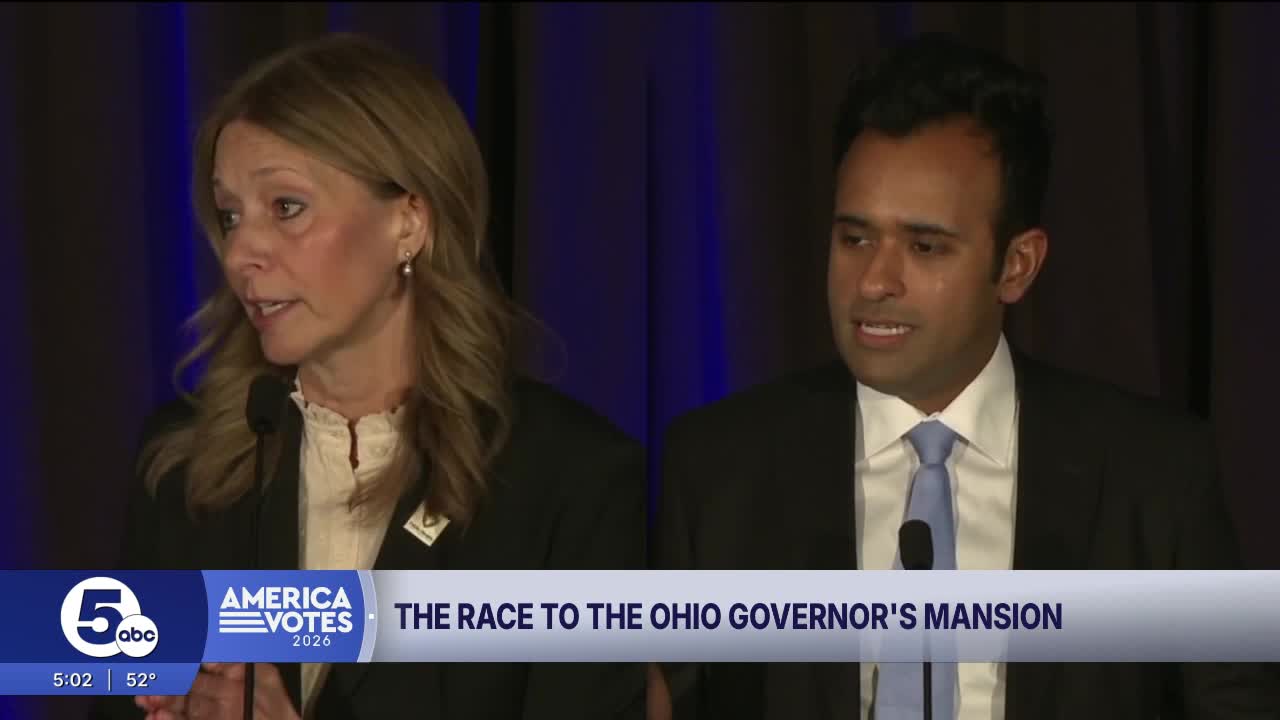


COLUMBUS, Ohio — With the primary out of the way, the race is officially on to become Ohio's next governor. Republican Vivek Ramasawmy will take on Democrat Dr. Amy Acton in an already record-breaking expensive general election.
Ramaswamy, a Cincinnati businessman and billionaire, celebrated his win in Columbus with a crowd of supporters.
"I believe we're on the cusp of a new dawn for Ohio," Ramaswamy said.
He thanked his family, the voters and his running mate, Senate President Rob McColley, a legislative leader and attorney from Northwest Ohio.
The pair won with more than 82% of the GOP vote, according to unofficial election results from the secretary of state website. They beat out YouTuber and car designer Casey Putsch.
"I'm proudly the most pro-free enterprise, pro-liberty, conservative, and pro-capitalist governor this state will have," Ramaswamy said.
Ramaswamy is running on the platform of cutting taxes, reducing government waste and advocating for more energy independence. So far, he has raised $50 million in this race, half of it coming from himself.
RELATED: Ohio governor’s race set to become most expensive in state history
"We are in this because we believe that together with the complementary skills that we bring to the table, we are the two people in this state who can work together as a team to lead Ohio back to our true potential, to our greatest heights, to put more money in your pocket, to bring down those costs, and to give our kids the world class education," Ramaswamy said, referencing McColley.
The Democratic nominee is COVID-Era health director Amy Acton from Youngstown, who is running with David Pepper, a former party leader and attorney from Cincinnati.
"I am running for governor because people in this state are struggling; They are doing everything right. They're working harder than they ever have, but there is no more breathing room. They're struggling with the cost of everyday life," Acton said. "And I refuse to look the other way. We are refusing to look the other way."
Also at a crowded event for supporters, Acton thanked her voters and talked about the importance of the election. She was unopposed in the primary.
"It is time to put working families, Ohio's families, first," she said.
Her platform is affordability in housing and healthcare, as well as improving public education and supporting small businesses.
"Together we're gonna make Ohio affordable so that we can pursue our dreams again, so that we can live a good life, so that we can age in place with dignity," Acton said.
She has raised more than $10 million for the race.
"Ohioans need somebody fighting for them, not the self-funding billionaires and special interests," Acton said.
RELATED: How gubernatorial candidates Ramaswamy, Acton want to fix Ohio's mental health crisis
While Acton and Ramaswamy both bring up affordability, they have different ways to accomplish it.
Acton wants to fully fund education so that schools don't rely on increasing property taxes, as well as put forward a working families tax cut. She also proposed a new system to reduce prescription costs.
"I will fight to protect Medicaid and ensure that everyone in Ohio has access to quality healthcare, affordable healthcare," she said.
Ramaswamy would limit automatic property tax increases and has suggested shutting down universities he calls "subpar," like Akron, Kent State, or CSU, in order to pay for an income tax cut. Expanding natural gas development will also make life more affordable, he added.
RELATED: Vivek Ramaswamy still focused on shutting down 'subpar' Ohio universities
"We're bringing down your electric bills because we're producing more energy in Ohio," he said.
And for each of them, they say the race is really just beginning.
"Now the real destination is in November," Ramaswamy said.
While Ramaswamy and Acton are the frontrunners, Libertarian Don Kissich, a veteran from Northwest Ohio, will also be on the ballot. He is running with brokerage director James Mills. They are focused on rooting out corruption, which Acton is as well.
"This campaign has never been about insiders, political machines, or corporate influence. It has been about everyday Ohioans- workers, parents, small business owners, young people struggling to afford a future, and citizens who feel unheard by a broken system," Mills said in a statement over text.
He congratulated both Ramaswamy and Acton's teams, then said that his campaign is about giving a voice back to the people.
"We are going to continue building a coalition of people who believe in individual liberty, government accountability, economic opportunity, and restoring trust between citizens and their institutions. We will fight for affordable living, transparent government, civil liberties, and a future where Ohio families can thrive without being crushed by corruption, bureaucracy, and division," he added.
What other races stood out?
Ohio's 9th Congressional District
Ohio's 9th Congressional District had a very competitive five-way Republican primary to choose a candidate to run against longtime Democratic U.S. Rep. Marcy Kaptur.
The November election will be a rematch between her and former lawmaker Derek Merrin.
Merrin won with 44% of the vote, according to unofficial results. Notably, He beat out Ohio House Majority Whip Josh Williams and former ICE Deputy Director Madison Sheahan.
The 2024 race was incredibly close, just about a 2,000-vote difference. Thanks to redistricting, the area is more red than it was before. However, President Donald Trump won't be at the top of the ticket.
Ohio's 7th Congressional District
Brian Poindexter, a union ironworker from Cleveland, won a crowded seven-person Democratic primary for Ohio's 7th Congressional District. He won with 37% of the vote, according to unofficial results, beating out former Cuyahoga County Executive Ed FitzGerald.
He will take on incumbent and Trump ally U.S. Rep. Max Miller.
Ohio Supreme Court
Former Franklin County Common Pleas Judge Colleen O’Donnell won a four-way Republican primary to take on Justice Jennifer Brunner this fall. She won with 32% of the vote, according to unofficial results.
If she beats Brunner, the Supreme Court will be made up of all Republicans, as right now it is 6-1.
State Treasurer
Although the race looked tight at first, former lawmaker Jay Edwards won the Republican nomination over state Sen. Kristina Roegner (R-Hudson). He won with 53% of the vote, according to unofficial results.
He will face off against Cincinnati Councilman Seth Walsh, who ran unopposed in the primary.
Secretary of State
Both parties had two candidates running. Treasurer Robert Sprague beat veteran Marcell Strbich with 70% of the Republican vote, according to unofficial results. Former House Minority Leader Allison Russo beat doctor Bryan Hambley with 67%.
Tom Pruss, a libertarian, will also be on the ballot. He ran unopposed in that primary.
This race will be one to watch in November.
Incumbent lawmakers
Two incumbent Republican state lawmakers held onto their seats, at least for the primary, despite heavy campaigning against them.
Former Speaker Jason Stephens (Kitts Hill) defeated primary challenger Larry Kidd, while Rep. Ron Ferguson (R-Wintersville) beat former state Sen. Frank Hoagland. Both won by 62%, according to unofficial results.
State Sen. Andrew Brenner (R-Delaware), when trying to move over to the House, lost to former lawmaker Shawn Stevens.
State Rep. Beth Lear (R-Galena) tried to switch to the Senate, but was beaten by businessman Ryan Rivers. State Rep. Jim Hoops (R-Napoleon) also tried to move to the other chamber, but narrowly lost to former lawmaker Craig Riedel.
Follow WEWS statehouse reporter Morgan Trau on Twitter and Facebook.
