


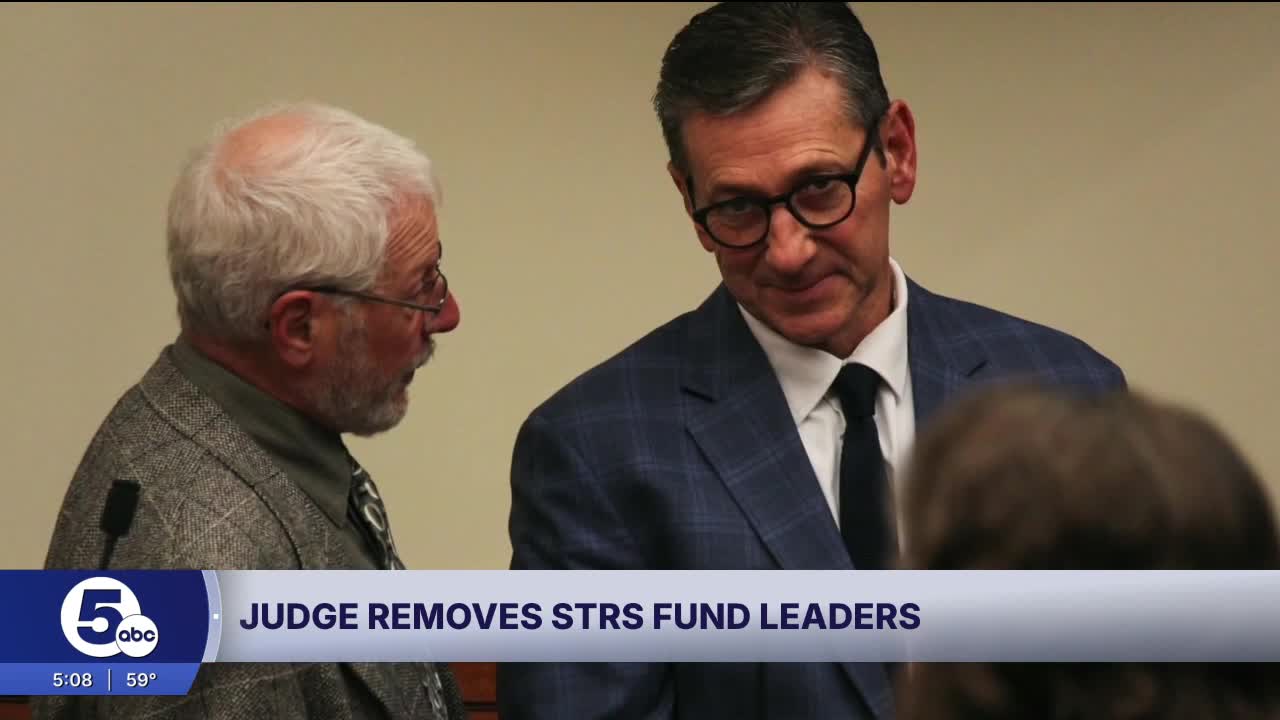



COLUMBUS, Ohio — An Ohio judge has removed the current board chair of the retired teachers' pension fund and barred both him and a former member from ever returning to public pensions for corrupt behavior.
This is a developing story and will be updated.
RELATED: Judge to rule on retired teachers' pension fund corruption trial, ethics investigation continues
Franklin County Court of Common Pleas Judge Karen Held Phipps decided that State Teachers Retirement System (STRS) board chair Rudy Fichtenbaum should be immediately removed from his position. He and former board member Wade Steen will never be allowed to be on the board again, the decision states.
The scandal centered on Steen and Fichtenbaum and their relationship with startup investment firm QED Technologies, run by former Ohio Deputy Treasurer Seth Metcalf and Jonathan (JD) Tremmel.
"In the end, the evidence presented in this case showed that Steen and Fichtenbaum were essentially acting as agents for their undisclosed principals: QED, Metcalf, and Tremmel," Held Phipps wrote in her decision.
Steen and Fichtenbaum caused the public confidence in STRS to "suffer greatly," and will take an "untold amount of time to erase," the judge continued.
"At best, Steen and Fichtenbaum followed the directions of Metcalf and Tremmel and, at worst, were mere puppets of Metcalf and Tremmel," the judge wrote.
Attorney General Dave Yost is glad the men have been removed indefinitely — barring appeal.
“Wade Steen and Rudy Fichtenbaum each took a solemn fiduciary oath, promising they would uphold the highest standards of conduct while serving as STRS board members. But instead of keeping their promises, they breached their fiduciary duties in a high-stakes scheme that jeopardized the financial security of half a million teachers and retirees. Their actions were deceptive, disruptive and fundamentally incompatible with their fiduciary duties. The court today rightly found that defendants have forever forfeited any right to serve as members of the STRS board,” Yost said.
Gov. Mike DeWine's spokesperson, Dan Tierney, is pleased with the decision.
“Our office thanks Attorney General Yost and the court for acting on Governor DeWine’s concerns regarding board members of STRS. This issue has always been about protecting Ohio’s retired teachers and ensuring they have a stable pension system led by board members who act in the best interests of STRS members,” Tierney said.
We have reached out to Steen and Fichtenbaum for comment. They are able to appeal.
"We’ve received the court’s decision issued earlier today. The State Teachers Retirement Board will continue its focus on good governance and the important work of providing retirement benefits to Ohio’s public educators," STRS said in a statement.
How we got here
In May of 2024, the governor received a 14-page anonymous whistleblower memo alleging a massive public corruption scheme brewing and moving quickly within STRS. In 2020, Metcalf and Tremmel set their eyes on STRS, according to the document.
The documents claim that they tried to convince STRS members to partner with them and provide them with $65 billion.
Steen and Fichtenbaum had allegedly been bidding continuously, pitching QED's direct documents to board members and proclaiming the company's talking points to other staff.
All of this failed, and finally, a whistleblower reached out to state officials.
Days later, Yost filed a lawsuit to remove Steen and Fichtenbaum from the board, stating they were participating in a contract steering "scheme" that could benefit them. Yost started the investigation after the memo, now known as being prepared by STRS employees, alleged that Steen and Fichtenbaum had been bidding on QED.
For more of an in-depth recap, please click here.
The state said that Metcalf worked behind the scenes to try to illegally secure the deal, pointing out concerns that the board members were too close to him.
Communications obtained via a records request of a court filing reveal that QED associates consistently told then-board member Steen what questions to ask, gave him documents to propose, and pushed him to follow its plan.
To read what the texts said, CLICK HERE.
However, the defense argued that seeking advice isn't a crime, and they were simply trying to get better financial returns for educators. They also had a focus on increasing their cost-of-living adjustments.
RELATED: Key witnesses testify in Ohio retired teachers' pension fund corruption case
Each of Fichtenbaum and Steen’s attorneys wrote in their closings that the state didn’t prove that they would gain anything financially from this, and no harm was done because the proposal never went through.
Both also adamantly said that they never really proposed $65 billion. This was disputed by the state.
Steen's attorney, Norm Abood, argued that the former board member was a "hero" to pensioners, stating that this has been a sham case.
Judge's decision
The defendants argued that they were fighting for the COLA, which is an admirable goal, Held Phipps said.
"There can be no reasonable disagreement that reestablishing annual COLA was and is a worthy goal. A worthy and desirable goal, however, does not allow a fiduciary to violate their duties in attempting to achieve it. In other words, a fiduciary may not employ a by-any-means-necessary approach," the judge said.
The men broke their fiduciary duty of loyalty to STRS pensioners by demonstrating favoritism towards QED, she continued.
"It is a generally accepted premise in public affairs that sunlight is the best disinfectant," Held Phipps wrote. "Secrecy rarely leads to a desirable result for the general public and is the polar opposite of transparency. So too here."
The evidence showed that the men had an ultimate goal of steering a significant amount of money to QED, she added. And, it was done in a secretive way.
"The STRS beneficiaries had every right to know that the source of information driving the conversation regarding QED was QED," the judge said.
With what prosecutors called a "smear campaign," Fichtenbaum and Steen ruined legitimate business relationships in order to help QED, the decision said.
"There is no doubt that Steen and Fichtenbaum’s breaches of their fiduciary duties caused even greater damage to STRS’s public image," she wrote.
Moving forward
The defense can appeal this decision, but in the meantime, Fichtenbaum will be removed.
If they want to appeal, their legal payments have to change, though. For the Held Phipps trial, they used funds from the lobbying group Ohio Retirement for Teachers Association (ORTA).
The Ohio Ethics Commission, after a complaint, has now determined that to be against ethics laws.
RELATED: No charges filed against retired teachers' pension fund leaders after ethics complaint
STRS Board Vice Chair Pat Davidson will be acting chair, and will be able to call meetings. The next scheduled date is in March. The board will need to solicit nominations to replace Fichtenbaum.
Other changes to the board may be coming in the future, but are currently on hold.
An appellate court upheld a temporary block on a new state law that would have eliminated the majority of educators on the board. Due to the above controversy on the board, lawmakers passed a bill in the summer that changed how educators are heard.
It changed the makeup of the board from seven elected teachers—five contributing and two retired—to three elected after seats are phased out over several years. Two of the educator seats will be for actives and only one retiree seat.
RELATED: Ohio educators to remain on STRS as court upholds temporary block on board changes
The board changes were proposed by state Rep. Adam Bird (R-New Richmond), who has been adamant about holding Fichtenbaum and Steen accountable.
“I commend today’s judicial action, which upholds important protections for the State Teachers Retirement System and safeguards the benefits of both current and future retirees. This decision affirms the necessity of the legislature’s efforts in the recent state budget to strengthen oversight and provide greater accountability within the system. As chair of the Ohio Retirement Study Council, an STRS retiree and an elected official committed to protecting taxpayer dollars, I view this ruling as a significant victory for transparency, fiscal responsibility, and the long-term stability of the retirement system,” Bird said in a statement Thursday.
Follow WEWS statehouse reporter Morgan Trau on Twitter and Facebook.
