


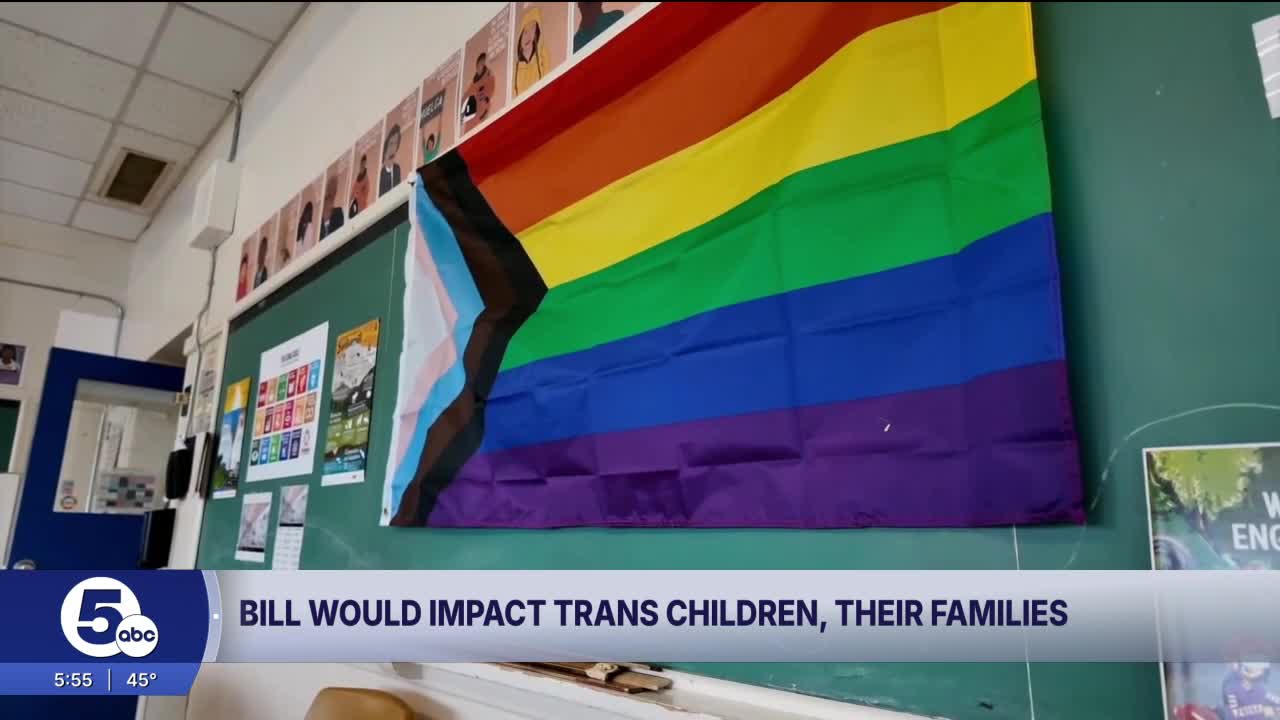



COLUMBUS, Ohio — Ohio Republicans have introduced legislation that would punish state and local governments for being too supportive of LGBTQ+ youth. The bill sponsors argue that municipalities are too hard on those who don't accept transgender and nonbinary identities.
Among a slew of provisions, conversion therapy would be reinstated where it has been banned, teachers may be prevented from using a student's preferred pronouns, and parents wouldn't be able to lose custody due to refusing to support their child's gender identity.
"State institutions, government institutions cannot promote that woke ideology," state Rep. Gary Click (R-Vickery) said in an interview Tuesday.
Click believes government agencies have been overly affirming of LGBTQ+ children, which in turn has hurt parents. He and state Rep. Josh Williams (R-Sylvania Township) introduced a 55-page bill that would change how agencies can interact with transgender kids.
"We're going to say in Ohio, it is not a danger to treat your child normally and to affirm your son is your son and your daughter is your daughter," Click said.
H.B. 693 prevents agencies from penalizing parents for being unsupportive of their child’s LGBTQ+ gender identity. Specifically targeting Cuyahoga County, the bill limits how supportive government services can be.
Click said that the county's use of the Sexual Orientation Gender Identity and Expression (SOGIE) policy proactively screens children for their gender orientation without the child even volunteering it. It's unclear whether the county is still using it, as their prior LGBTQ+ policy called 'Affirm Me' ended in 2025.
The former policy, at least, would compile data from these statistics, which Click said shouldn't be allowed. He also brought up how the county did a re-education program for parents.
"Educate the parents regarding the fact that sexual orientation and gender identity are not a choice, and that they did not do anything to make their child LGBTQ+," the Affirm Me policy stated.
Click's bill also prevents a parent from losing custody if they refuse to affirm their child’s gender identity. It also prohibits an agency from barring child placement with foster couples who don't support transgender identities.
Some LGBTQ+ advocates had previously mentioned how this could be unsafe for the child. Click responded that it would only be unsafe if actual abuse was taking place.
"There are always laws against being abusive, regardless, and so if a parent becomes abusive, physically abusive and maybe even verbally abusive, those are different things, and there are laws against that," Click said. "This bill says that for the solitary reason of the fact that you affirm that child's natural sex, that is not abuse."
Another provision in the bill would overturn a dozen conversion therapy bans across the state by reframing counseling to "reverse" someone from being transgender as not legally considered to be conversion therapy.
"It is not conversion therapy to help children discover their identity and who they are biologically," Click said.
Cuyahoga County responded to the allegations by Click, with their spokesperson, Jennifer Ciaccia, arguing against conversion therapy.
"In September 2025, Cuyahoga County became the first county in Ohio to enact a ban on conversion therapy, a hateful, misleading and dangerous practice discredited by over 28 major medical organizations. We remain committed to upholding this policy and the protections it provides for children and families in our community," Ciaccia said. "Cuyahoga County is aware of legislation introduced today in HB 693, and are currently reviewing it to assess its potential impact on our operations and residents."
Other than Cuyahoga County, cities like Cleveland, Akron, Columbus and Cincinnati all banned any form of conversion therapy.
RELATED: Lakewood earns perfect equality score while expanding LGBTQ+ protections with Gender Freedom Policy
The bill goes into the classrooms, too. Provisions in the bill would bar teachers from discipline for not using a student’s preferred pronouns. The legislation could potentially prevent teachers from using a student’s preferred pronouns.
"When a child walks into a classroom, the teacher is not thinking this is a trans student, or this is an LGBTQ+ student, or anything else about that student," Ohio Federation of Teachers' Melissa Cropper said. "What they're seeing is somebody's future."
Cropper is concerned with the bill and said schools are being put in the middle of Republicans' culture war, which only hurts vulnerable kids.
"It's an absolute travesty that we have politicians who are attacking some of our most vulnerable students, who are using our teachers as as ways to attack these students and are using this to advance their own political agenda and their own political careers, instead of thinking about what's best for our students, what's best for our public education system, what's best for our communities, what's best for us as humans," Cropper said.
Last General Assembly, the lawmakers passed H.B. 8, which requires schools to notify parents if the child identifies as LGBTQ+, as well as allow parents to opt out of so-called "sexuality" content.
RELATED: Ohio LGBTQ+ advocates warn against school 'forced outing' bill
"It's an attack on autonomy. It's an attack on local control. It's an attack on professionalism," Cropper added. "It's a lack of respect for the educators who, as I said before, are there to make sure that every student has what he or she needs to succeed."
The legislation also provides a mechanism to yank state funding from any state or local government that doesn't abide by the bill.
Click previously sponsored H.B. 68, legislation now in law that prevents LGBTQ+ minors from accessing gender-affirming care such as hormone blockers, hormone replacement therapy (HRT) and some mental health services. It also prohibited trans athletes from participating in middle, high school or college athletics on teams that align with their identity.
RELATED: Ohio marriage equality, LGBTQ+ equal rights amendments 1 step closer to being put on ballot
Follow WEWS statehouse reporter Morgan Trau on Twitter and Facebook.
