


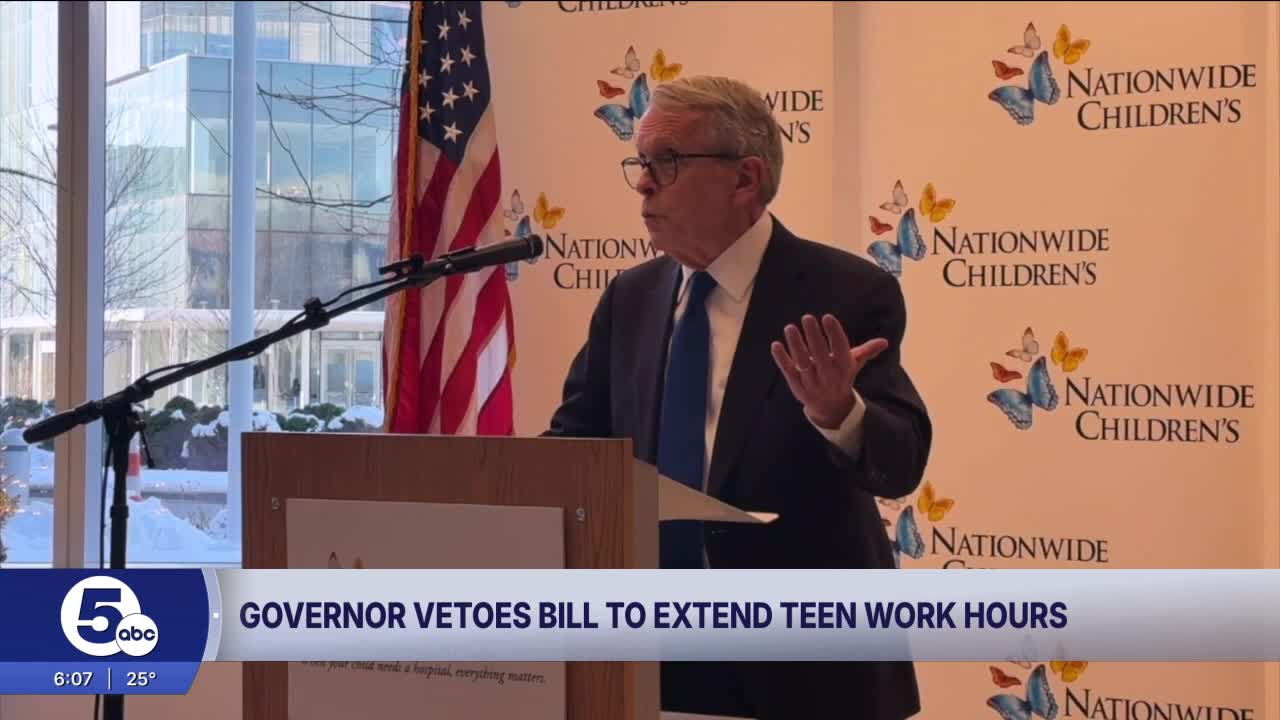



COLUMBUS, Ohio — Ohio Republican Gov. Mike DeWine has vetoed a bill that would have loosened child labor laws, allowing 14- and 15-year-olds to work until 9 p.m.
Teens learn time management, communication skills, and responsibility during their first jobs — but for some working kids, there is another motivator.
"My son, in particular, he's got his heart set on an electric dirt bike. The wife will not buy it for him," father of three Donovan O'Neil said. "We'll see if he raises enough money to buy it."
O’Neil said his 13-year-old son Connor, is ready to hit the workforce. To earn dollars faster, that can sometimes mean working longer hours.
The father, who works as a lobbyist for the libertarian conservative political organization Americans for Prosperity, was thrilled when lawmakers passed a bill that would extend how late 14- and 15-year-olds could work on school nights from 7 to 9 p.m.
Right now, the teens can only work until 9 p.m. during the summer or while on a school holiday. The regulations differ for kids who are 16 and 17.
"You have some real opportunities to learn some skills and responsibilities that are gonna be impactful to the future," O'Neil said.
But DeWine said kids need to pack up early, as he vetoed the bill.
At an unrelated event with both the governor and state Sen. Tim Schaffer (R-Lancaster), I asked DeWine why and asked the senator to react to the veto.
"It's the balance between kids studying and kids learning how to work, and I think they can learn how to work [while] not [having] to work on a school night — we're talking about a school night — beyond 7 o'clock at night," the governor responded.
Right now, the state is aligned with federal labor standards and isn’t allowed to make weaker rules. Thus, Ohio legislators have also passed a resolution urging Congress to loosen its child labor laws.
"It is pretty much the law in this country, it's 7 o'clock," DeWine said. "So, this would be a rather dramatic change in the law in Ohio."
Some states, like Idaho, have weaker child labor laws. The federal government can investigate and file lawsuits, but mainly it just fines businesses.
Schaffer wouldn't comment when I asked and then left the event prior to the press conference finishing.
“I understand the governor’s concerns, though we addressed them in numerous committee hearings and during floor debate. This is the same bill that all Democrat and Republican senators voted “yes” on in the 134th General Assembly, except for the addition of a democrat amendment, that we accepted to address democrat opposition to helping these kids," the senator said in a written statement. "I still look forward to supporting these kids who want to work by negotiating with the governor’s office and addressing his concerns."
State lawmaker Allison Russo (D-Upper Arlington), who voted against the bill, said she is glad DeWine said no.
"There's absolute value in making sure that children get experience, they learn how to earn their own money and how to budget their money," Russo, a mom of three, said. "But we should not be also rolling back protections for children in these workplaces."
Under the law, teenagers don't need to earn the Ohio minimum wage, which is about $11. Oftentimes, they only need to be paid the federal minimum, which is $7.25.
Russo's kids have bused tables, and as the restaurant industry has struggled with staffing, some supporters argue their labor fills gaps in the workforce and provides income.
"They should not be shouldered with the burden of working later hours during the school year to help the economics of their families," the Democrat said.
But O’Neil argues that it's not mandatory, and parents would get the choice to sign off on their child working later.
"It's just a fundamental difference in vision for the role of government," he said.
"Do you see this as a parental rights kind of case?" I asked him.
"That's the lens that I look at it through," he responded. "Stripping that decision from the family unit is really a disservice in the long run."
Some GOP lawmakers said they are interested in possibly overriding the veto, which would require 20 votes in the Senate and 60 votes in the House. The bill was passed by 24 in the Senate and 62 in the House originally. An override vote wouldn't happen for at least several months. The Senate is set to come back in December for a session, but the House isn't scheduled to return until February.
Follow WEWS statehouse reporter Morgan Trau on Twitter and Facebook.
