





COLUMBUS, Ohio — Ohio Republicans have started to pass anti-abortion bills that attempt to get around the state's constitutional amendment protecting reproductive rights. Abortion rights advocates are frustrated, but committed to fighting back.
Voters overwhelmingly chose to protect access to abortion in 2023. Issue 1 passed 57-43%, enshrining reproductive rights into the state constitution. It states Ohioans have the right to make their own decisions about abortion, contraception, fertility treatment, miscarriage care and continuing pregnancy. The state is prohibited from interfering with or penalizing someone for exercising this right, as well as penalizing anyone else — including healthcare professionals — from assisting.
RELATED: Ohio's abortion ban is unconstitutional. Why is the state still fighting for it?
“We're seeing bill after bill after bill trying to undo the will of the voters,” Abortion rights advocate Jaime Miracle said.
Despite the voters speaking, Miracle said this isn’t stopping Republican legislators from attempting to add barriers to access.
"We have the legislators, once again, proving why we went to the ballot, ignoring the will of the people, ignoring the pro-abortion majority in our state and trying to pass more abortion restrictions that the voters of Ohio do not want," she said.
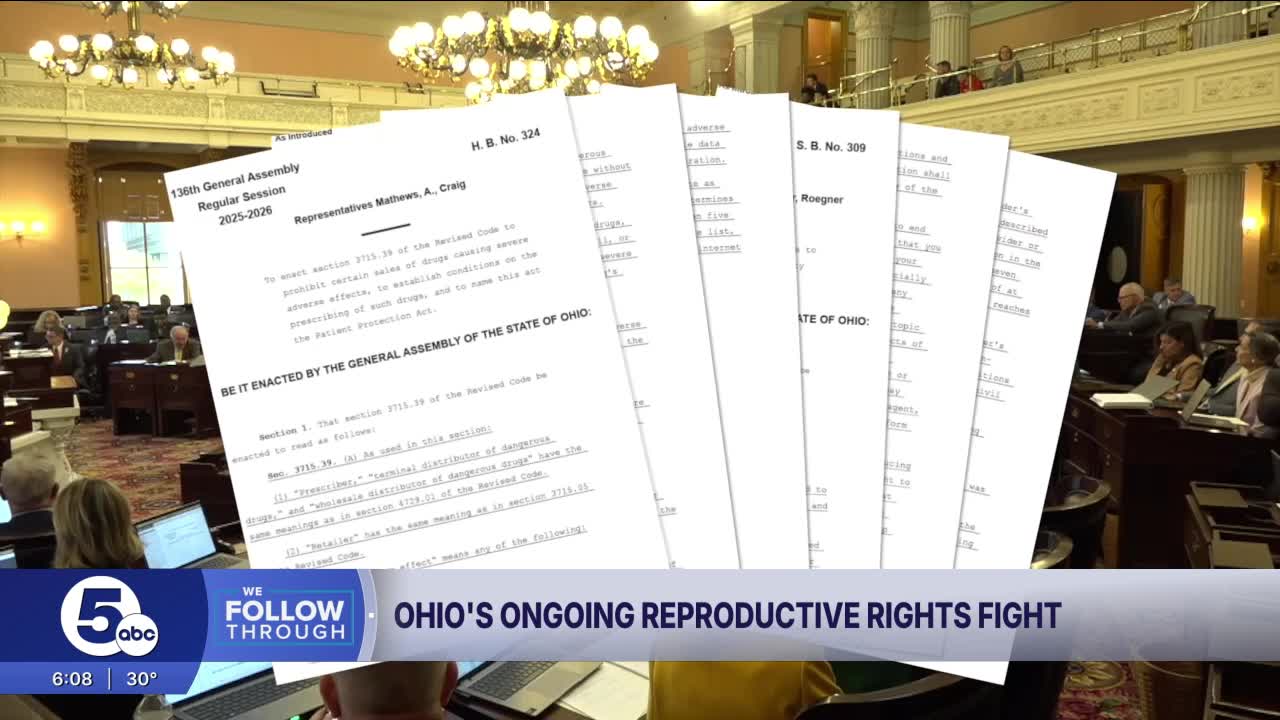
Republicans have introduced about a dozen bills that would impact reproductive rights.
State Sen. Kyle Koehler (R-Springfield) introduced S.B. 309, which could add steps to access the abortion pill mifepristone.
"[The bill] provides a framework for healthcare providers to educate a woman on the risks associated with a chemical abortion and makes her aware of her and her family’s rights to sue if the pill results in complications, injuries, a failed abortion, or her death," Koehler said.
The legislation creates a speech for doctors to give patients about the dangers of Mifepristone, and requires the individual to sign an informed consent document. It allows the patient, the father of the fetus, or grandparents if the patient is a minor, to sue if they feel the patient was uninformed when taking the pill.
In an interview on Wednesday, he said that he was focused on targeting online "mail-order" providers, not Ohio's existing brick-and-mortar abortion clinics.
"We're not trying to stop them, and we're trying to stay within the Constitution," Koehler said. "Just [making] sure they know they have rights, and that there are unintended consequences that can and have reportedly happened to women who take mifepristone without ever seeing a doctor.
Miracle explains that the medication abortion is safe and highly regulated, which doctors are now having to defend at the Statehouse as another GOP bill tries to ban mail-order abortion pills.
RELATED: Ohio GOP lawmakers move to ban telehealth, mail-order abortion pills
"This is anti-abortion propaganda that is being forced upon providers and their patients," Miracle said.
Another abortion-related bill that has passed the House is H.B. 485, which would require fifth graders and older to watch either “Meet Baby Olivia,” a GOP-supported fetal development animated video created by anti-abortion organization Live Action, or a very similar piece.
"Children are a gift, and we're hoping that we can change the culture to be celebrating life instead of destroying life," state Rep. Melanie Miller (R-Ashland) said.
RELATED: Ohio Republicans move to include more 'positive' impacts of Christianity in public schools
The video teaches that life begins at conception and goes through each stage of growth. Miracle said that the video isn’t appropriate.
"It's not scientifically accurate," she said. "It is not even visually accurate."
Kellie Copeland, who works with Miracle at Abortion Forward, explained further about the informational inconsistencies.
"It does not include the pregnant person; it includes idealized images of what fetal development looks like," Copeland said. "It doesn't talk about complications, things that could go wrong. This is not about being medically accurate."
The development cycle and graphics shown in the video conflict with the American College of Obstetricians and Gynecologists' research.
But Miller believes that it is accurate and can help provide insight into pregnancy since Ohio teaches abstinence-only sex ed.
"Visible, engaging tool to help them truly understand these early stages of life," Miller said during debate on the floor before it passed.
Meanwhile, some activists are still pushing for a total abortion ban, but GOP leaders said that seems unlikely to go through.
RELATED: Republican lawmakers in Ohio to propose total abortion and IVF ban
However, when asked during the fall about abortion legislation, House Speaker Matt Huffman (R-Lima) addressed a bill that would reinstate the 24-hour waiting period for abortion services.
"Ohio did pass an extraordinarily expansive abortion rights in our Constitution," he said, but noted that there are all types of regulations on constitutional rights.
"The 24-hour rule — is that prohibiting somebody from obtaining an abortion? Probably not," Huffman said. "What if it was 12 hours? What if it was 1 hour? You know... at some point, absolutism can't rule the day with whatever it says in the constitution."
RELATED: No waiting period: Ohio abortion clinics doing same-day services after court win
Still, all of these are bills that Miracle said continue to be unconstitutional.
"We will be fighting it every step of the way," Miracle said.
Follow WEWS statehouse reporter Morgan Trau on Twitter and Facebook.
