


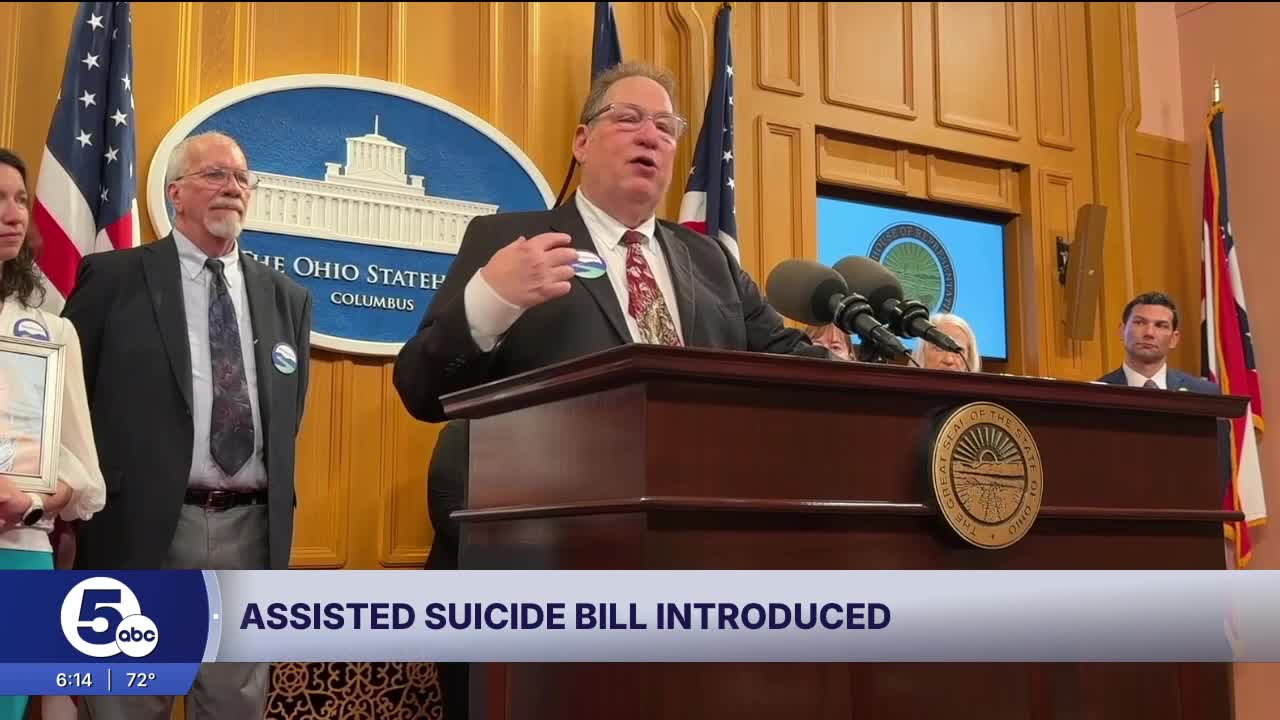



COLUMBUS, Ohio — A group of Ohio Democrats has introduced a bill that would legalize medically assisted death for terminally ill patients.
Michael Oser's doctor told him he has six months to live. He has terminal cancer, first diagnosed in late 2021.
"I make this decision not in fear, not in panic, but with dignity, with my family's support and with peace," Oser said. "This is not about giving up."
He says he isn’t worried about when he dies — but how.
"I don't want the pain and suffering, but not necessarily for me, but for my family," Oser said.
He doesn’t want his family to go through the pain that Jim O’Neil and his daughter did when he lost his wife, Addie, to cancer.
"She wished for a way to end her suffering on her terms, sparing herself the pain and her family the trauma of watching her slowly fade away," O'Neil said. "She did not have that option."
They are supporting state Rep. Eric Synenberg's (D-Beachwood) new bill that would allow for “medical aid in dying,” or physician-assisted death, often called suicide.
"It is a decision shared between them, their faith, their loved ones and their medical providers," Synenberg said. "The question before us is whether we trust Ohioans to make that decision for themselves."
The legislation authorizes terminally ill patients who live in Ohio, are at least 18, are given a prognosis of six months to live by two separate doctors, have mental health evaluations and are competent to make health decisions, to take medication to end their life.
"No individual provider or facility is required to participate, and no one can be compelled to act against their own personal or religious beliefs," Synenberg said.
The bill requires informed consent, and the patient can withdraw at any time. Doctors and medical providers are immune from prosecution, liability, disciplinary action or any other sanction for assisting or refusing to provide the medication.
Insurance companies would not be allowed to withhold benefit payouts if someone dies by medically assisted suicide, the lawmaker said.
Ohio would become the 14th state to legalize this method of death, and closely modeled the bill after Oregon's law.
Social worker Jessica Rodgers is fighting against the bill, saying it is coercive to vulnerable groups, as the medication needed in assisted suicides is cheaper than full hospice care.
"Certainly none of us want to see our loved ones suffer, and we want them to have the full range of appropriate end-of-life care, and it is not appropriate end-of-life care to abandon a patient with lethal drugs to overdose on," Rodgers, who is the coalition director for Patients Rights Action Fund, said.
She and groups like Ohio Right to Life and the Catholic Conference of Ohio argue that this lacks guardrails. Rodgers pointed out that it has been used in Colorado in the case of severe anorexia, an eating disorder that can be reversible.
"This is legitimizing the idea that some people have a life not worth living, and when that's the case, it's perfectly acceptable societally for them to take their own life," Rodgers said.
Each of the state's Republican leaders says they are "pro-life." State Sen. Steve Huffman (R-Tipp City), a doctor, had previously helped introduce a bill that would stop the "funding of death" in the state — no more capital punishment and no dollars for abortions or the illegal physician-assisted suicide.
"Medical aid in dying, otherwise known as assisted suicide, directly contradicts thousands of years of medical practice and religious ethics," Huffman said, adding that it violates the Hippocratic Oath to "do no harm." "It is morally wrong to avoid a natural death. For the government to allow such a practice means that it is no longer trying to protect and help the less fortunate but actively destroying them."
The bill will be a hard sell in the Republican-controlled legislature, but the advocates in favor say it's worth a conversation. State Reps. Crystal Lett (D-Columbus), who works in mental healthcare and Dr. Anita Somani (D-Columbus), an OB-GYN, are cosponsors. State Rep. Tristan Rader (D-Lakewood) also signed on.
"How are you planning to get this passed?" I asked Synenberg, noting the "pro-life" sentiment of the GOP.
"I think Michael's pro-life, too," he responded. "As beautiful and as great as life is and can be and should be, hopefully for all of us, why should we have to go through the most painful and worst part of it at our end?"
Oser said when you get sick, you understand what it is like. It's no longer an "esoteric debate."
"I have lived with dignity in Ohio," Oser said. "When my time comes, I should be able to die here with dignity."
Follow WEWS statehouse reporter Morgan Trau on Twitter and Facebook.
