




COLUMBUS, Ohio — Ohio lawmakers are continuing their push to regulate artificial intelligence, moving to crack down on explicit and nonconsensual content.
With just one prompt, a staunch Republican can become a diehard Democrat.
Artificial intelligence can create and edit photos and videos. Fake pictures or videos of people, called deepfakes, have become more prevalent online.

"You should be able to tell someone, 'Please take that down, that picture never happened,'" Mathews said.
Having been a victim of AI fraud himself, letting me previously deepfake him for a story, Mathews explained that lawmakers and celebrities aren't the only targets for fake images.
RELATED: Which photo is real? Ohio lawmakers want to regulate deepfakes, AI content
"Everyone should have the dignity of themselves, and the way that they can present themselves out into the world," he said.
Law enforcement officials in California and Arizona have opened investigations into X's AI tool Grok for nonconsensual explicit content. Users have been able to ask Grok to undress people, including children, and put them in compromising outfits or positions.
Mathews is trying to stop this type of misinformation. He and state Rep. Ty Mathews (R-Findlay) proposed House Bill 185, which would regulate AI content.
"It's based on protecting the name, image and likeness of everyday Ohioans, whether that's using AI or whether that's using Photoshop, or whether that's using any type of image manipulation with or without AI," Mathews said.
The legislation would allow everyone to own their image, and it would be a trademark infringement to produce malicious content without someone’s consent. There could be civil penalties of tens of thousands of dollars.
The bill also makes it a third-degree felony to create or distribute malicious AI content in order to extort the individual being deepfaked.
Any pornographic deepfakes or deepfakes of a child are completely banned, with or without a disclaimer.
Malicious deepfakes, AI meant to harm someone’s image, would only be allowed as long as they have a clear watermark that they were artificially manipulated.
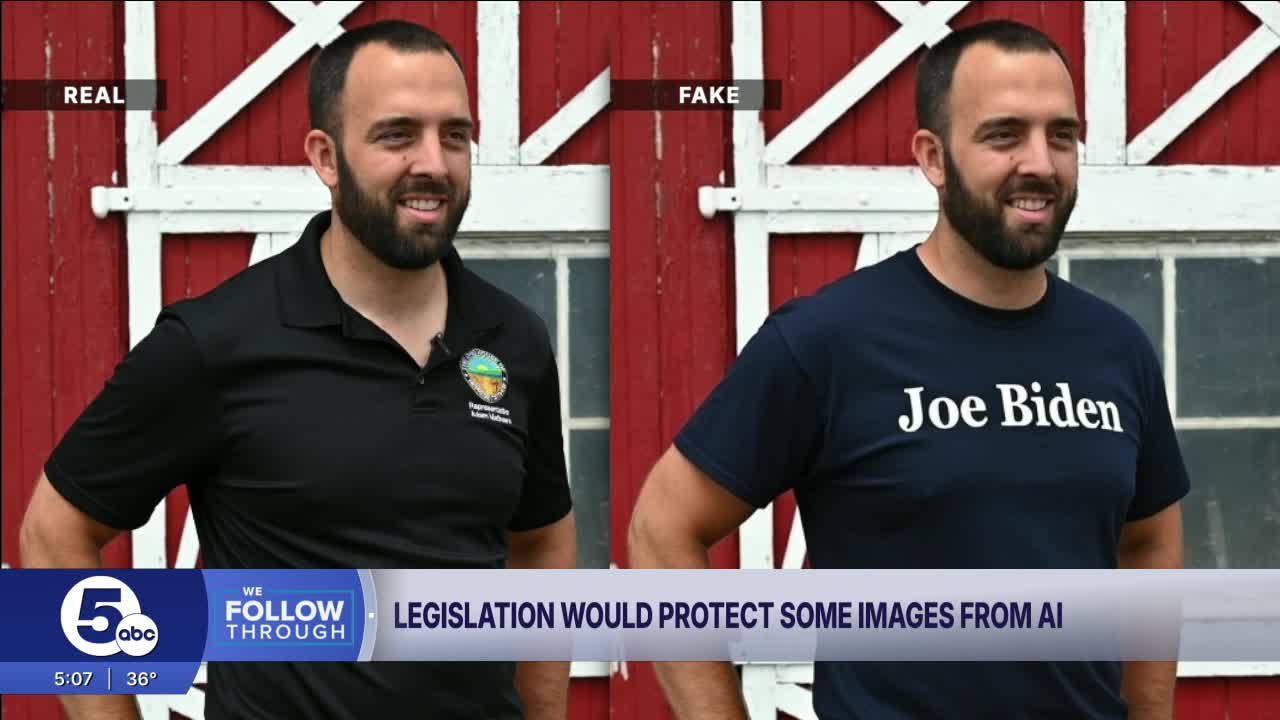
Let's show some examples:
Original photo

This is the original photo of Mathews wearing a black shirt and standing in front of a barn.
Deepfake 1 — Needs disclaimer

This is a deepfake I made of him with his permission — one where he has "Joe Biden" written on his shirt. This image, created with Grok, would require a disclaimer.
Deepfake 2 — Doesn't need a disclaimer

This is an expertly drawn "deepfake" I made of him. This one would not require a disclaimer.
"Political cartoons are totally protected; no one thinks that a drawing actually happened," Mathews said.
Reaction
The Motion Picture Association of America is opposing it, saying it goes against freedom of speech. Previously, Case Western Reserve University law professor Eric Chaffee told us that they have a point.
"Requiring these disclaimers, in fact, may be spoiling that art or forcing people to say things that they don't want to say," Chaffee said. "There are certainly First Amendment concerns."
But CWRU technology professor Erman Ayday pointed out that the actual challenge with this bill would be enforcement.
"People will keep trying, you keep changing the prompts," Ayday said. "I don't think there's a 100% guarantee that you can stop Grok from undressing people."
Mathews said he hopes his bill also inspires action from tech companies to put more guardrails on AI. In recent days, X announced that it added new measures to prevent fake explicit pictures without consent.
"AI is going to continue to grow, and we need to make legislation that is not chasing where technology is now," Mathews said.
This legislation would also get around President Donald Trump's AI executive order. In December, Trump signed an order that would punish states from making their own regulations on AI. Because this bill is about NIL, Mathews, a lawyer, doesn't think that Trump's AI regulations would apply.
RELATED: Ohio lawmakers want AI companies held liable for bot-encouraged suicides
Follow WEWS statehouse reporter Morgan Trau on Twitter and Facebook.
