


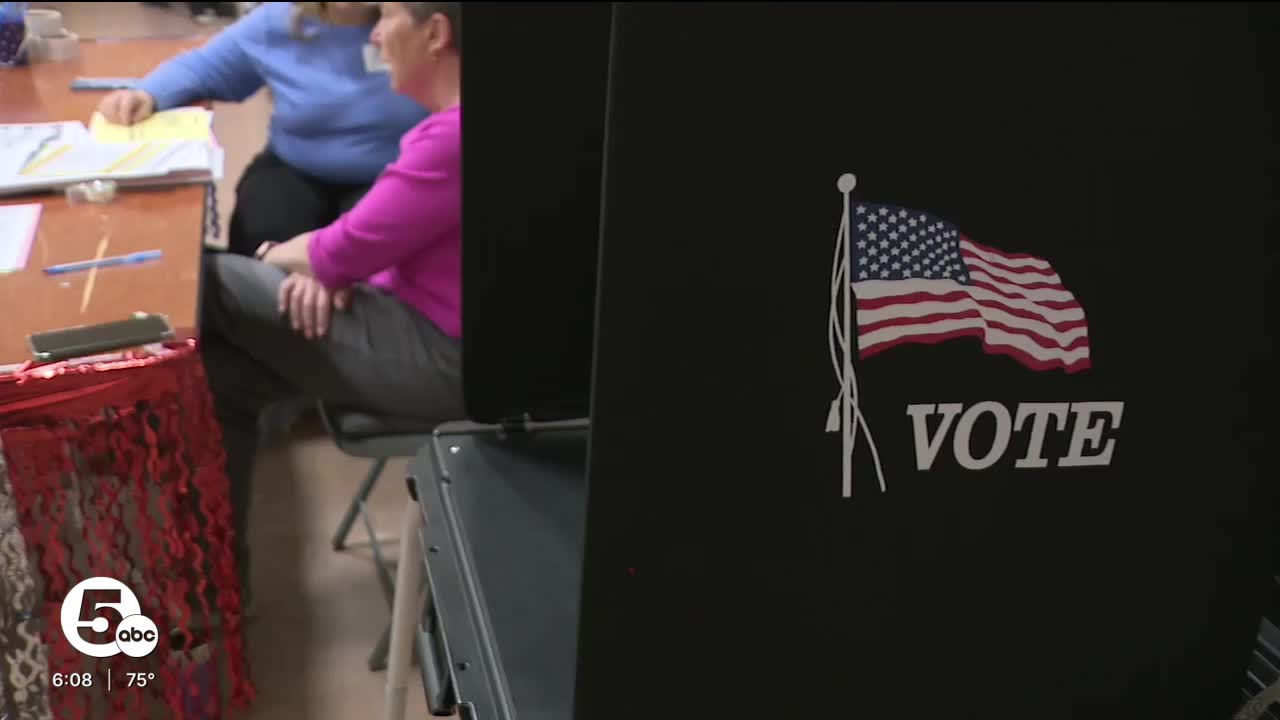



COLUMBUS, Ohio — Liberal and conservative Ohioans have come together to oppose an amendment to require voters to show photo ID at the polls. The resolution, created by Republican lawmakers, would enshrine already existing state law into the Constitution — but the leaders deny any political shenanigans to boost turnout in an election that may be better for Democrats.
Statehouse Republicans want to take voter photo ID a step further, putting a question on the November ballot to put the current voter ID law into the state constitution. The legislation is proposed as House Joint Resolution 9.
"We offer the voters the opportunity to decide for themselves whether they want to put this in the Constitution, offering at the highest possible level of protection to secure the system that they have in place, to secure the fundamental right of voting and maintain that confidence in our election system in Ohio," Senate President Rob McColley (R-Napoleon) said.
A future general assembly could reverse the law, unless it's in the constitution, McColley said. Photo ID for voting went into effect in 2023.
The ACLU’s Gary Daniels thinks it’s for another reason.
"It's 'put something on the ballot attractive to certain voters, and hope that they turn out,'" Daniels said.
In 2022, another midterm year, Republicans put a proposal on the ballot that bans noncitizens from voting in all Ohio elections. Noncitizens already couldn't vote in state or federal elections.
McColley denies this is an effort to increase Republican turnout in the midterm election, one that strategists say will be better for Democrats than 2024.
"Seeing this as a turnout juicer or anything like that, it's not really backed up," he said, adding that polling shows that the majority of voters do like having photo ID requirements.
House Minority Leader Dani Isaacsohn (D-Cincinnati) said that the GOP was definitely putting forward the amendment "politically."
"This is a way to try and distract voters from the fact that their gas is over $5 a gallon," Isaacsohn said.
This is what happens when people have been in power for too long, he added.
"You think that Ohioans, when they can't afford their childcare, their healthcare, their gas, their utility bills, are going to be motivated, instead, to go out and vote for something that is already the law in Ohio."
Daniels is also concerned about unintended or intended consequences from enshrining the policy into state law.
"It seems to me that they're angling with some of the language in here to eventually eliminate, for instance, or greatly restrict early voting or perhaps introduce a new form of photo ID," he said.
McColley also denied this.
"There are no plans to eliminate early mail-in voting or absentee voting in the state of Ohio," he said. "I don't believe there would even be support in either one of our caucuses to do that."
But the ACLU has found allies with conservative activists like Lake County resident Christina Camuendo.
She is against the proposal because she said it doesn’t do anything for actual election integrity, which, to her, is requiring photo ID for absentee ballots.
"Many Ohioans are concerned that H.J.R. 9 would constitutionally strengthen ID requirements for in-person voters while leaving absentee ballot verification standards comparatively weaker or inconsistent," Camuendo said.
To be clear, there is no evidence of widespread voter fraud in Ohio, even when photo ID wasn't the law. Thousands of audits have proven that. I asked McColley if H.J.R. 9 was furthering a baseless narrative that voter fraud is rampant. He said no.
"If having ID is so important, why don't we have it for absentee already?" I asked McColley.
"There's nothing in this that would prevent the legislature from enacting that; we've had members in our caucus who brought up that question," the president responded. "At this point, we thought it important to focus directly on the provisions that are already in the Ohio Revised Code."
At a committee hearing on Wednesday, only one Ohio group submitted testimony in favor of the amendment. Another individual is listed as a supporter, but their testimony was unrelated to H.J.R. 9 and about Israel. There were 78 people and groups against the resolution.
"Does that mean anything to you? Do you think that the lawmakers care if people are coming to talk to them about this, rather negatively, on both sides of the aisle?" I asked House Speaker Matt Huffman (R-Lima)
"Uh, yes, it means something to me," Huffman responded, but then dismissed the people who testified. "The number, as we know, often it's the same set of people who are being invigorated by the same groups to come and testify."
Legislators also hear from their constituents who don't come to the Statehouse to speak up, he said.
This looks like it could be a repeat of previous years, when the lawmakers go against the will of the people, Daniels said.
"I hope that they don't ignore the will of the voters here," he said. "But what we've seen, they continue to get ignored."
In 2023, thousands of protestors across party lines rallied at the Statehouse against the Republicans for putting Issue 1 on the August special election ballot. It would have taken away majority rule in Ohio. The proposal would have raised the threshold for constitutional amendments to pass from 50%+1, a simple majority, to 60%. It was defeated 57-43%.
RELATED: Another fight over majority rule in Ohio? Republican leaders float the idea.
The lawmakers, in recent years, have also ignored large swaths of Ohioans on controversial higher education legislation, abortion policy, LGBTQ+ rights, union protections and marijuana laws.
The lawmakers will need 60% of each chamber to get the resolution on the ballot this fall.
Follow WEWS statehouse reporter Morgan Trau on Twitter and Facebook.
