



COLUMBUS, Ohio — Ohio universities' new centers to combat "liberal bias" aren't popular with students, so a Republican leader wants to require attendance.
Bringing in America’s 250th anniversary, the Republican supermajority in Ohio's legislature wants to expand civics education at colleges and universities. That hasn't been getting the warmest of welcomes on campuses.
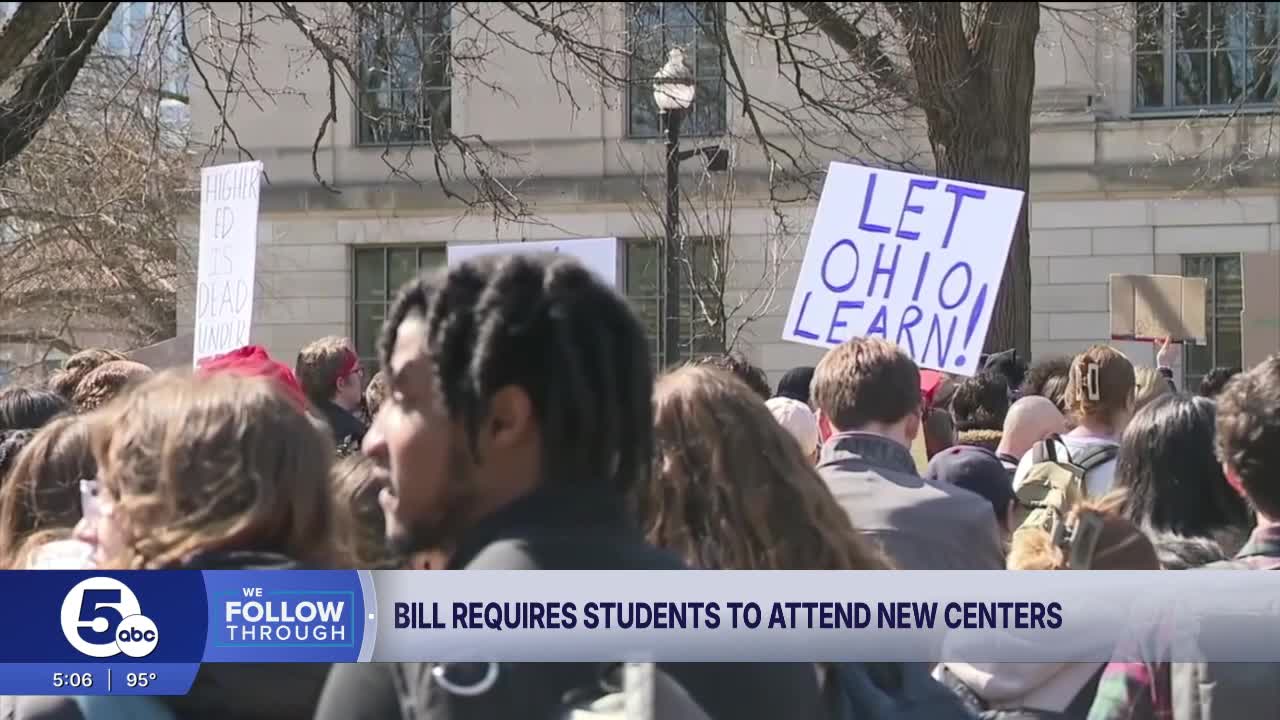
For years, college students from around the state, specifically OSU, have fought back against the GOP-created higher education reform.
"It ignores certain realities of what higher education is, what it stands for," OSU student D'Laveance Bert-Sims told us.
Students say they want real education, not what Sabrina Estevez calls propaganda.
"I think there is a fundamental misunderstanding with what indoctrination actually is," Estevez said.
In 2025, Senate Finance chair Jerry Cirino (R-Kirtland) got legislation passed, dramatically changing higher ed.
RELATED: Ohio bill would defund public universities for promoting DEI
S.B. 1 focuses on what Cirino calls “free speech,” banning public universities in Ohio from Diversity, Equity and Inclusion initiatives, having “bias” in the classroom and limiting how “controversial topics” can and can’t be taught. "Controversial" under Ohio law includes "belief policy that is the subject of political controversy, including issues such as climate policies, electoral politics, foreign policy, diversity, equity, and inclusion programs, immigration policy, marriage, or abortion."
The legislation also mandates students to take a civics course to graduate.
"Higher education in Ohio was in a really tough spot," Cirino said in a June press conference. "I think the left wokeness had taken over for a long time."
Prior to S.B. 1, Cirino created five “intellectual diversity” civics centers on college campuses to teach American history and political science. These are intended to combat what he calls “liberal bias.”
RELATED: Ohio House bans DEI, passes education overhaul bill
The centers currently exist at OSU, Cleveland State, Miami University, University of Toledo and Wright State.
"We have to change people's minds and hearts," he said.
But these conservative centers aren’t popular with students. Only 159 OSU students out of the more than 67,000 were enrolled at the Chase Center for Civics, Culture and Society in 2025, according to state data. That is .2% of the campus.
The data, collected by our news partner Ohio Capital Journal, sheds light on the interest in the centers.
Cirino is sponsoring a bill that would mandate attendance.
"It requires any student at a university with a center to take the course through the center," he said.
Professors' union leader Jennifer Tisone Price is shocked by this, calling conservative educational mandates the definition of indoctrination.
"This effort to create these ideological centers and make sure that only one viewpoint is being offered is wrong," Price said.
The bill would also require the school to spend state funding and tuition dollars on these centers. It gives them more freedom as well, stating that they would have all the same rights and privileges of an "independent college of the university."
"It requires that the centers receive all tuition and revenues from course offerings to ensure fairness and financial integrity," Cirino said.
Cirino claims that the attendance problem is set to be fixed next semester, saying OSU's center expects more than 800 students. That would be 1% of the student body. He also added that Miami University anticipates 3,000 students (13%), Cleveland State going from 28 to 1,400 (10%), Toledo at 250 (1.9%) and Wright State at 600 (5%).
"The reason that some of them are still a little bit low is because they're at different stages of getting started," Cirino said. "Toledo and Ohio State obviously had the jump start."
Under his bill, the center directors have the sole, exclusive and unlimited authority to oversee, develop and approve the center's curriculum. They would also have all control over hiring and tenure.
OSU's human resources department recommended that the Chase Center fire a civics center professor after he tackled a cameraman, according to WOSU. This incident was made public by political blogger The Rooster, and the professor has pleaded not guilty to assault in the Franklin County Court of Common Pleas.
The legislation would also create the Ohio Civics Board, a new statewide body made up of directors of the existing centers. They would get to have the sole approval of "American civic literacy courses established under this section, including course modality, syllabi, class size, faculty teachers, and course content."
For higher education institutes that don't have a civics center, they must institute a course approved by the Civics Board.
"They're pulling money away from colleges, universities that could be spent in the classroom," Price said.
Cirino argued that the centers are designated as independent. But through a quick analysis, the majority of speakers for OSU's "250 years of Freedom" program are conservative, affiliated with the Republican Party or support right-leaning policies.
"We should be focusing on making college accessible and affordable and investing in that instead of investing in ideological pursuits and these efforts to change hearts, minds and cultures," Price said.
Follow WEWS statehouse reporter Morgan Trau on Twitter and Facebook.
