





COLUMBUS, Ohio — The U.S. Supreme Court's latest major decisions involve topics that Ohio politicians know well: transgender athletes participating in sports, birthright citizenship and campaign finance laws.
On Tuesday, the nation's top court released three rulings, coming after a slew on Monday.
Transgender athletes
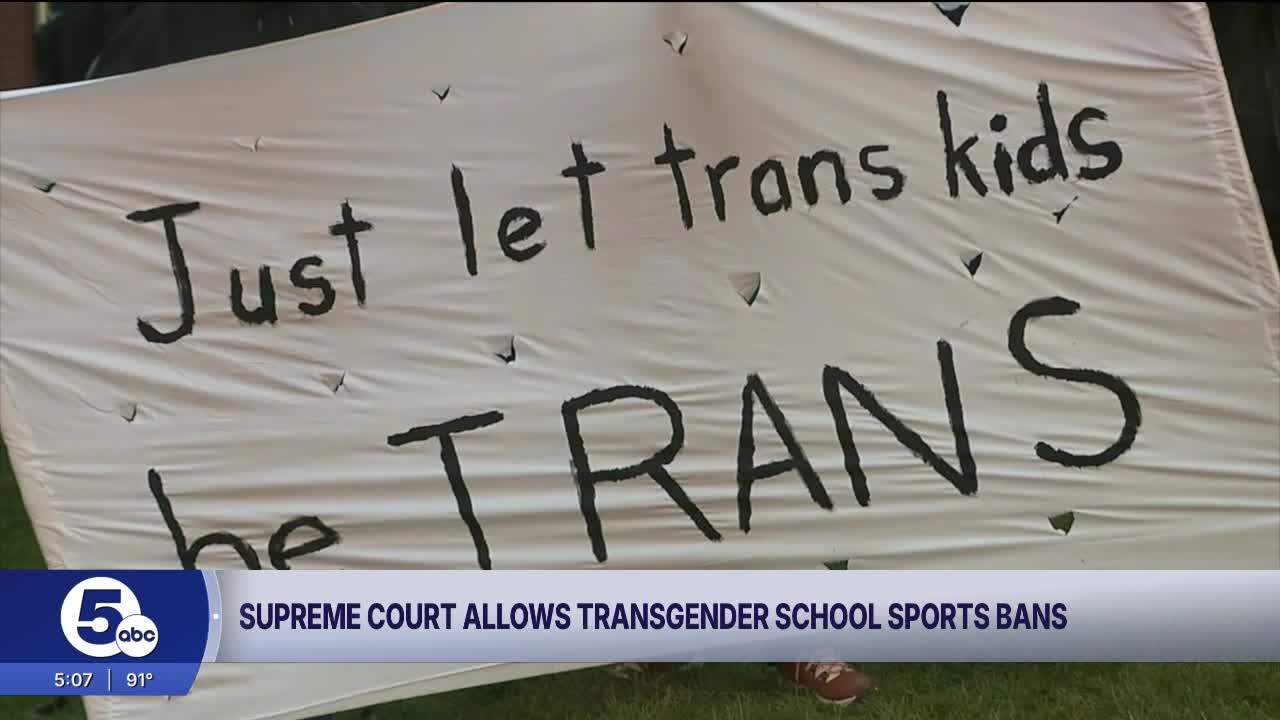
The justices ruled that states can ban transgender athletes from competing in school sports.
Ohio already has a similar, broader law in place.
The trial against part of House Bill 68, the controversial legislation that prevents LGBTQ+ minors from accessing care such as hormone blockers, hormone replacement therapy (HRT) and some mental health services, is being heard at the Ohio Supreme Court. The bill also prohibits trans athletes from participating in middle, high school or college athletics on teams that align with their identity.
While the SCOTUS ruling wasn't surprising, it does worry LGBTQ+ community members about future decisions.
"This just sets up a slippery slope where more laws are going to be targeting children like my own," the father of a transgender child, Sam Shim, said.
For two years, transgender children and teens in Ohio have been prohibited from playing on teams that align with their gender identity.
Before being banned, there were only six trans student athletes, ones who had to abide by state athletic association regulations.
This has made LGBTQ+ youth feel isolated, Shim said, since school sports are meant to be about community.
"I think it says that kids like my own are not welcome in schools or they're not as welcome," the dad said. "I think it’s very scary."
State Rep. Gary Click (R-Vickery) wrote the ban in Ohio and celebrated the ruling.
"This creates equity all across the nation for young ladies who deserve fairness in their athletic competitions," Click said.
He expected this ruling, he said.
"There are some boys and some men who want to come across and identify as girls, and they have a tendency to dominate that, and that's certainly not fair," Click added.
There is no widespread evidence of boys claiming to be transgender to participate in girls’ sports, Shim said, but Click argued that this ruling will prevent it from happening.
The Republican wants a federal ban, rather than just leaving the decision to the states.
"Biology doesn't change across state lines," Click said.
Shim worries that the justices have now set the stage to allow further discrimination, he said.
"If they go after the children, they're going to go after trans adults next, and then they'll go after another segment," he said.
Birthright citizenship
The justices protected birthright citizenship — the idea that if you're born in the U.S., you automatically are an American citizen.
In a blow to President Donald Trump, the court rejected his restrictions on citizenship.
The president signed an executive order in 2025 saying that babies born in the U.S. to parents who were undocumented or on temporary visas weren't actual citizens.
Now that it was struck down, local leaders like Global Cleveland's Joe Cimperman are thrilled.
"Its ruling gave a lot of people a sense of relief," Cimperman told me.
"More so, Morgan, it gave people who are international newcomers, immigrants, and refugees here in the United States a sense that they belong here, and that the Supreme Court saw them and recognized that they had protections under the law."
Global Cleveland is a nonprofit dedicated to helping and welcoming immigrants.
Statehouse Republicans criticized the rulings.
"I don't think that makes sense in any civilized society to say people can come over here, you know, pop out a kid and go back home, but that kid is now an American citizen and can have influence over our elections, can run for office, be a president someday," Click said.
Haitian TPS
Although Cimperman counted the birthright ruling a win, the justices are allowing Trump to end the Temporary Protected Status for Haitian immigrants, ones who came to the U.S. legally.
About 15,000 Haitians call Springfield home. Once their TPS expires, tens of thousands of Haitians will lose their jobs, be forced to leave or become undocumented.
"When you've got a community of law-abiding, faithful, churchgoing, taxpaying people who came here legally, and they're being told that they have to go home to a home... They've been doing so well here," Cimperman said. "It can't be a surprise to people that immigrants are feeling the fear and the anxiety."
Gov. Mike DeWine, unlike most GOP leaders, has been standing up for the Haitian community for years.
"What I would hope that the Trump administration would do is reconsider this. Look at how it's going to impact states like Ohio. In Ohio, the Haitians are working primarily in manufacturing. They're also working in the food area. But if you look at where they're working across the country, probably the most important area they're working is in health care. It's Haitians who many times are taking care of your mom or your dad who has Alzheimer's, taking care of family members who might be in a nursing home. And to say we're going to pull all those out, it's just not in our own self-interest," DeWine told our news partners at CNN.
U.S. Senator Bernie Moreno is against Congress extending TPS.
"It’s called TEMPORARY protected status (TPS) for a reason," Moreno posted on X. "The Senate will not expand TPS. The House’s bill is an insult to the millions of people patiently waiting in line & a tacit approval of Biden’s border invasion where TPS became de facto amnesty. Republicans will not continue to allow wage suppressing illegal migration to destroy working Americans with high prices, healthcare shortages, housing scarcity, and degradation of our social safety nets."
Cimperman is urging politicians to think about what happens to children.
"There are many, many Haitian moms and dads whose kids were born here. Today affirms that the kids can stay here," he said. "The moms and dads, by the decision a few days ago, say that they have to go. So, now we're gonna make these children state of Ohio orphans."
Ballots
The court has allowed for mail-in ballots to still be counted even if they are received after polls close, defying Ohio Republicans' expectations.
In a 5-4 decision, the justices ruled that states can create their own grace periods for counting votes as long as ballots are postmarked before Election Day.
The state GOP lawmakers preemptively passed legislation eliminating the grace period because they believed SCOTUS would side with them and require all votes to be in on election night.
Campaign finance
The court struck down limits on how much political party committees can spend in coordination with candidates.
This case was first filed by Republicans like Vice President JD Vance, who was an Ohio Senate candidate at the time.
Since the Watergate era, there's been a cap on how much party committees can spend in coordination with a campaign. As a result, money flooded into super PACs, which have no spending limits.
The ruling could reshape campaign fundraising for this year's midterms.
Police information
The justices ruled that law enforcement's use of sweeping cell phone location data obtained through a "geofence warrant" could constitute an unreasonable search and seizure.
Oftentimes, other citizens' data is scooped up when police are looking for a suspect, even if they have no connection to the crime.
Other cases
The justices ruled that Trump can remove a member of the Federal Trade Commission purely for policy reasons. That ruling paves the way for him to transform the federal government.
However, they blocked the president's efforts to fire the Federal Reserve's governor. The justices noted the Fed's long tradition of independence.
The court also rejected Trump's appeal in a defamation case involving columnist E. Jean Carroll. The president asked the court to overturn a verdict that said he sexually abused and defamed Carroll. With the Supreme Court not getting involved, he is still required to pay her $5 million.
Follow WEWS statehouse reporter Morgan Trau on Twitter and Facebook.
