


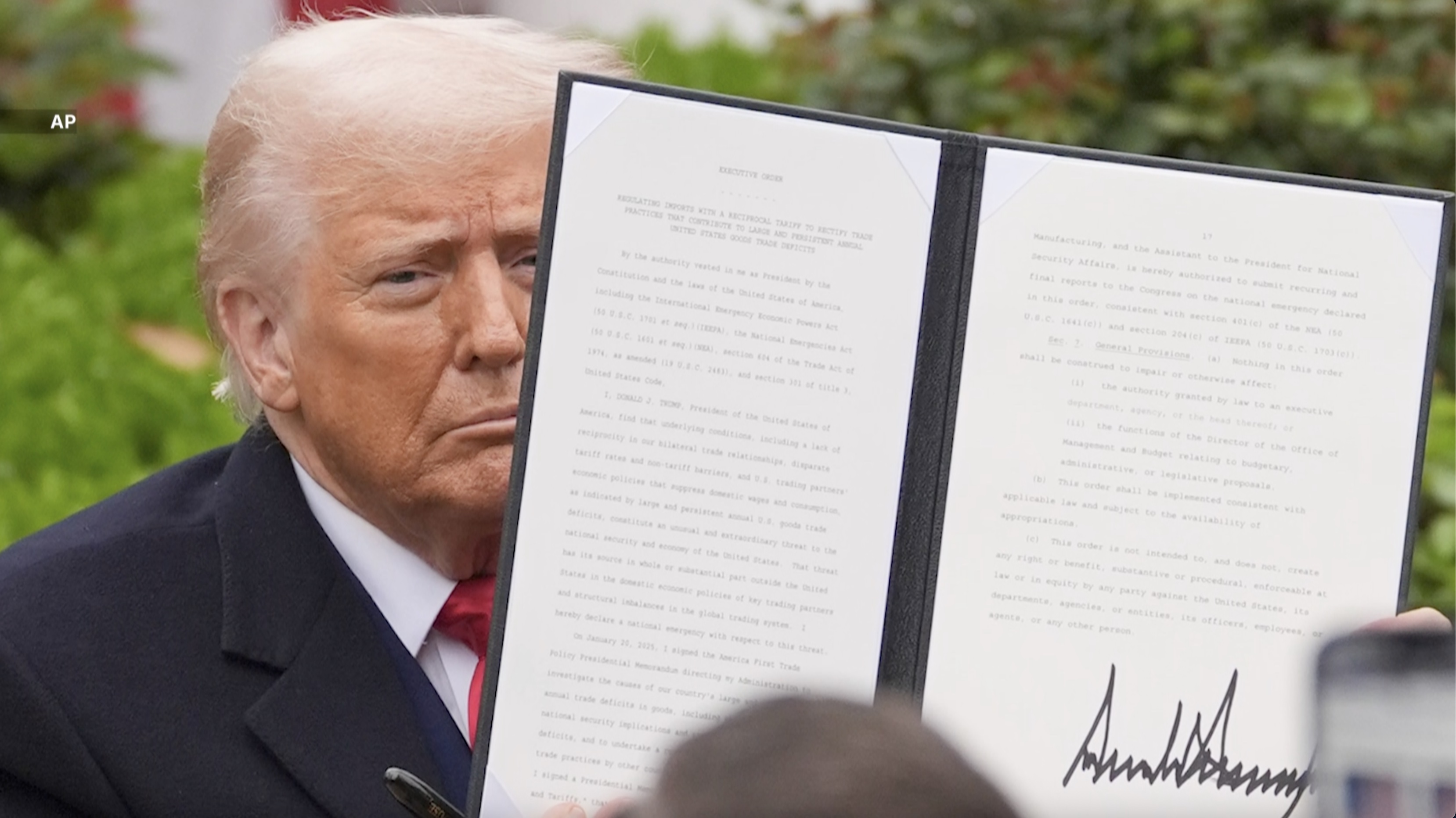


Nearly one year ago, President Donald Trump announced sweeping reciprocal tariffs that would lead to market volatility, a trade war, and a major legal showdown.
By invoking the International Emergency Economic Powers Act (IEEPA), Trump placed a universal 10% tariff rate, as well as differential reciprocal tariffs on major trading partners with rates as high as 50%.
"Foreign nations will finally be asked to pay for the privilege of access to our market," Trump said during a White House speech on April 2, 2025, a day he called 'Liberation Day.'
It was the first time the emergency law was used to impose tariffs.
By February 2026, the Supreme Court ruled most of his emergency tariffs were unconstitutional, kickstarting the complex and unprecedented process of issuing refunds to impacted importers.
While many of those original tariffs are now gone, their impact is still being felt.
Following Trump's April 2 announcement, companies warned consumers about potential shortages and higher prices.
"We haven't seen a lot of relief," said Jonathan Ernest, an assistant professor of economics at Case Western Reserve University. "In fact, we saw tariffs drive up consumer goods' prices by another 2% or so over the last year, and estimates are that somewhere between 90 and 95% of the tariff actual cost is essentially being passed on to consumers."
RELATED STORY | New analysis shows Trump's tariffs cost US households an average of $1,000 last year
While costs remain high today, Ernest said one of the Trump administration's intended effects, more U.S. manufacturing, has yet to materialize.
"We've still seen in 2025, a decline of about 100,000 manufacturing jobs in the U.S. rather than a sudden boom and increase," Ernest said.
Automation and a wave of retirements also contributed to the decline.
Rathna Sharad, CEO of the shipping platform FlavorCloud, agrees that a manufacturing shift has not played out.
"Because the expertise isn't there, number one. Number two, the labor costs are nowhere near trying to do that manufacturing in some of these other countries that they currently use," Sharad said.
Ernest said Trump's promise to shrink the trade deficit has also not occurred.
"We saw things actually continue to progress in terms of larger trade deficits, which aren't necessarily a bad thing on their own," he said. "But those actually grew rather than shrink over the last year, even with all of this tariff activity."
After the Supreme Court’s IEEPA ruling, the process of issuing refunds to businesses is taking shape.
RELATED STORY | ‘Who did this to them’: Democrats weaponize tariff backlash in campaigns
Kyle Peacock, principal at Peacock Tariff Consulting, said it's not entirely clear whether consumers would benefit from the refund process.
"We may see a wave of litigation that comes through from consumers to retailers, but it's at the point where retailers haven't received the funds yet," Peacock explained. "So even if they were going to pass it back to the consumers, it's this vicious cycle that we're seeing."
Hours after the Supreme Court's ruling, the Trump administration implemented a global 10% tariff under the Trade Act of 1974 that has a 150-day limit. The president has suggested raising that tariff to 15%, but any extension requires approval from Congress.
