


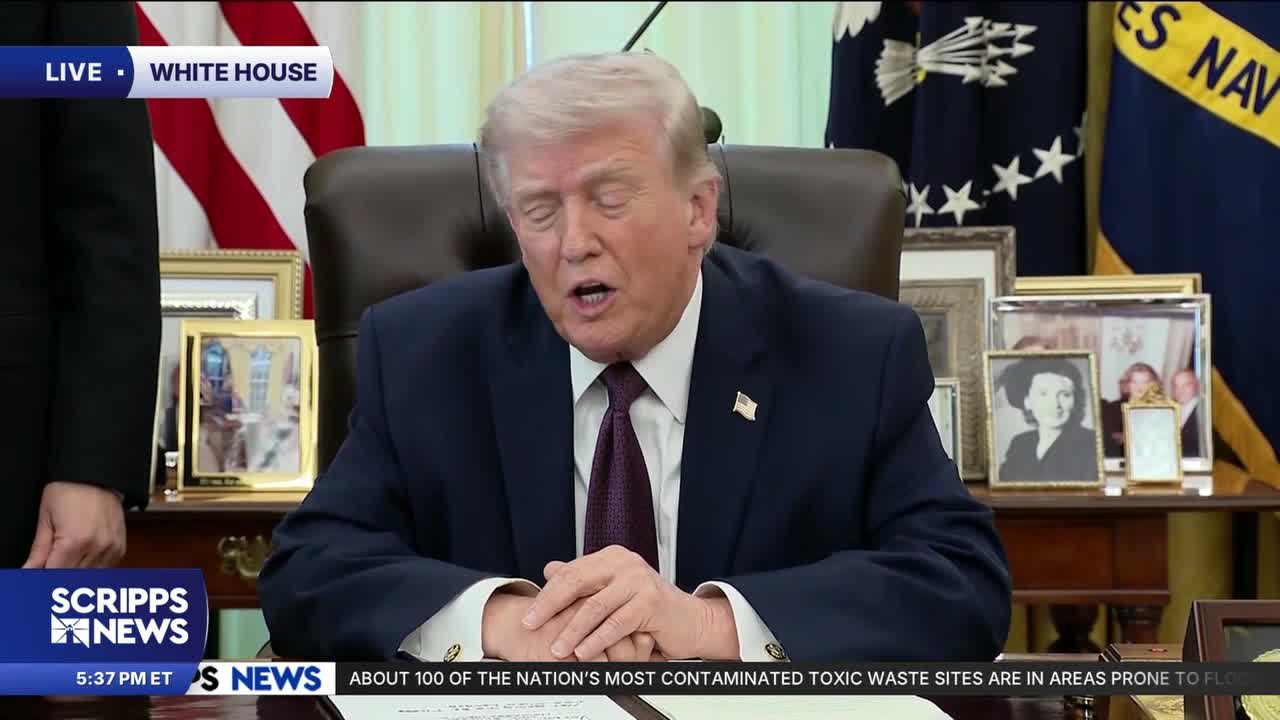


President Donald Trump signed an executive order Tuesday that seeks to reinforce the integrity of U.S. elections by putting new restrictions on voting by mail.
The new executive order directs the Department of Homeland Security and the Social Security Administration to create a nationwide list of eligible voters.
The order also directs the U.S. Postal Service to verify that mail-in ballots are sent to and returned only by people who are eligible to vote.
"The Federal Government has an unavoidable duty under Article II of the Constitution of the United States to enforce Federal law, which includes preventing violations of Federal criminal law and maintaining public confidence in election outcomes," the order reads. "To enhance election integrity via the United States Mail, additional measures are necessary."
A national voter roll is likely to face immediate legal challenges, experts told the Associated Press.
“The Constitution is very clear — the president has no power over elections in the states,” said David Becker, a former Justice Department lawyer. “This will be blocked as soon as lawyers can get to the courthouse.”
It is also not clear if the president has the authority to compel USPS to track voting eligibility.
The U.S. Constitution makes "The Times, Places and Manner of holding Elections for Senators and Representatives" the responsibility of individual states.
The Trump administration claims inaccurate voter rolls have allowed ineligible voters to participate in U.S. elections. It also claims mail-in voting has become "rife with fraud" as ineligible voters receive and return ballots.
RELATED NEWS | Judge blocks Trump’s attempt to overhaul US elections
Earlier in his second term, President Trump signed an executive order compelling states to require voters to show proof of citizenship when voting, and requiring that all ballots be received after Election Day deadlines. That order was quickly blocked pending litigation by a federal judge who noted "The Constitution does not grant the President any specific powers over elections."
