

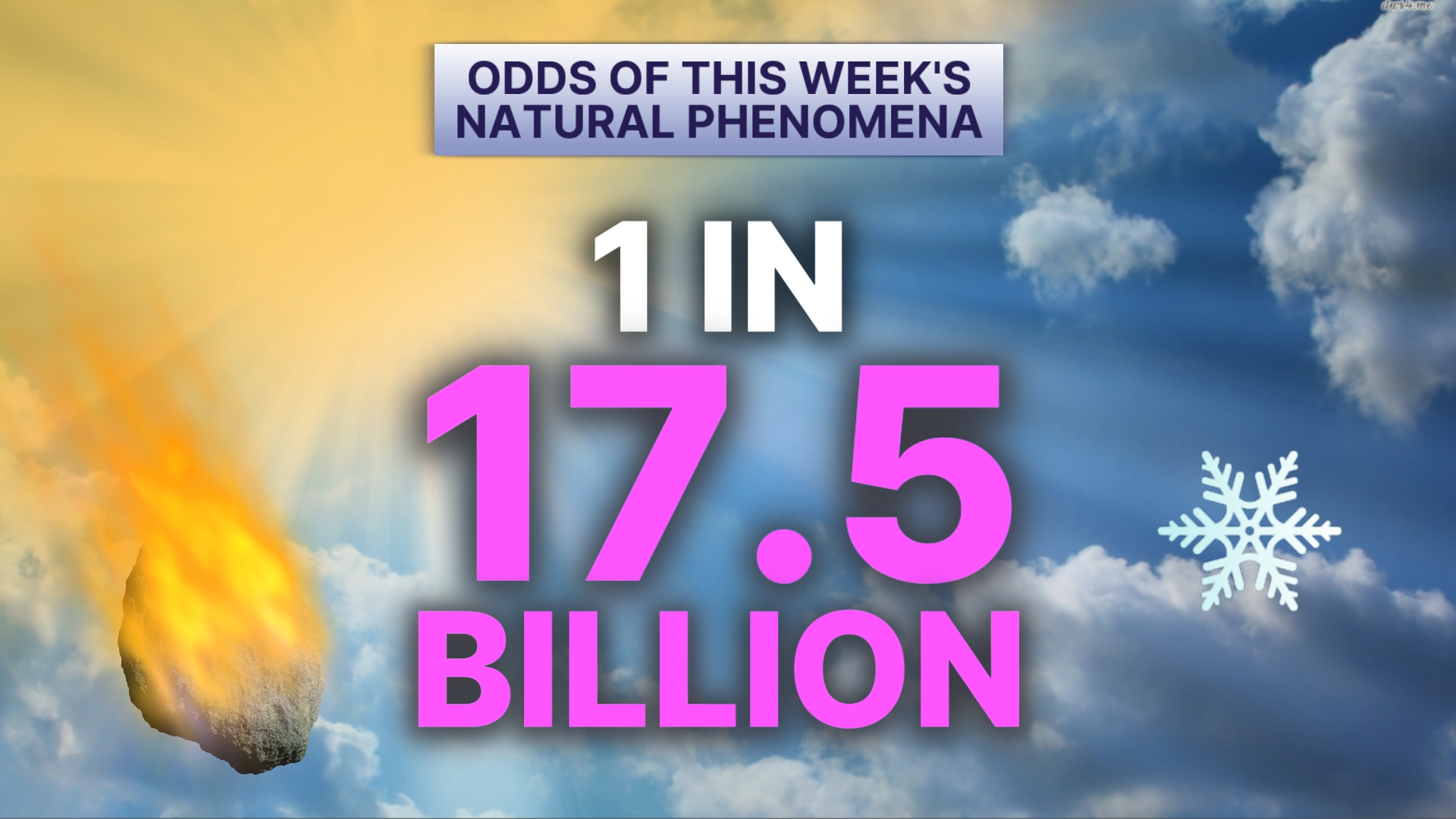



This past week, from March 13 through 19, has been one for the record books. From record-shattering wind to near-record warmth, accumulating snow, and of course, a daytime fireball with sonic boom, Northeast Ohio saw an improbable number of extreme weather and natural phenomena seemingly at once. What are the odds of seeing what just happened?
1 in 17.5 BILLION. That's right, billion with a "B."
For reference, it is LOWER odds than winning the Powerball lottery. That is 1 in 292 million, according to Powerball.
How about getting struck by lightning? That is a measly 1 in 15,300.
There are only two major probabilities that are lower than this. It is harder to shuffle a deck of cards and get it in the same order. It is also harder to get a perfect bracket for the college basketball championship. That sits at 1 in 9.2 quintillion!
Let's dive into the data. This first part will be a quick overview. For all the math and science nerds, or skeptics, keep scrolling for the hard data.
First, let's note the independent events that occurred this week:
- Friday, March 13: Magnitude 2.2 earthquake in Lake County, light shaking reported.
- Friday, March 13: Record 77 mph gust at Hopkins, 85 mph gust at Burke
- Sunday, March 15: Near-record high of 75 degrees
- Tuesday, March 17: Daytime meteor with sonic boom
- Wednesday, March 18: Low of 15 degrees
(NOTE: In this one week, there was also more than 1 inch of snow recorded at Hopkins, but snow is a dependent event that is not easily calculable and would not change the odds significantly.)
First, the wild temperature swing. There have only been THREE other times in recorded history when Cleveland saw a high of 75 or higher AND a low of 15 or lower. This week is the fourth. This alone is 172:1 odds, lower than the Browns winning the Super Bowl as of March 19, which is 150:1.
Next, the record-breaking gust. The criteria for a "severe" wind gust is 58 mph. There are 16 total times when gusts were severe in March. So, the odds of seeing severe gusts in one week are actually almost 6%, the highest of all events.
Now, here come the natural phenomena. Friday's earthquake was a M2.2. The odds of a magnitude 2.2 earthquake or greater in Ohio in any single week is 2.56%.
Then comes the daytime meteor and sonic boom. This one was the hardest to calculate, and ended up being the most improbable event of the week. The odds are at just 0.0006%.
Okay nerds, here's the process behind the probabilities:
NASA's CNEOS Fireball Database has detected 782 bolides between 1988 and early 2022, which is a period of 33 years. (The size of our asteroid was more than 1 meter, which qualifies as a bolide.) In order to get this value converted to a single week, divide the 782 by 33 years, 12 months in a year, 31 days in a month, then multiply by 7 days in a week, to cancel out the units. For any AP Chemistry students, see the video on how that looks, and how important it is to cancel units! That's not all. It is safe to assume (sorry, physics majors!) that half the bolides were during the day, and half were at night. That means to divide by 2. According to a study called the "Millman Fireball Archive," about 12.8% of meteors produce a sonic boom. That means to multiply the number by 12.8%. There is still one more step, because our current number is for the entire planet Earth. So, the last step is to multiply by the area of Ohio, divided by the area of Earth. The final number? 0.000006497, or 0.0006%.
For the temperature and wind probabilities, I multiplied the number of occurrences by the total amount of Marchs on record, then divided it by 31/7, 31 days in March and 7 days in a week, to cancel out the units and be left with the probability in a single week in March.
- Wind: 16 instances of severe gusts recorded in 61 years of record-keeping. 16/61 divided by 31/7 equals 0.05922, or 5.92 percent.
- Temp: 4 instances in 156 years of record-keeping. 4/156 divided by 31/7 equals 0.005790, or 0.58 percent.
For the earthquake, the Ohio Department of Natural Resources says there have been 431 earthquakes M2.2 or greater since 1776. 431 divided by 250 years of data, 12 months in a year, and the same 31/7 to keep the week unit the same, equals 0.02567, or 2.56 percent.
To get to the 1 in 17.5 billion odds, multiply each of the four probabilities (temp, wind, earthquake, meteor) together. The final probability is 5.72*10^11, which is in scientific notation because the number is so small! That number gives us the 1 in 17.5 billion odds.
Phew, that was a lot! This took MANY hours of data searching and ensuring the data used was accurate. Now you know, what Ohioans just experienced is VERY rare."
Want the latest Power of 5 weather team updates wherever you go? Download the News 5 App free now: Apple|Android
Click here to view our interactive radar.
Follow the News 5 Weather Team:
Trent Magill: Facebook & Twitter
Katie McGraw: Facebook & Twitter
Phil Sakal: Facebook & Twitter
Allan Nosoff: Facebook & Twitter
