

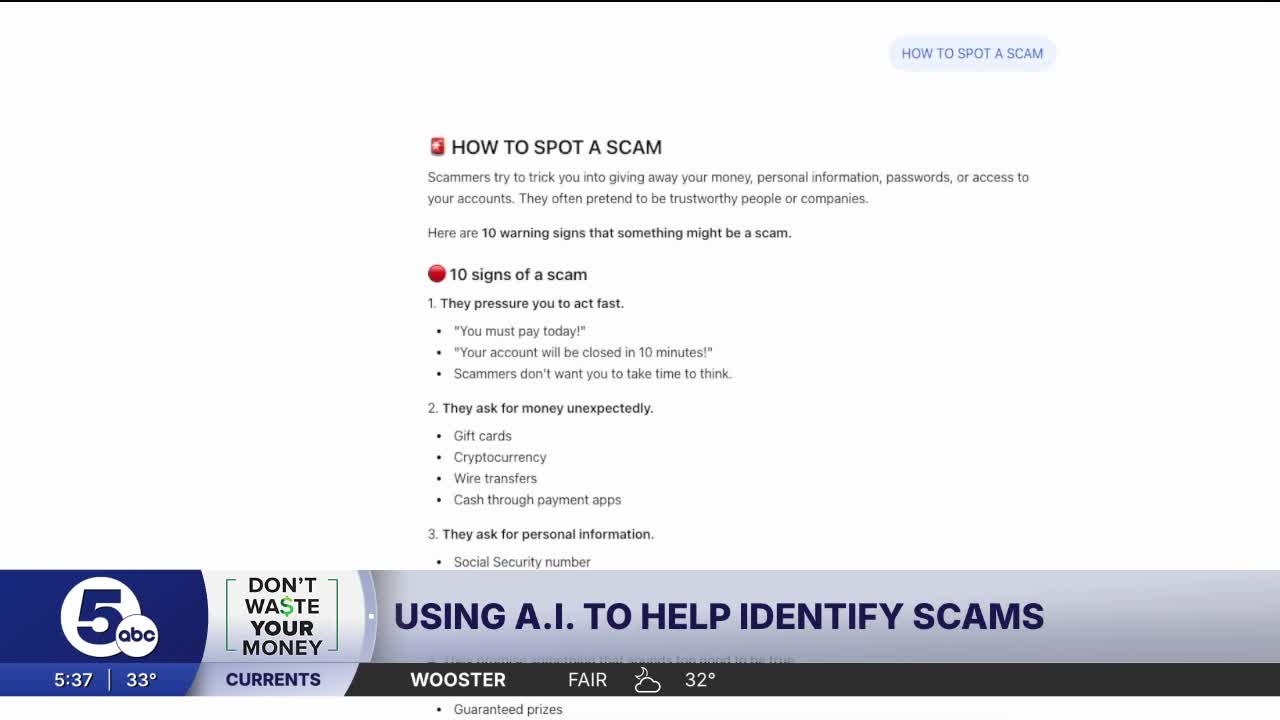


CLEVELAND, Ohio — Could ChatGPT help you spot a scam before you lose money?
Millions of people are turning to the artificial intelligence tool every week to find out whether a suspicious text, email or message is legitimate.
During Fraud Prevention Week, I'm sharing information that could help you avoid becoming the next victim.
And one increasingly popular tool people are turning to is ChatGPT.
I recently spoke with Jack Stubbs, lead scams investigator with OpenAI, who shared some eye-opening numbers.
According to Stubbs, about 25 million people every week are now asking ChatGPT whether a suspicious text or email they've received is a scam.
OpenAI's testing found two important things.
First, ChatGPT reliably identifies scams and provides appropriate safety guidance about what people should do next.
But Stubbs says there's another benefit: The tool doesn't simply give users a yes-or-no answer.
"And the other thing that I actually think is really awesome is ChatGPT doesn't just give you a binary. Yes, this is fine on those. It's a scam. What it does is help people make their own informed decision. It walks people through a kind of personalized risk assessment, identifying the signals that something might be off and advising on how to proceed safely if they wish to proceed," Stubbs said.
More than 50% of people using ChatGPT for this purpose every week are describing a situation in their own words or uploading an image, according to Stubbs.
In other words, they're asking questions like:
- Does this text look like a scam?
- Is this email legitimate?
- Does this message sound suspicious?
- Can you help me figure out whether this is real?
Stubbs says it's an accessible way for people to get guidance as scam attempts continue to bombard consumers.
THE BOTTOM LINE
If something feels off, take a minute before responding, clicking a link or sending money.
You can ask ChatGPT to examine a suspicious message or image and explain the warning signs.
But remember, AI isn't a guarantee that something is legitimate.
Never share passwords, verification codes, financial information or other sensitive personal information, and independently verify unexpected requests through a trusted phone number or official website.
When it comes to protecting your money, a few extra minutes could make all the difference.
This story was reported on-air by a journalist and has been converted to this platform with the assistance of AI. Our editorial team verifies all reporting on all platforms for fairness and accuracy.
