

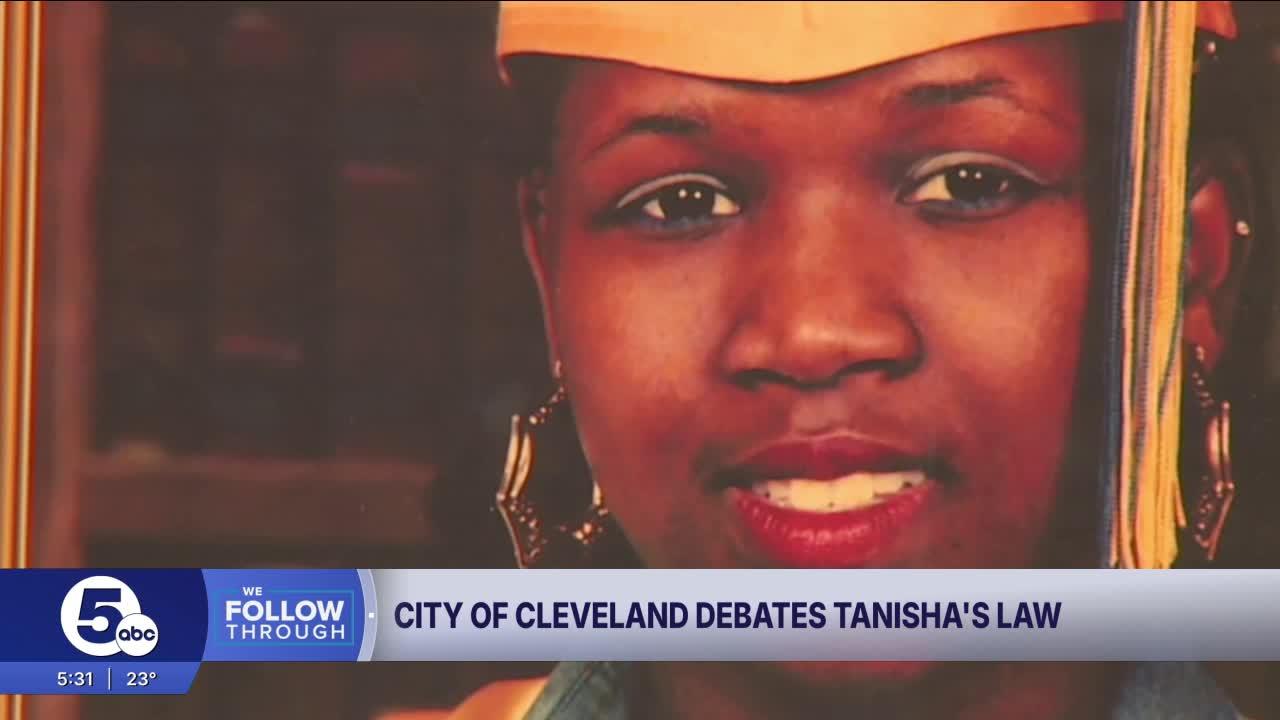


CLEVELAND — More than a year after legislation was introduced, the Cleveland City Council's Public Safety Committee held its first hearing on Tanisha's Law Thursday afternoon.
WATCH:
READ MORE: 10 years later: Cleveland City Council considering Tanisha's Law
The emergency ordinance would transform the city's response to mental health emergencies.
The proposed law was created by Tanisha's uncle, Michael Anderson, and Case Western Reserve University School of Law students.
Tanisha Anderson died after being restrained by Cleveland police officers during a mental health crisis in November 2014.
"It's very important, not only for Tanisha but for other people who suffer from mental health issues," he said.
What Tanisha's Law would do
The law would create a Department of Community Crisis Response, which would administer and oversee the city's mental health programs.
Instead of police, the law would also direct some 911 calls to mental health clinicians.
It would also codify the city's current programs into law - so they can't be abandoned by future administrations.
The city currently has seven co-responder teams, where a trained police officer and a mental health clinician respond to calls for help — and every Cleveland police officer receives 40 hours of training in crisis intervention techniques.
Mayor Bibb's response
However, Cleveland Public Safety Director Wayne Drummond said the administration does not support the current proposal.
He said crisis response should remain under public safety, not in a separate department.
He also said the city wants to conduct a third-party analysis of 911 calls to determine the scope of need.
However, Drummond said it "supports the spirit" and intent of Tanisha's Law.
"We understand what the sponsors want to accomplish - and we want to get there as well - it's just how we get to that particular point," Drummond said.
A call for help
Anderson hopes the administration changes it mind and decides to support Tanisha's Law.
"She passed saying the Lord's prayer. She was asking God to forgive the officers who were holding her down," he said. "That compassion that she actually had for the officers, I'm asking city hall to extend that same compassion to people who suffer from mental health."
Anderson had bipolar disorder and schizophrenia.
The night she died , Anderson's family had repeatedly called 911 for mental health assistance.
Instead police officers arrived and handcuffed Anderson face down on an icy sidewalk. The medical examiner concluded she died while restrained in a prone position.
