

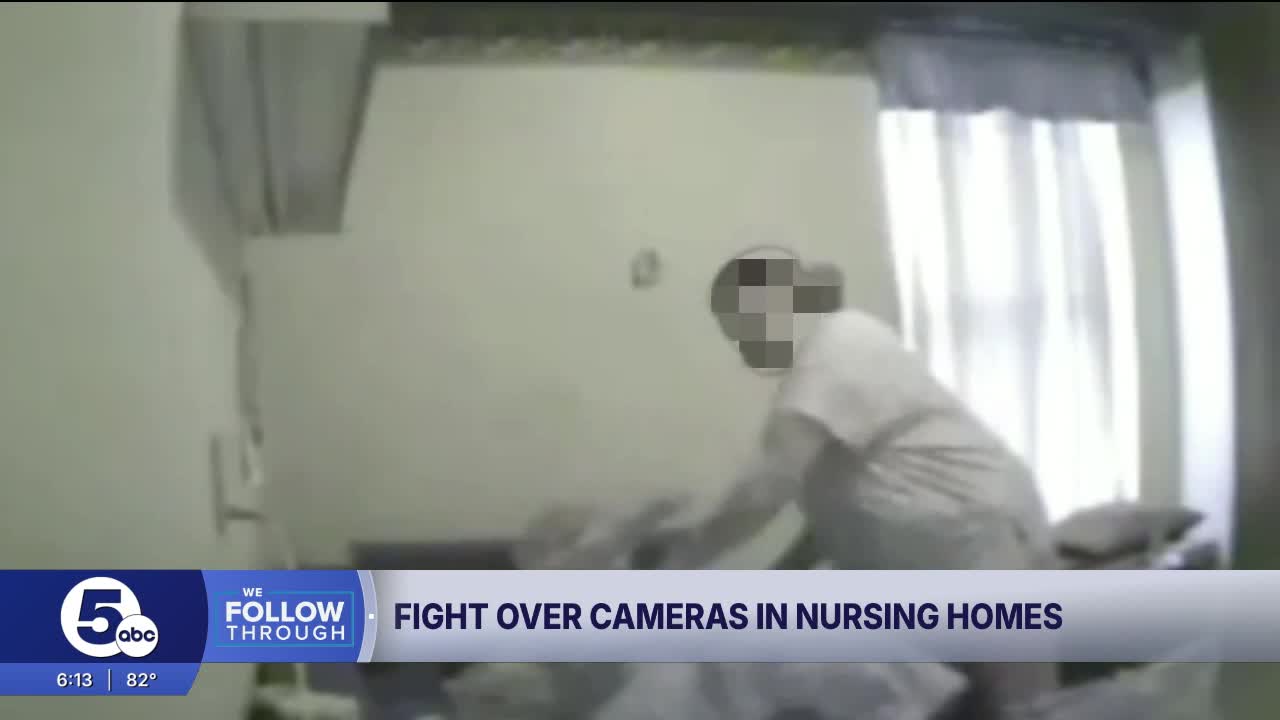


CLEVELAND — Cameras in private nursing home rooms allow you to see and interact with your loved ones, but there are newly proposed changes to the law that lets you put up those cameras.
You might remember that News 5 Investigators were instrumental in the coverage of Esther’s Law in previous years. Steve Piskor from Northeast Ohio thought his mother was being abused in a nursing home, so he put up a hidden camera that then caught the abuse. That led to Esther’s Law, named after Piskor’s mom.
New bills in the Ohio legislature want to expand the law, but a major change to the Senate bill has Piskor upset.
When he caught abuse against Esther with a hidden camera in her nursing home, it was troubling.
“That’s really tough. You don’t know what to do,” said Piskor.
What he did do, over numerous years, was get Esther’s Law eventually passed in Ohio, where residents and loved ones can put cameras in nursing home rooms.
“There’s no question about that cameras help. I mean, we’re seeing things that are actually happening, you know?” said Piskor.
Since then, Piskor’s been helping other states with camera legislation, and he’s gotten complaints from Ohioans who say some nursing homes have taken away their cameras.
NORTHEAST OHIO NURSING HOME CITED
In fact, the Ohio Department of Health followed up on one of those complaints last month. An inspection report cited Grande Oaks in Oakwood Village after the administrator removed a camera from a resident’s room for what the nursing home called “non compliance with policy.” However, inspectors wrote “the facility provided no documented evidence” that would justify “the abrupt removal of the camera.”
The inspection also showed the daughter of the Grande Oaks resident reported that “she had numerous recorded incidents of staff yelling at or mistreating the resident and staff blocking the camera by placing towels over it…” and so forth, but those events were lost “because the SD card from the camera was missing when the facility returned the device to her.”
“I mean, that’s totally illegal,” said Piskor. “The camera is personal property.”
THE BATTLING BILLS
At one point, a recently introduced Senate bill (SB 154) sought to expand Esther’s Law to allow cameras in assisted living facilities.
“Some of those folks end up in the same kinds of situations,” said Ohio Senator Catherine Ingram from Cincinnati, who is the bill’s primary sponsor. “It makes guardians and loved ones feel a whole lot better,” she told us. “It also takes the place of not having a visitor.”
But, in the Ohio House, a bill (HB 809) co-introduced by Representative Melanie Miller from northeast Ohio wants to expand to assisted living, too, but also allows those who run the homes to have more control of the cameras if they choose to provide the cameras.
She told us that organizations like the Ohio Health Care Association, which represents nursing homes and assisted living facilities, helped shape the bill’s language.
“I’m not an expert in this space,” said Rep. Miller. “I don’t run a facility, and so that’s where it’s important to bring these folks to the table to see, you know, when it comes to implementation, how this works.”
PISKOR: IT DOESN'T PROTECT RESIDENTS
We asked Piskor about Rep. Miller’s bill.
“And does that protect residents?” we asked.
“No…actually, the way we made this law was is so that the nursing home would have as little to do with the law as possible,” said Piskor.
Piskor originally told us he liked Senator Ingram’s bill, and Senator Ingram even said the House version wasn’t good.
“I don’t want whatever that house bill is to give the providers more leeway. No, that’s just not fair to people,” said Sen. Ingram.
But, now with new changes, both bills look similar, giving additional rights to elderly care businesses, saying “if a long-term care facility does not provide” the camera, then the resident “may select any electronic monitoring device…”
“We’re not wanting to give more power to the facilities but we also…it needs to be, there needs to be a balance there,” Miller said.
“Whoever owns the camera, owns the footage of it, too,” said Piskor. “It’s like whoever takes the picture owns the copyright to it. That’s the same thing with video, too.”
NEO HOME FINED, CITED FOR ESTHER'S LAW VIOLATION
The Ohio Department of Health told us of the many violations in the recent inspection of Grande Oaks, including that it “failed to report alleged abuse, neglect and misappropriation…” then “failed to thoroughly investigate” allegations and the Esther’s Law citation, and ODH fined the home $5,000.
News 5 Investigators asked Grande Oaks several times for a sit-down interview. Grande Oaks gave no response.
In the meantime, Piskor said he now opposes the Senate bill (SB 154) and hopes to get more hearings so you can voice your thoughts about the cameras before legislators take a break for the summer.
“We were very specific saying that this law, this camera is not to catch abuse. It’s to stop abuse,” Piskor told us.
The proposed bills address other concerns that residents and their families have about the costs of camera installation, WiFi service, and fees.
Piskor said he has written letters and will continue his fight for more camera access for families.
