

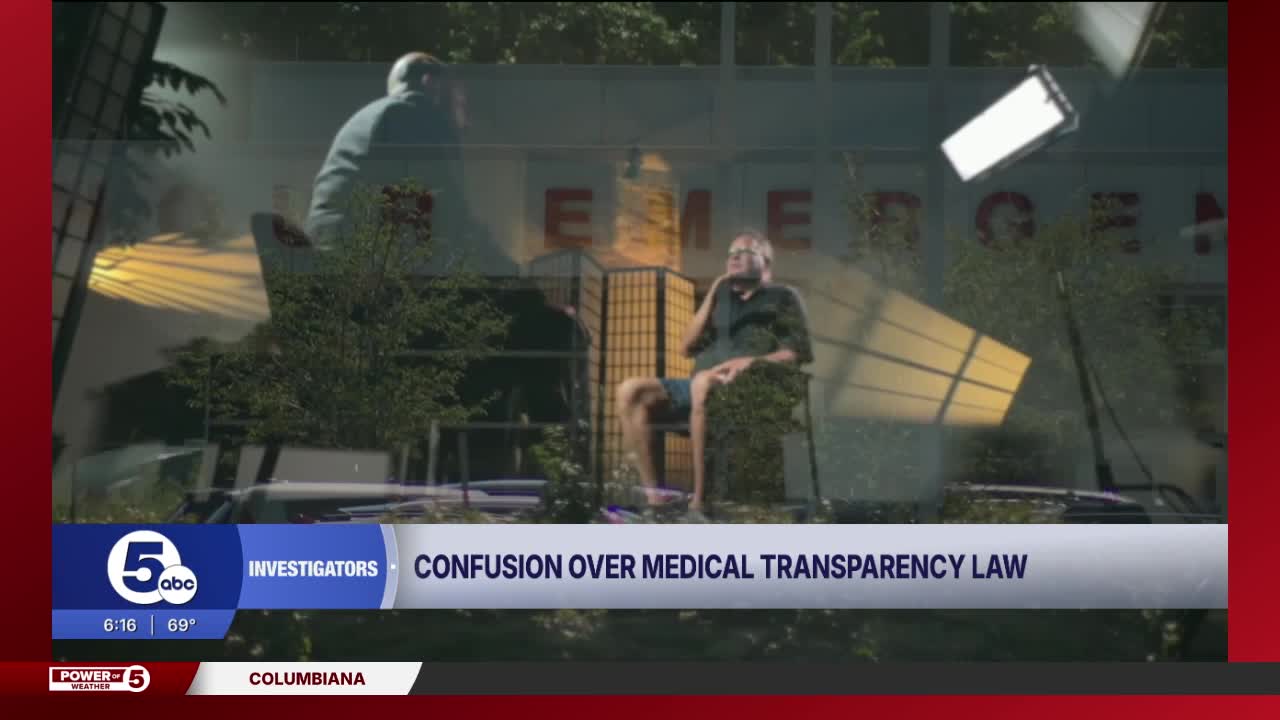


CLEVELAND — Ever gotten a medical bill and asked what the heck those costs are? You’re not alone. Ohio does have a new law that all hospitals have to be transparent with their medical pricing, and the state’s department of health has to enforce that law. We uncovered that price transparency audits have not been conducted across the board in Ohio each month.
“Did they ever tell you how much all of this was going to cost?” we asked Tim Hardie from North Canton.
“No,” he replied.
Hardie said he called ahead of time and talked to the staff of Summa Health’s Green Emergency Department in Uniontown about needing help with some stitches. “I was given nothing but the affirmative that, yeah, this was going to happen,” said Hardie. “We’ll take care of it…We do it all the time. No problems.”
But when he was examined, Hardie said the doctor then told him he could not do anything for him. He then received a bill from Summa for $1,600 and another bill from the doctor’s group.
“That actual doctor…that was over $700…$2300 for basically taking up space and maybe having 3 or 4 minutes of the doctor’s time,” said Hardie.
To say the least, he has been frustrated.
“Any other good or service that I buy, no matter how simple or complex, I have a very good understanding upfront,” Hardie told us.
ODH ENFORCEMENT AND THE POLITICIANS
The Ohio Department of Health (ODH) is responsible for enforcing the Hospital Price Transparency Law in 200+ hospitals in the state, making sure, for example, health systems show prices for services in dollars and cents.
Ohio Representatives Tim Barhorst and Ron Ferguson are the architects of the law that went into effect last year.
“We can stabilize the cost of healthcare and, hopefully someday, drive it down because the transparency and the price is out there,” said Rep. Barhorst.
ODH’s first enforcement list showed half a dozen medical facilities not in compliance. This month, it shows just one hospital in the state not complying. Is Rep. Ferguson a bit skeptical about that?
“People at the Ohio Department of Health probably aren’t going to be as strict as consumers, actual Ohioans, would be,” said Rep. Ferguson.
JUST A LIST, NOT AUDITS EVERY MONTH
News 5 Investigators were persistent with questions to ODH, which then admitted it does not audit every hospital each month. It just puts out a list as required.
But since 2021, the feds have been leading the crackdowns on hospitals, including most recently with the Trump Administration involving hundreds of facilities.
“This is the largest enforcement action that we’ve seen to date by far,” said Ilaria Santangelo, the director of research for PatientRightsAdvocate.org, that’s been tracking high rates of non-compliance from hospitals across the country for years now. Its next report comes out in August. “96% of Americans want price transparency,” said Santangelo. “So, the more monitoring, the more enforcement from Ohio or for the federal government, this is great for all American patients.”
FEDS DOING MORE
However, there is a big difference at the heart of that enforcement. News 5 Investigators combed through pages of federal data and found CMS cited 19 different Ohio hospitals since January, while the most that ODH cited this year was 5, with each monthly list having the same hospital, except one facility would basically come off the lists every month.
There are different standards for federal and state levels, but the data shows the feds keeping their pulse on price transparency more.
HOSPITALS NOT HAPPY
The American Hospital Association said this month “improving price transparency…is not working….” calling the requirements on hospitals a “significant administrative burden” and the complexity of health plans is “much of the challenge” to giving patients true prices.
Meanwhile, Hardie has been hard at work on his bills. “In this case, it’s just really sticking in my craw,” he told us. He said he got the doctor’s $700 bill dropped.
Summa apologized to Hardie, cut its $1,600 bill in half, and said, in part, Hardie “was billed accordingly.”
Hardie told us that more transparent details should be given to patients on their way out of appointments and procedures. “All the materials that were used, all the processes, tests, so you had an idea of what to expect coming in the mail,” he said.
The Ohio Representatives told us that while more enforcement and compliance are good, they still want to add consumer protections for you so you can hold hospitals more accountable. They’ll look at that next legislative session.
ODH, CMS and Summa would not go on camera and answer our questions. You can read their full statements below.
Statement from Summa:
“We want to make clear that Mr. Hardie's experience is important to us, and we have been in ongoing communication with him to address his concerns regarding the bill he received for services that were provided during his visit.
When Mr. Hardie contacted us, we provided information about the scope of services available at our facility; however, the actual care provided is always based on what a patient's individual needs are at the time they are assessed.
We sincerely regret any confusion this caused and acknowledge how frustrating it can be to navigate an unexpected billing situation. Mr. Hardie received care at our facility and was billed accordingly. We take patient satisfaction seriously and appreciate the opportunity to clarify this matter.”
Statement from ODH:
"The Ohio Department of Health (ODH) actively monitors all state hospitals, including performing periodic audits, and posts non-compliance lists based on state laws. Keep in mind that the administration and enforcement provisions are very different at the state and federal level. We certainly would encourage anyone to check both ODH and CMS resources to get the most information possible.”
Statement from CMS:
“CMS publicly reports Hospital Price Transparency (HPT) enforcement activities through the HPT Enforcement Activities and Outcomes dataset: https://data.cms.gov/provider-characteristics/hospitals-and-other-facilities/hospital-price-transparency-enforcement-activities-and-outcomes. This dataset can be sorted by date and enforcement action type, is updated monthly and currently includes information on enforcement activities from Jan. 1, 2021, through May 31, 2026.CMS conducts compliance reviews of hospitals’ compliance with the HPT regulations. Should deficiencies be found, CMS issues warning notices and requests for Corrective Action Plans (CAP) as part of its established enforcement process. For hospitals that have not made any attempt to satisfy the requirements (i.e., those that have not posted any machine-readable file or shoppable services list/price estimator tool), CMS will not issue a warning notice to the hospital and will instead immediately request that the hospital submit a CAP.HPT remains a priority for this Administration. CMS will continue to monitor compliance and take appropriate enforcement action to ensure hospitals provide consumers with meaningful pricing information as required by law. Learn more at: www.cms.gov/priorities/key-initiatives/hospital-price-transparency.”
