



CLEVELAND — Millions of your taxpayer dollars gone! There’s been a lot of attention recently on Medicaid fraud in Ohio and around the country. The News 5 Investigators wanted more answers and took a deeper dive into Medicaid fraud in the state and Northeast Ohio.
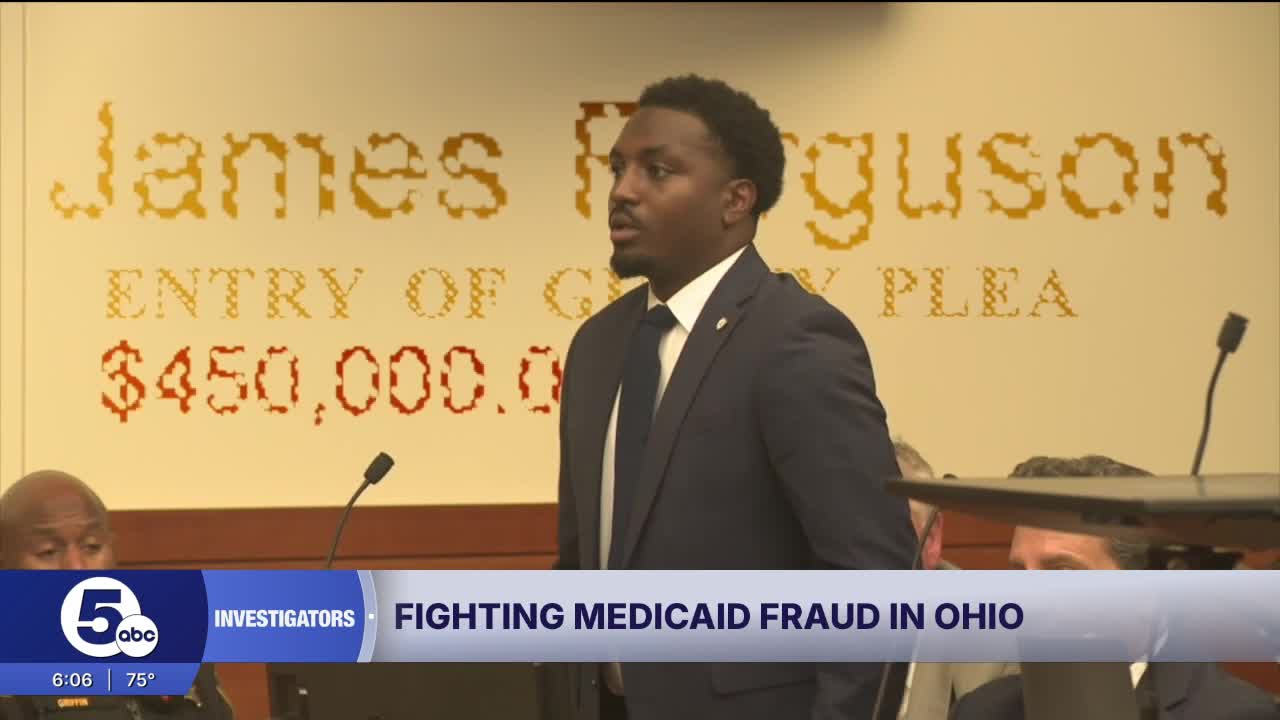
James Ferguson, 29, from Cleveland, admitted he stole $450,000 from Medicaid.
“I’d like to first apologize to the court and as well as to my family for my actions,” said Ferguson as he stood in a Franklin County courtroom during his sentencing earlier this month.
He claimed that during his year and a half of taking your taxpayer dollars, it was a mistake.
“Just was an act of misguided judgment and an aberration, your honor,” Ferguson said.
THE SENTENCE, REACTION, & HISTORY
The judge sentenced him to five years' probation and suspended any prison time. Our research shows this kind of sentence is common even with big-dollar Medicaid fraud. That does not sit well with investigators.
“There needs to be some sort of punishment and deterrent effect on this. I feel pretty strongly about that,” said Ben Karrasch, chief of the Healthcare Fraud Section at the Ohio Attorney General’s Office.
Over the last 15 years, Governor Mike DeWine said there have been more than 2,200 Medicaid fraud convictions with more than $640 million recovered. Notable big-money cases have occurred during that time, along with criticism from some state legislators about not catching crooks sooner.
WHY SO MUCH FRAUD?
Why so much fraud? Karrasch said one reason is that it was easier to get approved for Medicaid work.
“The Medicaid program has always been a pay-and-chase system,” said Karrasch, explaining how benefits are paid first and then when they find fraud, they go after the criminals. “So, you want to give people these services because getting people their healthcare is very important.”
Karrasch told us Medicaid has been tightening that doorway, and a new law taking effect in October will, among other things, allow investigators to suspend payments as soon as they suspect credible fraud, enact a GPS-like tracking system to verify caregivers are actually going to people’s homes, and provide harsher sentences.
“The enhanced penalties is going to be huge,” said Karrasch. “There’s going to be more accountability hopefully than just repaying the money that you fraudulently stole.”
THE FELON
In Ferguson’s case, investigators said he billed for more hours in a day than there are actual hours in a day. During his sentencing, the judge asked about dollar amounts.
“What is a monthly minimum you know you can make every month towards restitution?” asked Judge Adria Noble.
“$350, your honor,” Ferguson responded.
At $350 a month, it would take Ferguson more than 100 years to pay it all back.
News 5 Investigators asked Ferguson about his case as he walked to the elevator after being sentenced.
“Why did you take the money?” we asked.
“No comment. You can talk to my attorney. Thank you,” said Ferguson.
“Were you just trying to make a quick buck?” we inquired.
“You can speak to my attorney. Thank you,” said Ferguson.
Karrasch told us he thinks about the Medicaid recipients when fraud cases come up. “And (criminals are) using people who need these services to facilitate this and that’s a problem,” said Karrasch.
THE WORKAROUND, FEDS, & DATA
What else is the problem? Criminals constantly adapting.
“You put one thing in place. They’re going to find a way around it,” said Karrasch. “If you put something with technology in place to help, they’re going to find a way around it.”
So, how is Ohio doing? In June, federal leaders came to Columbus and announced more Medicaid crackdowns. “Ohio is facing some of the most significant fraud schemes in the country,” said Todd Blanche, who is now the U.S. Attorney General. But that same day, leaders also said Ohio is the “gold standard” for catching fraud.
They also announced a new federal-state system for sharing data to help fight guys like Ferguson.
“Why would you participate in Medicaid fraud?” we asked Ferguson while he waited for the elevator. “Are you committed to paying this money back?”
Ferguson gave no response.
The AG’s fraud unit works with the Department of Medicaid to find problems. The second-most fraud tips come from Ohioans who call the AG’s hotline at 614-466-0722 or file potential issues online.
“If I could wave a magic wand, it is to keep the interest going, to increase accountability, and to just keep developing the tools to fight this,” said Karrasch.
