


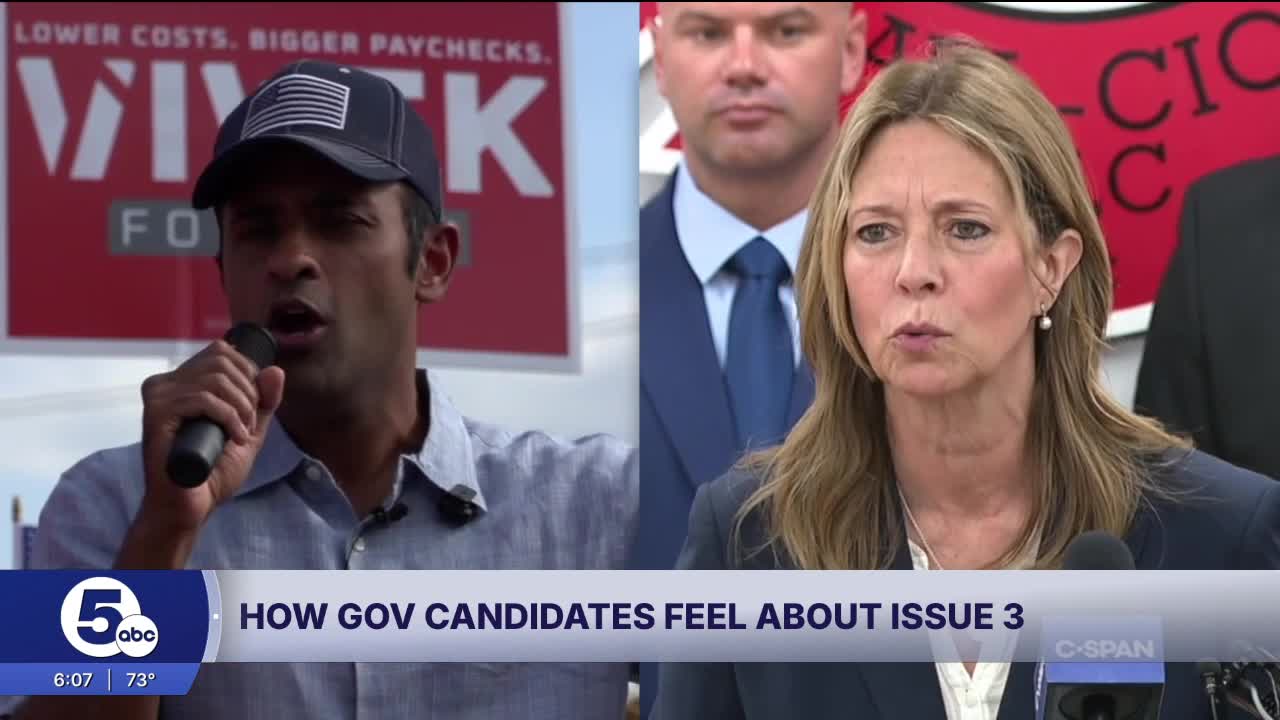



COLUMBUS, Ohio — Democratic candidate for Ohio governor Amy Acton is breaking with her party to support Issue 3, an amendment enshrining the state's voter photo identification requirement in the state constitution.
This could put some of her colleagues in a bind.
RELATED: What is Issue 3 on the Ohio ballot?
What is the current law?
Ohio requires that voters show photo ID when casting a ballot in person. Acceptable forms are a valid Ohio driver's license, a U.S. passport or a military ID. You may no longer use bank statements or utility bills.
The IDs must have an expiration date that has not passed, a photograph of the voter, and the voter’s name, which must substantially conform to the voter’s name as it appears in the Poll List or in the Poll Book.
Other acceptable forms of ID are a state of Ohio ID card, an interim ID form issued by the Ohio BMV, a U.S. passport card, an Ohio National Guard ID card and a U.S. Department of Veterans Affairs ID card.
To be clear, there is no evidence of widespread voter fraud in Ohio, even when photo ID laws weren't in place. Thousands of audits have proven that.
RELATED: Voter photo ID amendment on Nov. ballot in Ohio
Positions
Issue 3 asks voters whether they want to make it more difficult to change the current voter ID requirements.
"That's common sense," Vivek Ramaswamy, the Republican candidate for governor, said Friday.
A future General Assembly could reverse the law, unless it's in the Constitution.
"Number one is it actually says you need a photo ID to vote, but number two is it also builds up our public trust in the democratic process," Ramaswamy continued.
Voter ID is a popular policy, he said.
"There aren't that many issues anymore in politics, sadly, that bring nearly everybody across the aisle together," the Republican said.
But in the governor’s race, Issue 3 is.
"We have to make sure every Ohioan's voice is heard," Acton told me Friday.
She is breaking with her fellow Democrats, who accuse Issue 3 of being just a way to get GOP voters to turn out, since it doesn’t create any new policy.
"Do you support having a photo ID to vote?" I asked her in the morning.
"Yeah, I believe that we have to have a way to have voter ID, so I will support this," she responded.
After her comments to us, outlets reached out to clarify where she stood on Issue 3 versus just supporting voter ID.
“This amendment has overwhelming support from Ohioans across the state," Acton said. "As this doesn’t change what is already law, as governor, I will support it."
When speaking with me on Friday, she added that while voter ID is something Ohioans want, she is prioritizing easier access to the ballot for eligible voters.
"I'm a big believer, though, that part of this law was making sure that everyone had free, accessible, close by, and easy to do ability to vote," Acton said.
Her support does put Democrats in a bit of a bind, as the top of their ticket is supporting Issue 3, while all the lawmakers in the legislature voted against putting the question on the ballot, saying it was political gamesmanship.
"What you'll see that's a little different about me is everybody's going to get access," Acton said.
Democrats are arguing that Republicans will now be able to attack lawmakers for opposing Issue 3, using Acton to prove their point that this is a bipartisan idea. Several said they had no idea she was going to take this position, and they are now trying to figure out a strategy.
The Libertarian Party leaders are splitting from both Ramaswamy and Acton. Gubernatorial candidate Don Kissick and his running mate, James Mills, oppose Issue 3.
“My concern with taking what is already law in Ohio and forcing it into our constitution is the potential for unintended consequences, by giving the state a green light to pass ill-advised, restrictive laws we don’t really need,” Kissick said.
The team supports secure and transparent elections, but noted that Ohio already has voter identification requirements in law, and voter fraud is "exceedingly rare," they said.
"There is little evidence that it occurs at anything approaching a scale that would justify further constitutional restrictions on Ohio voters," the pair said.
This is a poorly thought-out solution looking for a problem, they continued.
"The Ohio Constitution should primarily serve as a restraint on government and a protection of the rights of Ohioans," they said. "It should not become a place where politicians constitutionalize existing statutes or create broader authority to address problems that the evidence shows are exceedingly rare."
Follow Statehouse and Columbus bureau reporter Morgan Trau on X, Instagram and Facebook. Email her at Morgan.Trau@wews.com.
