


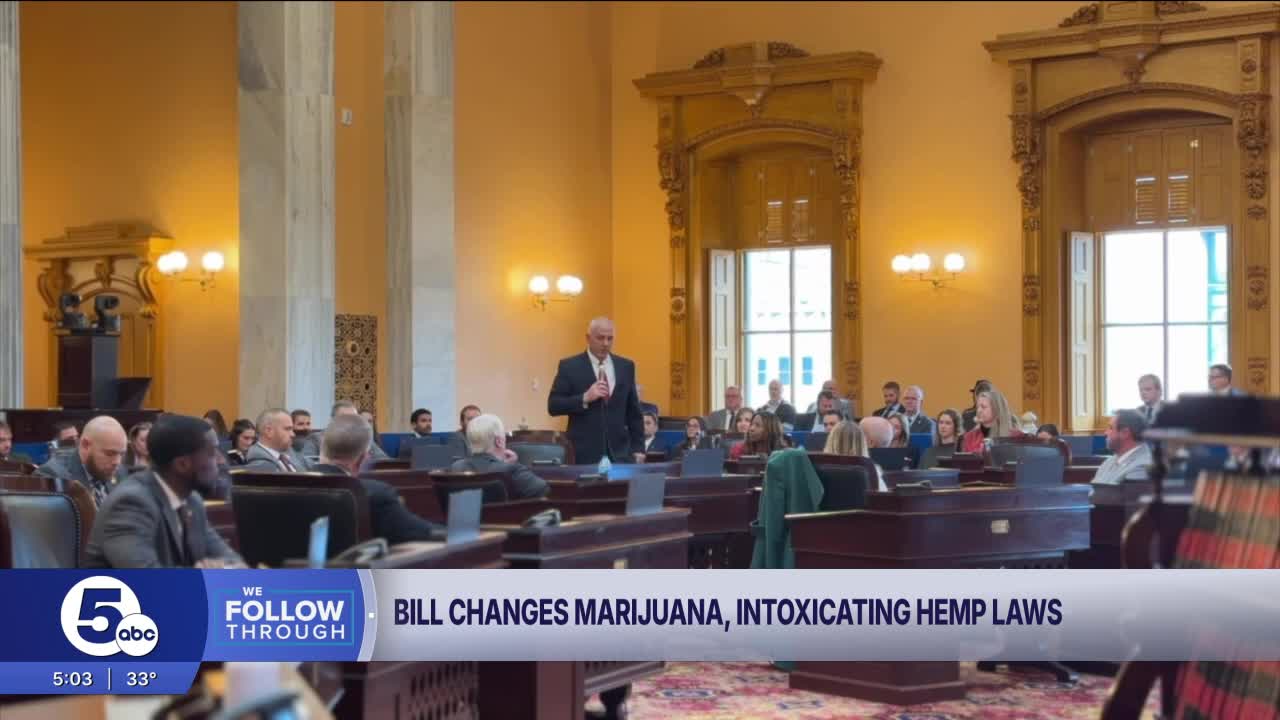


COLUMBUS, Ohio — Ohio lawmakers have sent a bill changing marijuana policy to Gov. Mike DeWine's desk, creating a slew of new criminal offenses, such as buying weed in Michigan to smoking in a public area.
It’s taken years, but finally, recreational marijuana policy is heading to the finish line. This was an effort by the Republicans to "make changes" to the legislation to make it "better," lawmakers have continued to say.
In November of 2023, 57% of Ohioans voted yes on Issue 2: the legalization of recreational cannabis.
"This bill leaves the crux of Issue 2 and marijuana access intact while providing for several important public safety concerns," state Sen. Steve Huffman (R-Tipp City) said about S.B. 56.
RELATED: Ohio lawmakers burn hemp, but protect marijuana policy
While Republicans like Huffman are happy about what they call a compromise — creating some restrictions but keeping the amount of marijuana you can have the same — Democrats call it:
“Bull****,” Senate Minority Leader Nickie Antonio (D-Lakewood) said.
Antonio is frustrated, and so is marijuana policy researcher Karen O’Keefe.
"It's a slap in the face to voters," O'Keefe said. "Voters overwhelmingly voted in Ohio to legalize cannabis, full stop, and this creates numerous exceptions where innocuous conduct would be re-criminalized."
I have been covering marijuana policy extensively for years, including a series answering viewer questions about cannabis.
"It instituted a public smoking ban... prohibits open marijuana containers and smoking in cars," Huffman said.
Also, it gives landlords the ability to prohibit smoking and vaping, bans outdoor venues from allowing marijuana and requires all products to be kept in the same package they were bought in.
"Imagine if you have a pill container where you track your dosage, because it's medicine — that would be a crime," O'Keefe said.
The open container law is one of the most worrisome, she added.
"If you have a baggie of edibles in the backseat of a Lyft or on a public bus — if it had ever been opened, you would be a criminal," she said.
It also makes it a crime to buy out-of-state cannabis. Federal law currently doesn't allow marijuana to go across state lines, but it isn't enforced. This would be an enforceable state provision preventing a citizen from going to Michigan, where the weed is cheaper, to buy.
"If you're a medical cannabis patient in the state to the North... you would be a criminal," O'Keefe said.
The legislation also removes protections against discrimination for housing, employment and even organ donation.
"In the voter-approved initiative, there was language to stop a person's life from being ruined for cannabis in a number of ways, in addition to the criminal offenses," O'Keefe said. "One of those was that a person couldn't be denied medical care, including organ transplants, just for being an adult-use cannabis consumer."
As well, Democrats argue that a provision would allow for police to have probable cause during traffic stops if someone is a "known consumer" of marijuana.
"What is your response to them saying that this is a recriminalization of marijuana?" I asked Senate President Rob McColley (R-Napoleon).
"I don’t really subscribe to that," McColley responded.
Enforcement of the new crimes, like having gummies in different packaging, won’t be a priority for law enforcement, the president said.
"There are a variety of provisions in this bill... It's not something that's going to be heavily penalized, but it's something that we need to make sure that [police] have the tools necessary in the event that they need to be able to enforce," he said.
This will just lead to selective enforcement, O'Keefe said, hurting marginalized communities that have historically been negatively impacted by drug convictions.
"If you're African American, you're far more likely to have a criminal record because of this kind of disproportionate enforcement," she said.
"So you think there will be more arrests due to this bill?" I asked her.
"I think so," O'Keefe replied. "In Minnesota, more than 3,500 people have been arrested under an open container law. I expect that we will see thousands more people arrested."
The bill now goes to Governor Mike DeWine, who says he will review it. But many marijuana supporters are hoping for a lawsuit.
Adding insult to injury, the lawmakers also took away Issue 2's funding for expungement.
"This has some very kind of milquetoast, weak expansion of expungement language, at the same time as it's pulling away all the funding," O'Keefe said.
This will cause an even bigger burden on people who voted to get their records clear, she added.
Still, the marijuana advocates fared much better in the legislature than the hemp industry. The bill completely banned the vast majority of "intoxicating" hemp — products with low-level THC that you can buy in gas stations and smoke shops.
Breweries and stores with liquor licenses will still be able to sell THC drinks until the federal ban on hemp goes into effect next year.
RELATED: Ohio lawmakers may compromise on marijuana, hemp policy but no changes to take effect soon
Follow WEWS statehouse reporter Morgan Trau on Twitter and Facebook.
