




COLUMBUS, Ohio — After national Democrats offered to help out with Ohio's expensive redistricting ballot fight in 2025, Republicans finally compromised. But there was never any money, just smoke and mirrors — and a plot that would only be revealed after Democrats won a majority of the races.
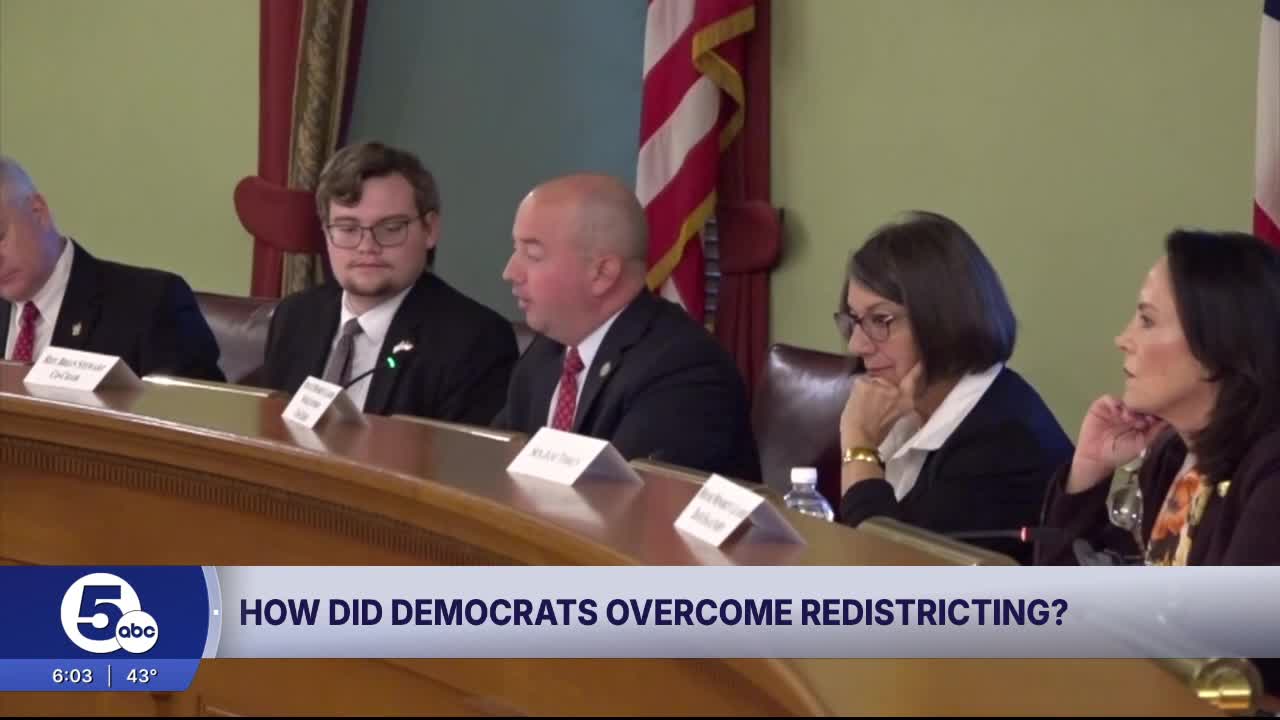
The Ohio Redistricting Commission, made up of five Republicans and two Democrats, passed a new congressional map in 2025.
"It was actually designed for it to be a Republican seat, but candidate quality matters," U.S. Rep. Emilia Sykes (D-13) told me Thursday.
Republicans had started eyeing her seat years before, wanting to flip the already red-leaning district.
"The days are numbered for Emilia Sykes," U.S. Senator Bernie Moreno said in 2025.
It produced new House lines that were expected to make several seats more conservative. The Republicans targeted Toledo’s Marcy Kaptur, Cincinnati's Greg Landsman and Sykes.
"Republicans in power really wanted to keep power without earning it, and they use the gerrymandering in order to do so," Sykes continued.
But all five incumbents won, and against all odds — Democrats flipped three more.
Embattled Cleveland Rep. Max Miller (R-7) lost to ironworker Brian Poindexter, Dayton’s Mike Turner (R-10) lost to cancer nurse Kristina Knickerbocker and Columbus’ Mike Carey (R-15) lost to professor Don Leonard.
"To every American disappointed by tonight's results, I mean, I'm disappointed too," U.S. House Speaker Mike Johnson, a Louisiana Republican, said on election night.
But much of it comes back to state Senate Minority Leader Nickie Antonio (D-Lakewood), who sat on the Republican-controlled line-drawing panel.
She had a plan.
"I knew that the path for the Democrats in every single one of those districts that we agreed to was possible," Antonio said in an exclusive interview Friday.
She and House Minority Leader Dani Isaacsohn (D-Cincinnati) voted alongside Republicans on a map, angering the progressive base. If they hadn’t agreed, Ohioans could have voted to repeal it.
For months, the pair were criticized in person and online.
RELATED: Despite redistricting, Ohio Democrats eager to flip congressional seats
But Antonio had a trick up her sleeve.
For the first time, she revealed that in a phone call with U.S. House Minority Leader Hakeem Jeffries, he told her that he wouldn't help with an expensive referendum effort.
"Leader Jeffries let me know that the cavalry was not going to be coming, that Ohio was considered a red state," she said. "But he said what he would do is talk to some people and at least do a public effort that showed that he was trying to maybe raise some money for a potential referendum."
"Enough to scare the Republicans," I replied.
"Thank you, yes," Antonio responded. "I knew that it could help us in going back into negotiations with the Republicans."
Soon after the call, news articles popped up saying Jeffries was committed to "fundraising" for a referendum effort.
House Finance Chair Brian Stewart (R-Ashville), who was on the committee, and other Republican leaders acknowledged how they wanted to avoid a referendum battle.
"Now you have an ability for all of the members of Congress to know who they represent..." Stewart said. "I think having that finality and not having a referendum, frankly, I think is good for both parties."
Antonio's plot worked. The Republicans came back with a revised map, once the "word" was out. Each side ended up calling it a compromise.
"The fact that there are 12 districts in which Republicans have a very good opportunity to be successful is something that our caucus is pleased about," Stewart said.
But Antonio saw a clear path to winning six seats. She said with the help of her map drawers, they knew where "potential Democrats and independents" were in and around those districts.
"The other two, I have to say, were a surprise," Antonio confessed about Turner and Carey's districts.
In the months since the map passed, Isaacsohn has been cheering their bipartisan process.
"I think the thing that we've been experiencing as a country, that a lot of elected officials and leaders have been experiencing is this sense from some people, truly on either side of the political spectrum, around the idea of 'We don't negotiate with the other party; there is something inherently wrong with compromising or negotiating with people with whom we so fundamentally disagree...'" Isaacsohn said. "We refused to be blinded by extreme ideology."
Not only does Ohio have a majority Democratic delegation for the first time in nearly two decades, but their three seat flips helped take control of the U.S. House.
As of Friday, Democrats are projected to flip more than 40 seats, including in Republican strongholds like Texas, Iowa and Indiana.
It wasn’t just the map that helped; Sykes said it was the political climate.
"People voted us in because they wanted us to help lower their costs, particularly around health care and goods, get rid of the tariffs and the war in Iran," Sykes said.
Antonio knows the national wave carried the Democrats to victory, but she doesn't believe that the initially proposed 13-2 and 12-3 Republican maps would have gotten as many Democratic wins.
Some activists still say that the Democrats won in spite of the map, not because of it. Antonio disagreed.
"I definitely, personally, feel vindicated," the Democrat said. "I knew that map had potential. I got to say... I have gotten a lot of calls and a lot of texts from people who have been telling me I was right."
Democrats originally offered an 8-7 Republican map. Ironically, it ended up being 8-7 Democratic, Antonio said.
Follow Statehouse and Columbus bureau reporter Morgan Trau on X, Instagram and Facebook. Email her at Morgan.Trau@wews.com.
