





COLUMBUS, Ohio — A leaked Ohio bill could allow data centers to qualify as "public utilities," giving them the ability to seize private property.
Ohioans rejected data centers on every ballot measure this election, but after that massive loss, Republican lawmakers may be moving to allow tech hubs one way or another.
For decades, Gretchan Francis has been fighting to keep her multigenerational family farm.
"It's not the farm that it once was," Francis said in an interview. "It's only 60 acres; it's not 160 acres."
Using eminent domain law, which allows the government to take property for public use, the state has seized her land numerous times for highway development.
"I understand that it is necessary, but I think it has to be done in the right way," she said.
While ODOT has always been able to do this, farmers like her are fearing that new legislation would take their livelihoods for a controversial cause.
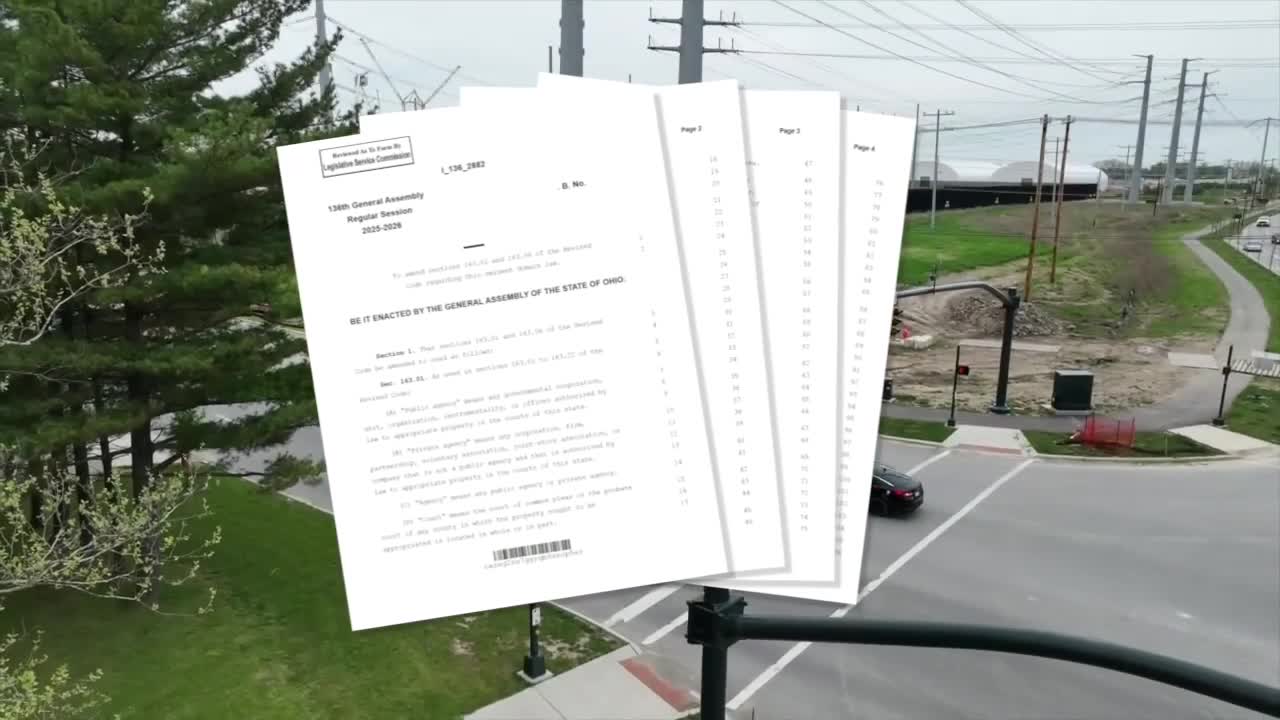
A draft bill leaked to us exclusively would expand the list of who qualifies to take land. The draft changes the definition of "public utility," from just an entity being owned or operated by municipal corporations, an electric cooperative and an agency holding a certificate of public convenience and necessity granted by the Federal Energy Regulatory Commission.
The legislation adds "and an agency holding a certificate of environmental compatibility and public need from the power siting board for constructing an electric transmission line and associated facilities or gas pipeline and its associated facilities."
This could mean a transmission developer may be able to seize land to power or place a data center, according to legal experts.
"That would be devastating," Francis said. "I think anybody would feel the same way if their personal land was taken for a data center. That sounds like it's a corporate, private, for-profit type of need, not for a public need."
In June, we discovered that the Ohio Business Roundtable, a powerful trade group that lobbies at the Statehouse, recommended that lawmakers change eminent domain law, and “should extend possession authority to energy infrastructure projects once public use and necessity have been established.”
RELATED: Ohio farmers fear new proposal would allow data centers to take property
The Ohio Farm Bureau, which is adamantly against changing eminent domain, had been preparing for this fight since.
"We are aware of efforts to further erode the limited protections that landowners have, allowing for quick take of property without first paying for the property and determining a landowner’s rights and compensation through a court of law," the Bureau’s Evan Callicoat said.
The Farm Bureau isn't opposed to data centers, but they are opposed to a violation of property rights, Callicoat said. He feared that with this proposed idea, it's broad enough that farmers could lose their land to data centers, not getting paid for it for months or years.
The Roundtable calls the program "deposit and build," and it's modeled after a system that 45 other states use.
"This recommendation is about making sure that Ohio's grid is reliable and affordable for Ohioans and that economic development can continue in the state," the Roundtable's Alexandra Denney said in an interview Monday.
The Ohio Power Siting Board controls the installation of utility facilities, including power lines, some gas pipelines, and wind farms. The Public Utilities Commission of Ohio can also help utility companies acquire land.
A utility will approach a homeowner for land and must provide them with a "fair" market price. If the owner refuses to sell, the utility company will take them to court and will need to determine "necessity" for the land. If a court sides with the utility company, deeming it necessary to take, the appraised value of the land is given to a court account. However, the owner can appeal this decision to fight for more money. While this court battle is going on, construction is not allowed to begin.
The draft bill changes the appraisal process, making it easier to seize land immediately.
"Ratepayers and Ohioans are paying the price because it's driving up costs and it's also delaying the critical infrastructure that we need to have a reliable grid," Denney said about construction delays.
While Denney was aware of the appraisal portion of the legislation, she categorically denied any changes to eminent domain. After I read the bill out loud, she said she would need to "look at" the changes in the definition of public utilities.
She said that Ohioans choosing to restrict or ban data centers in 21 different cities has nothing to do with the timing of this proposal.
"That is not the intent of the Ohio Business Roundtable to expand the ability to use eminent domain to anybody that doesn't already have that ability," Denney said.
Soon-to-be Senate President Republican Bill Reineke (R-Tiffin), who is working on the bill, echoed her sentiment.
“We keep talking about lowering costs, and one way we can do that is expanding infrastructure for public utilities to keep rates down. That’s what this is about," Reineke said in a statement. "It’s important to me that landowners keep their rights, and this would not extend eminent domain to anyone who doesn’t already have that privilege — rather, it is a framework to simplify our existing process that would put us in line with 45 other states."
He added that one of his top focuses was to make sure there was enough energy and lower costs.
But the legislation does specifically change who is considered a public utility, both for electrical transmission and for gas. Even without being a private electric transmitter who applies for a certificate, Francis believes it is feasible that a utility company can help take land in order to power a data center.
For farmers, they want Ohioans to know that this won't just impact their land, but anyone else's. Plus, Francis said, no economic development proposal is worth losing memories.
"It's very important," the farmer said, choking up. "I want my kids to know where they came from. It's hard to describe when you have roots not just to a family, but to a place."
The farming community plans to start calling their lawmakers to demand that they stop the bill.
Follow Statehouse and Columbus bureau reporter Morgan Trau on X, Instagram and Facebook. Email her at Morgan.Trau@wews.com.
