





COLUMBUS, Ohio — An Ohio Republican is proposing raising the sports betting tax to fund public stadiums and K-12 education.
"I have no apologies that I was going to the track and betting on horses when I was 5 years old, or that I had a bookie when I was 7 or 8," state Sen. Bill DeMora (D-Columbus) said.
For some, like DeMora, gambling starts early. And he doesn’t like it when people mess with his vice.
"You want the most bang for your buck," the senator said.
But he fears the state will take an even bigger cut of his winnings.
"If you have more taxes on it, you're gonna get less payout," he said.
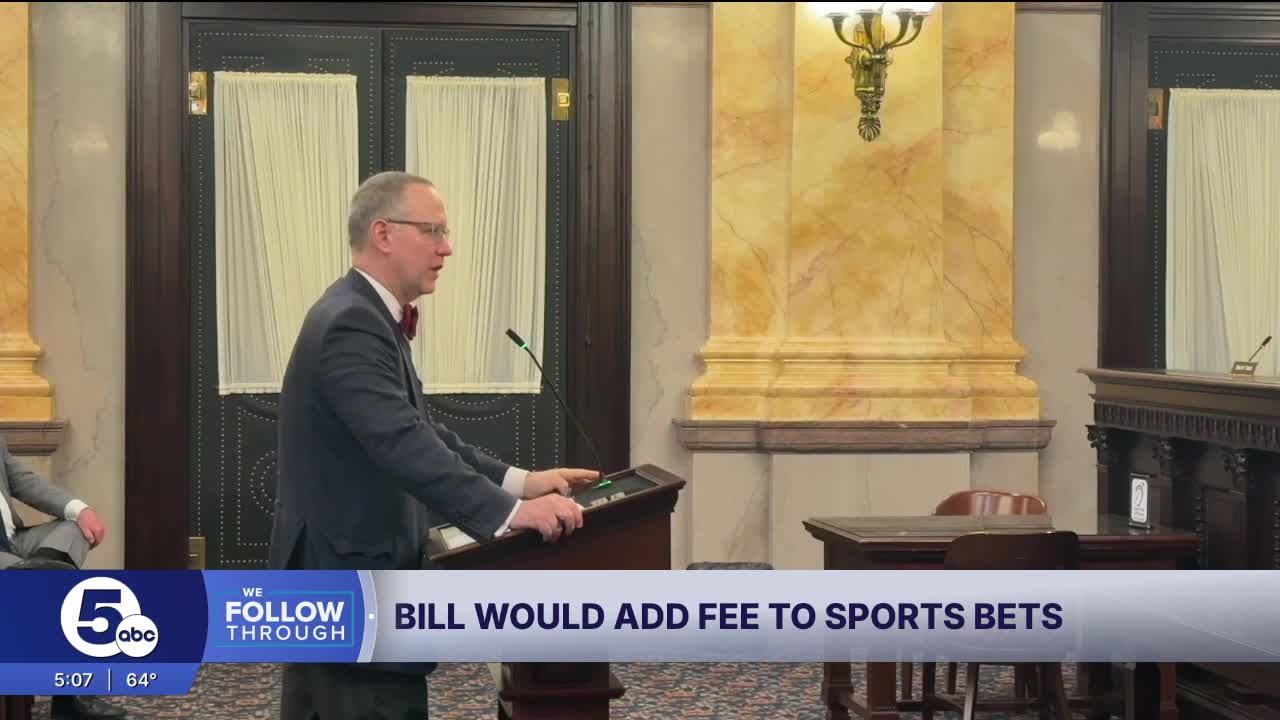
State Sen. Bill Blessing (R-Colerain Township) has proposed S.B. 199, a bill that would put a 2% fee on sports wagers. Ohio would use that revenue to fund public sports stadiums and K-12 education.
The legislation was originally introduced in 2025, when Blessing and Gov. Mike DeWine were attempting to find ways around funding the Cleveland Browns stadium that the legislative leaders were intent on supporting. Thus, this is a bill that is similar to DeWine's plan from last budget season.
This could be incredible cost savings, Blessing said. He added that, combined with the governor’s tobacco tax in the budget, a severance tax instituting a 25% excise tax on Kratom, as well as increasing the marijuana excise tax to 15%, Ohio would generate $1.5 billion per fiscal year.
"If we really do put school funding to bed for the foreseeable future — it's a public good," Blessing said in an interview Tuesday. "And again, people forget that school funding is, in fact, property tax relief."
The 2% fee is in addition to Ohio’s existing 20% tax on sports gaming receipts. This could raise an additional $200 million per fiscal year, Blessing said.
"You raise revenue at the same time that you're discouraging bad behavior," he said.
While Blessing was testifying, DeMora was skeptical of how much revenue this would actually bring in.
"Everybody assumes that when you tax more, you're going to get more revenue from it," the Democrat said. "But other studies show that the more the tax, the less likely you are to do these forms of gambling."
Blessing said that DeMora doesn’t need to worry, since the sportsbooks will be the ones paying the tax.
"What is to stop the sportsbooks from putting this 2% tax back onto the payees, back onto the sports bettors?" I asked Blessing.
"Well, if DraftKings and FanDuel are going against each other, they can't just pass everything on to the bettor," he responded. "To some degree, they have to eat that through lower profits because DraftKings [can say], 'Well, we can eat a little bit more of this to outcompete you guys.'"
We reached out to the leading sportsbooks, but none provided a comment. However, they may not need to worry. Select Committee on Gaming Chair Nathan Manning (R-North Ridgeville) said it likely wouldn't move out of committee, as it may be a "better conversation" for next year's budget.
"I don't think raising taxes necessarily brings in more revenue all the time," Manning said. "I think that could do more harm than good."
Although DeWine has been supportive of finding innovative ways to avoid using public dollars to pay for a billionaire's new stadium, his team says he is newly reviewing the bill. He did, however, catch a stray from DeMora.
"Why are we just taxing gambling because some people don't like it, including the governor, who doesn't like anything fun," the Democrat said.
DeWine's team declined to respond to that remark.
The governor is opposed to gambling, marijuana, intoxicating hemp and tobacco — and has pushed for restrictions on all.
Betting on gambling bills
This is the latest gaming bill to make waves in the Statehouse.
Last week, a group of House Republicans introduced two bills that would overhaul the state's sports gaming industry: banning online gambling, prohibiting wagers on college athletics, and restricting bet types.
RELATED: Ohio GOP lawmakers move to ban online sports gambling, betting on college athletics
The first bill, according to the lawmakers, bans in-game, parlay and prop bets, as well as wagers on all college athletics.
The second bans online gaming. It would prohibit the use of credit cards to make bets. It also limits bets to $100 and only allows up to eight wagers per 24 hours. It stops financial lures, which are deals that sportsbooks can offer to get a bettor to sign up, and bans ads during a live broadcast of an event.
These proposals received mass backlash online, which Manning noted to me.
NOW: Ohio Republican lawmakers are introducing two different bills to overhaul the sports gaming/gambling system:
— Morgan Trau (@MorganTrau) April 8, 2026
- No online bets
- Ban on in-game, prop and parlay bets
- Limits wagers to $100
- No ads during games
- No using credit cards to bet
@WEWS @WCPO @OhioCapJournal pic.twitter.com/HwGbqnR89a
"I saw your tweet about that has gotten a lot of traction — both probably good and bad... I understand where they're coming from. I think it's a little short-sighted and would do more harm than good."
Blessing, Manning and DeMora were not fans of either of these bills. One of the House bill sponsors, state Rep. Gary Click (R-Vickery), was equally not interested in raising sports betting taxes.
Follow WEWS statehouse reporter Morgan Trau on Twitter and Facebook.
