


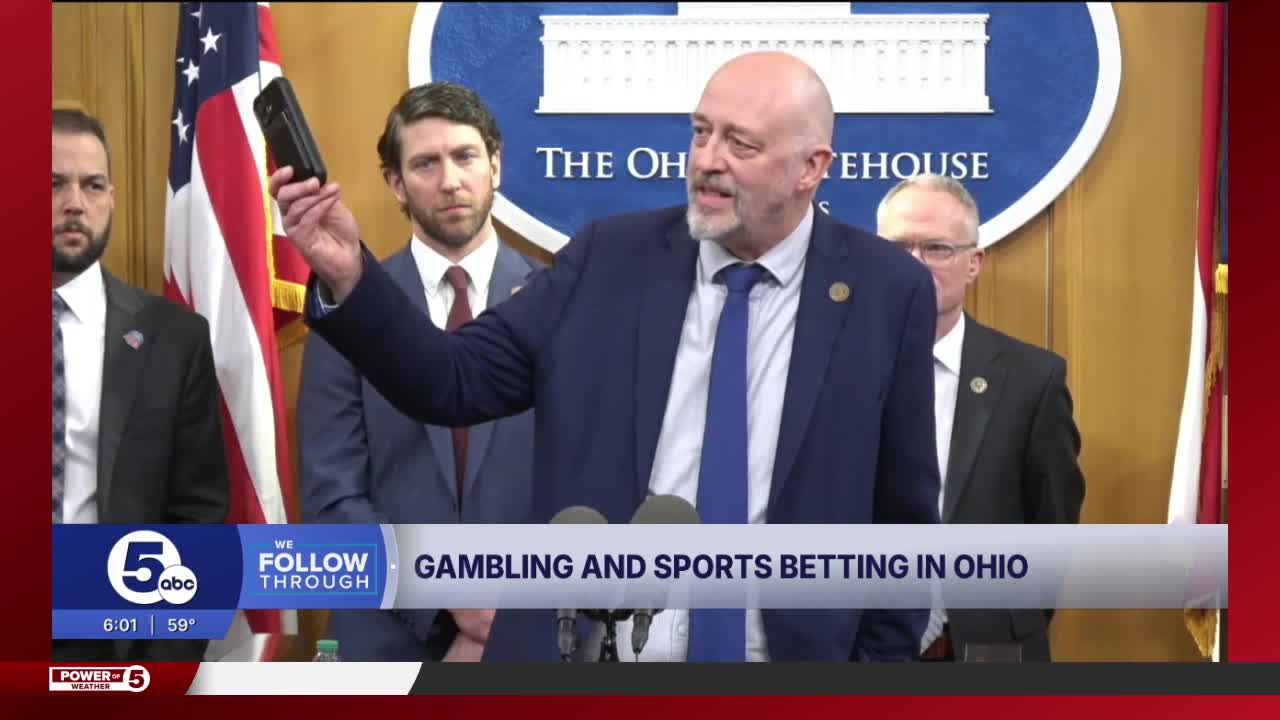



COLUMBUS, Ohio — A group of Ohio Republican lawmakers has introduced two bills that would overhaul the state's sports gaming industry: banning online gambling, prohibiting wagers on college athletics and restricting types of bets.
A slow pitch may just be a bad throw, but sometimes it's planned.
"Can you imagine the pitcher on the mound controlling the game to win bets?" state Rep. Johnathan Newman (R-Troy) said during a press conference Wednesday afternoon.
Ohioans don’t need to imagine it. Guardians pitchers Luis Ortiz and Emmanuel Clase pleaded not guilty to taking bribes and pitch-rigging to help bettors.
That and a state report showing an increase in gambling addictions helped to kickstart legislation overhauling the sports gambling system.
"We were going to put some common sense consumer protections in place to protect Ohio citizens," state Rep. Gary Click (R-Vickery) said.
Click, Newman, state Reps. Riordan McClain (R-Upper Sandusky) and Kevin Ritter (R-Marietta) have introduced two bills dedicated to sports integrity. Neither of the bills was available to read through independently.
The first, according to the lawmakers, bans in-game, parlay and prop bets and bans wagers on all college athletics.
"When you combine the addiction of gambling with the addiction of one of these devices," Click said, holding up a cell phone. "It's synergistic in a bad way."
The second prohibits the use of credit cards to make bets. It also limits bets to $100 and only allows up to eight wagers per 24 hours. It stops financial lures, which are deals that sportsbooks can offer to get a bettor to sign up, and bans ads during a live broadcast of an event.
The biggest change of all: it bans online sports gambling. This is the method of choice for many gamblers we've spoken to for years.
"I just use my phone," said Scott, a sports bettor. "It's a convenience factor for me, so instead of going somewhere, you just do it from the comfort of your own home."
The lawmakers said that the bill would not apply to Kalshi or Polymarket, just straight sportsbooks.
Backlash came swiftly online after we posted about the idea. There are hundreds of angry, profanity-laden replies, slamming the lawmakers for government overreach.
NOW: Ohio Republican lawmakers are introducing two different bills to overhaul the sports gaming/gambling system:
— Morgan Trau (@MorganTrau) April 8, 2026
- No online bets
- Ban on in-game, prop and parlay bets
- Limits wagers to $100
- No ads during games
- No using credit cards to bet
@WEWS @WCPO @OhioCapJournal pic.twitter.com/HwGbqnR89a
"Big government telling us how to live! Again. What happened to conservatives?" one X user wrote.
One user even made a mock flag saying "COME AND TAKE IT" under the sportsbook's logo.
Some of the replies say that some of the provisions were alright.
"No ads during games is fine. No online bets is probably for the best. 100 max is insane. No parlays or props is also insane," a user wrote.
The minority of responders said that this was a good thing.
"Awesome stuff. We need this in all 50 states immediately. Online gambling is an epidemic," a user said.
Others online noted how addiction is hurting families.
"We are financing mental health issues here in Ohio, and everyone talks about, 'Well, it's going to be a tax benefit,' but not really when we're creating mental health issues for our friends and for our neighbors," Click said.
RELATED: Michigan woman issues warning to Ohio after losing $2 million in 6 months from internet gambling
Tamera Hunter at Townhall II, the Kent-based behavioral health organization that helps those with mental health and addiction conditions, said that the prevalence of online gaming is having a direct impact on people's health.
"Gambling addiction has severely escalated since then," she said. "We’re definitely seeing through our screening an increase of 25%-30% since online sports betting has gone live."
The industry is booming in the state, bringing in record profits in 2025.
The lawmakers know how popular online betting is, and admit they are facing an uphill battle. McClain shared that he has received mixed results from his GOP colleagues, and even the very anti-gambling Gov. Mike DeWine disagrees with portions.
Another challenge the lawmakers would face is how this would be enforced, as banning an online system is legally challenging. The lawmakers have struggled to implement legislation restricting pornography and social media.
"We can set the standard for what's in here in Ohio, what Ohioans should have access to, and we hope that has an effect, obviously, on the broader picture," McClain said.
The lawmakers looked to Aaron Baer, a conservative lobbyist and executive director of the Center for Christian Virtue, for questions about the details inside the bill.
"The people are in charge, and they put in place some incredible leaders in the Ohio General Assembly who care about the future of our state, who care about exploitation, who care about children and just being able to enjoy a football game and not wondering, 'Is this rigged too?'" Baer said.
DeWine has said that if he could go back in time, he would not sign the bill that legalized sports betting.
Just a year after placing wagers on games became legal in 2023, the Ohio Casino Control Commission removed prop bets on college sports from the list of legal wagers. DeWine had pushed for this after there were threats against the University of Dayton basketball team players.
When the investigation began into Ortiz and Clase, DeWine began pushing for MLB and other sports leagues to take action. Last fall, the MLB and gaming companies agreed to restrict some micro-prop bets.
While these new bills look to clamp down on online gambling, there's also been a push to expand it.
Legislation being considered in the Statehouse would have brought iGaming — virtual slot machines and virtual table games online.
Those for it argue it would bring in more than $600 million in new tax revenue to the state, and nearly every state around us already has it. Some of those against it worry about fueling addiction and killing brick-and-mortar casinos and racinos.
IGaming expansion had been stalled.
Moving forward
There is some appetite to regulate the market from DeWine and legislative leaders. Not allowing credit card payments and regulating ads seem like the most feasible, according to other lawmakers not involved with the bills.
But ending online gaming altogether? I wouldn't bet on that.
Follow WEWS statehouse reporter Morgan Trau on Twitter and Facebook.
