




COLUMBUS, Ohio — Ohio has seen its fair share of major public corruption scandals over the past decade. The candidates to lead the state are weighing in on how to increase accountability.
While some politicians have spent years in prison for corrupt behavior, the laws that helped them pull off their schemes have remained the same.
In March of 2023, a federal jury found that former Ohio House Speaker Larry Householder and former GOP leader Matt Borges, beyond a reasonable doubt, participated in a racketeering scheme that has now left four men guilty and two dead by suicide. Householder is three years into his 20-year prison sentence for accepting the bribe from FirstEnergy, while Borges is out after serving half of his five-year sentence.
The trial involving two former FirstEnergy executives ended in a hung jury, but they are set to be retried.
WATCH:
RELATED: FirstEnergy corruption case ends with hung jury
Other notable recent scandals include the Electronic Classroom of Tomorrow scam and the attempted "hostile takeover" of the retired teachers' pension fund (STRS). ECOT was a publicly funded online charter school that was found to have inflated attendance numbers. The STRS scandal involved a startup investment firm that a judge found colluded with State Teachers Retirement System members to take $65 billion.
These types of scandals aren't acceptable for some political candidates.
Democrat Dr. Amy Acton
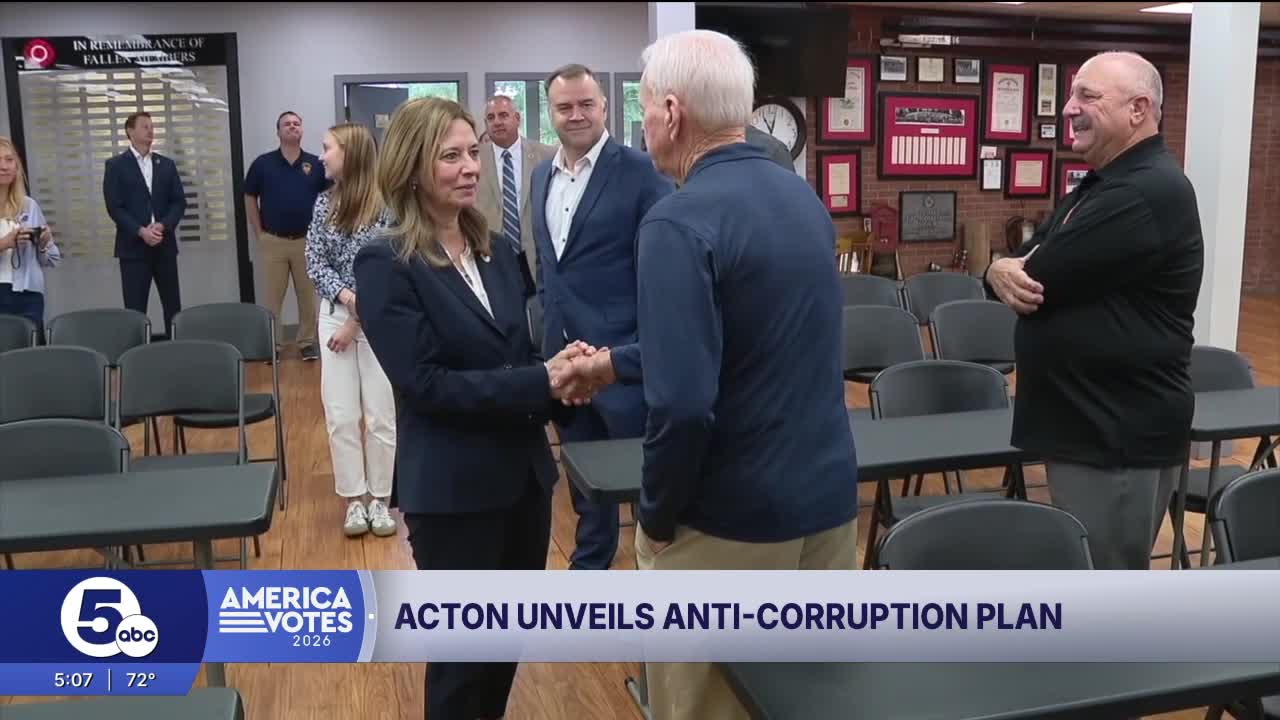
Democratic candidate for governor Dr. Amy Acton wants to provide accountability at the Ohio Statehouse by creating an anti-corruption task force. The group would hear from the public, conduct audits and make recommendations to fight waste, fraud and abuse, she said in an announcement in mid-August.
"We're going to stop this revolving door because some of our biggest scandals have to do with folks revolving in and out of industry getting paid and then coming in and regulating," Acton said.
She also wants a "top to bottom review" of JobsOhio, the state’s nonprofit economic development agency. Its operation is largely shielded from the state's open records law. Recent reporting has shown JobsOhio helped make open-ended deals, giving tech giants huge tax breaks for data centers.
"Our state houses are where a lot of these special interests' playbooks are being shoved," Acton said.
She is also pushing for greater transparency in state campaign finance laws, pointing to the $61 million FirstEnergy used to bribe public officials.
"One of the reasons, amongst the many, that our electric bills have gone up or did for quite a while," the Democrat said.
Her policies would prohibit lobbyists, lawyers and consultants who have represented, been employed by or received compensation from any organizations regulated by any Ohio regulatory entity in the past three years from then serving on the same regulatory entity. There would also be additional conflict of interest and ethics laws to make sure there is a recusal process.
She also wants to require state contractors and advocacy organizations that spend on political campaigns to publicly disclose their donors.
She would also require further disclosure from state contractors and vendors, mandating that any company bidding on contracts above $50,000 disclose beneficial ownership, shareholders with 10% or more equity, and political contributions.
But Republicans aren’t enthused by her plans.
Republican Vivek Ramaswamy
Republican candidate Vivek Ramaswamy’s team said her proposal was a "joke."
“Talk about the pot calling the kettle black: Amy Acton blasting waste, fraud and abuse in the very government system she comes from, while dark-money groups she pretends to denounce are spending millions to prop up her campaign," Ramaswamy's spokesperson Evan Machan said. "What a joke.”
Both Acton and Ramaswamy take millions of dollars from special interest groups, but it makes up only a minority of their donations.
Acton has raised $22 million for her race, according to campaign finance reports. Her latest filing report shows political action committees, which don’t need to disclose donors, spent nearly $550,000 for her.
Democrats point out that Ramaswamy has raised more than $50 million, half coming from himself. They add that of the $4 million from his latest filing, $230,000 comes from PACs.
"Her vision is not a winning one for Ohio," Ohio Republican Party Chair Alex Triantafilou said in an interview Monday.
Triantafilou doesn't think voters actually care about these types of corruption reforms.
"That's going back years and years ago to one scandal where people did go to prison, and it's ancient history really, for what Ohioans care about into the future," he said.
While Ramaswamy has not laid out a full plan to tackle political corruption, he has talked about getting rid of what he calls bureaucratic bloat—so more money goes back into Ohioans' pockets. The GOP has talked extensively about stopping Medicaid fraud, an issue Republican Gov. Mike DeWine said is not widespread.
"[Ramaswamy] is going to bring an outsider's perspective and a common-sense business perspective to government," Triantafilou said.
Libertarian Don Kissick
Libertarian Don Kissick and running mate James Mills said Ohio doesn’t need another entity to show that corruption exists.
Like Acton, they want more transparency, enforcement, and consequences when public officials violate trust.
"We want a publicly searchable database showing state contracts, lobbying activity, major government expenditures and incentives, and who is meeting with whom," Mills said on Monday. "If taxpayer dollars or public policy are involved, Ohioans should be able to follow the money."
The pair hopes to strengthen Ohio’s Sunshine Laws, also known as open record laws.
"Government should operate with transparency as the default, not something citizens have to demand after the fact," Mills said.
They also want to end the "routine" use of non-disclosure agreements by public officials when conducting the public’s business. This has come to a head as local governments have been signing NDAs with tech companies when agreeing on details for controversial data centers.
"Officials should be required to disclose meaningful financial or personal conflicts of interest before participating in decisions, particularly when contracts, subsidies, appointments or regulatory decisions are involved," Mills said; however, this already exists in state ethics laws.
"After scandals like H.B. 6, Ohioans have every reason to be skeptical of a system where money, lobbying and government decisions can intersect behind closed doors," the Libertarian said.
Any major anti-corruption proposal would need approval from the GOP-controlled General Assembly.
Follow Statehouse and Columbus bureau reporter Morgan Trau on X, Instagram and Facebook. Email her at Morgan.Trau@wews.com.
