


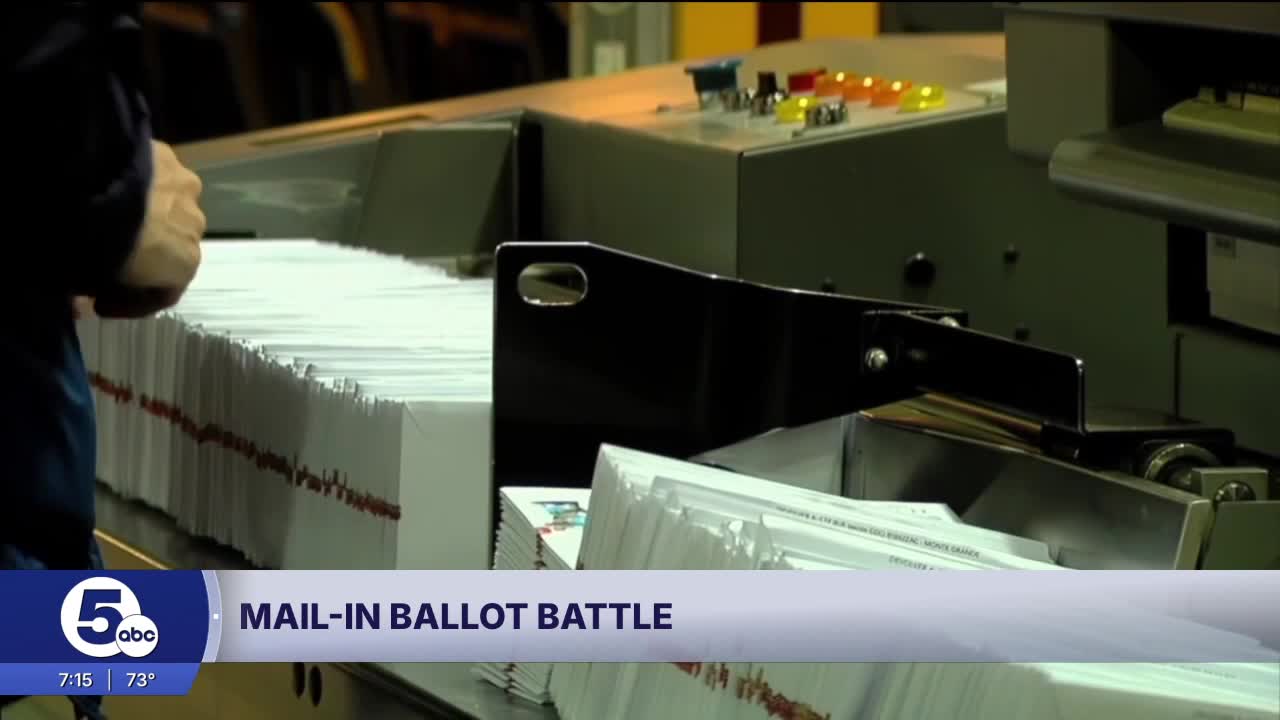



COLUMBUS, Ohio — Ohio's county election officials are warning against President Donald Trump's proposed changes to mail-in ballot procedures, saying the restrictions could delay access, increase costs and add significant stress to already busy workers.
Officials are working around the clock, getting ready for the November midterm election.
"We're anticipating a 60% turnout for this fall," Lake County Board of Elections Director Dante Lewis said.
But now, leaders like Lewis are also racing against the clock.
"If we don't have clear-cut guidance on something and we're uncertain, it could really put us in a difficult position," he said.
Trump is trying to enforce his executive order on mail-in ballots, one that allows the federal government to compile citizenship lists for voters in each state and would then require the U.S. Postal Service to only deliver and collect ballots from people on that list.
The Supreme Court allowed it to move forward Monday. By Thursday, the post office started implementing the order. That same day, a federal judge in Massachusetts blocked the new procedures.
RELATED: How Trump's Supreme Court win impacts Ohio voters
"It's getting eerily close to being too late for us to make drastic changes for this election cycle," said Aaron Ockerman, executive director of the Ohio Association of Elections Officials (OAEO).
The association is made up of all members of Ohio’s 88 county boards of elections, from urban centers serving nearly 900,000 voters to the smallest with less than 10,000. Rural areas, ones that rely heavily on mail-in voting, could be negatively impacted the most, Ockerman said.
"Those small counties, I think, disproportionately feel that impact because there's really no one for them to throw these new tasks onto," he said.
We reached out to the USPS, but didn’t hear back.
Case Western Reserve University elections law professor Atiba Ellis expects another round of fast rulings, as the administration is appealing the block, he said.
"The ultimate question is whether the postal service or whether the federal government has the power to intervene into states using the mail to administer elections," Ellis said.
For Ohio’s election officials, who work in a bipartisan fashion, every day without guidelines is another day of uncertainty — and expenses.
The Defiance County BOE, with 20,000 registered voters, only has two full-time employees; they said this policy would make mail go slower.
"In a larger county, that might be absorbed by bigger teams or automated tracking systems. For us, it usually means extending office hours, reallocating staff, and doing more hands‑on monitoring of ballot movement," Defiance County BOE Director Tonya Wichman said. "We must stay on top of every piece of mail because Ohio’s deadlines don’t change just because national policies do."
Luckily, Wichman said, her USPS team in the Northwest Ohio rural county is a great partner.
"At the end of the day, small boards of elections rely heavily on consistent mail flow," she said. "When that consistency changes — whether from USPS operational decisions or federal directives — we feel it right away. We adjust, we communicate and we make sure voters aren’t caught off guard. But there’s no question that even small national‑level changes can create big challenges for small counties."
But even for Lake County, which has more than 160,000 voters, there will be a ripple effect.
"In a way, you're in limbo when it comes to this executive order, and it's less than 70 days until the election," I said to Lewis.
"Essentially, we are," he responded. "We have to implement new procedures going forward in an expedited manner, and we could potentially have to replace our current supplies: voter literature, return envelopes, outgoing envelopes, ID envelopes."
The Trump administration should "listen" to the local associations of elections officials, he added.
"Those are the people that are actually in the trenches doing the work," he said. "They see it firsthand, dealing with voters. They see all the checks and balances and all the transparency already in place."
Mail-in voting is and always has been safe in Ohio. There is no evidence of widespread voter fraud, as proven by the many audits done by the state and counties.
I asked Ockerman if he felt frustrated that policies were being potentially changed when there was no legitimate basis.
"I would just say that the closer we get to Election Day, the tougher those policies are for us to implement — regardless of the intentions behind them or the validity behind them," Ockerman replied.
His final message to voters?
"Stay informed. Go to the Secretary of State's website, go to your county Board of Elections website, call your board of elections if that's your preferred method of communication, but stay informed," Ockerman said. "Read Morgan Trau's news reports every day to stay informed as a voter so that you know what your rights and your responsibilities are as we head into this very important election."
He added that Ohio has always risen to the occasion, and there is no doubt that regardless of the judicial outcome, the state will have a safe and secure election — as it always does.
"As always, Ohio remains the gold standard of elections because we’ve made preparation and readiness a priority, so we’ve been monitoring this issue for several months and developing plans for how to comply," the secretary of state's spokesperson Dan Lusheck said. "We’ll be ready for whatever is ultimately decided.”
Follow Statehouse and Columbus bureau reporter Morgan Trau on X, Instagram and Facebook. Email her at Morgan.Trau@wews.com.
