




CLEVELAND — Ohio is once again drawing national attention as the November election approaches, with the state's two marquee races — governor and U.S. Senate — now rated as toss-ups.
For years, Ohio held bellwether status in presidential elections because its voters' views represented the nation as a whole. About a decade ago, however, that pendulum shifted Republican and has largely stayed there. Now, as early voting is set to begin in less than a week, something has changed.
In the race for governor, the RealClearPolitics average of the five most recent polls shows Democrat Amy Acton leading Republican Vivek Ramaswamy by 3 points. In the U.S. Senate race, the average of the last eight polls shows former Democratic Sen. Sherrod Brown ahead of Republican Sen. Jon Husted by better than 3 points.
Polls, even averages of them, are snapshots — not predictions of the final outcome. In 2024, President Trump and Bernie Moreno both outperformed their polling averages in Ohio by about 2 points.
Still, independent tracking outlets like the Cook Political Report have placed the Ohio Senate race in their toss-up category, part of a broader picture showing likely Democratic gains.
"The House has been kind of a done deal for a good while but the Senate a year ago, it wasn't realistic to think that the Senate might flip but now it's very realistic," said founder Charlie Cook.
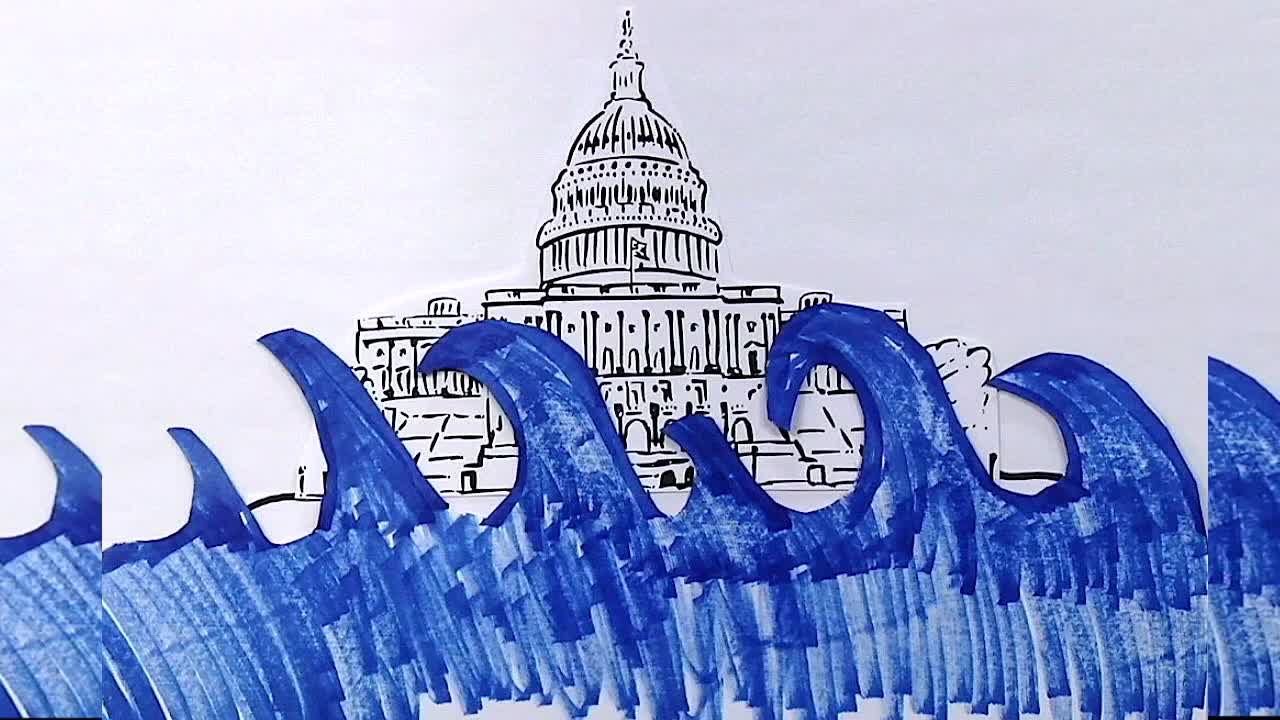
Shifts like these often happen in what are called wave elections — typically midterms — when one party is swept into power and another is swept out. Ohio Gov. Mike DeWine has experienced both sides of that phenomenon firsthand. He won his U.S. Senate seat during the Republican red wave of 1994 and lost it in the Democratic blue wave of 2006.
When asked whether he sees similarities to those elections DeWine told News 5:
"Well, we're going to see; every election is a little different."
What DeWine said he learned as a candidate in both of those wave elections is that there are forces at play bigger than any individual campaign.
"There are some years that you're swimming upstream and some you're swimming downstream and as a candidate you really can't do much if anything about that," DeWine said. "Sometimes there are forces out there that are very, very, very, very strong."
DeWine said that lesson took time to learn.
"When you start in politics, running for office, I'll speak at least for myself, I ran for county prosecuting attorney, and gee, I thought it was all about me. You know, if I went out and knocked on enough doors and saw enough people that I could control the outcome, and that's true to a certain extent," he said.
That kind of change usually comes from the bottom up. As he travels the state, DeWine said he finds a common theme among voters.
"This is a time I think where people are really focused on their pocketbook because they've been hurt, they've been impacted, and so that's really what I think people are really focused on," he said.
This story was reported on-air by a journalist and has been converted to this platform with the assistance of AI. Our editorial team verifies all reporting on all platforms for fairness and accuracy.
