




COLUMBUS, Ohio — The nation's largest prediction market platforms are all ignoring Ohio's legal threats to shut down their sports trading sections.
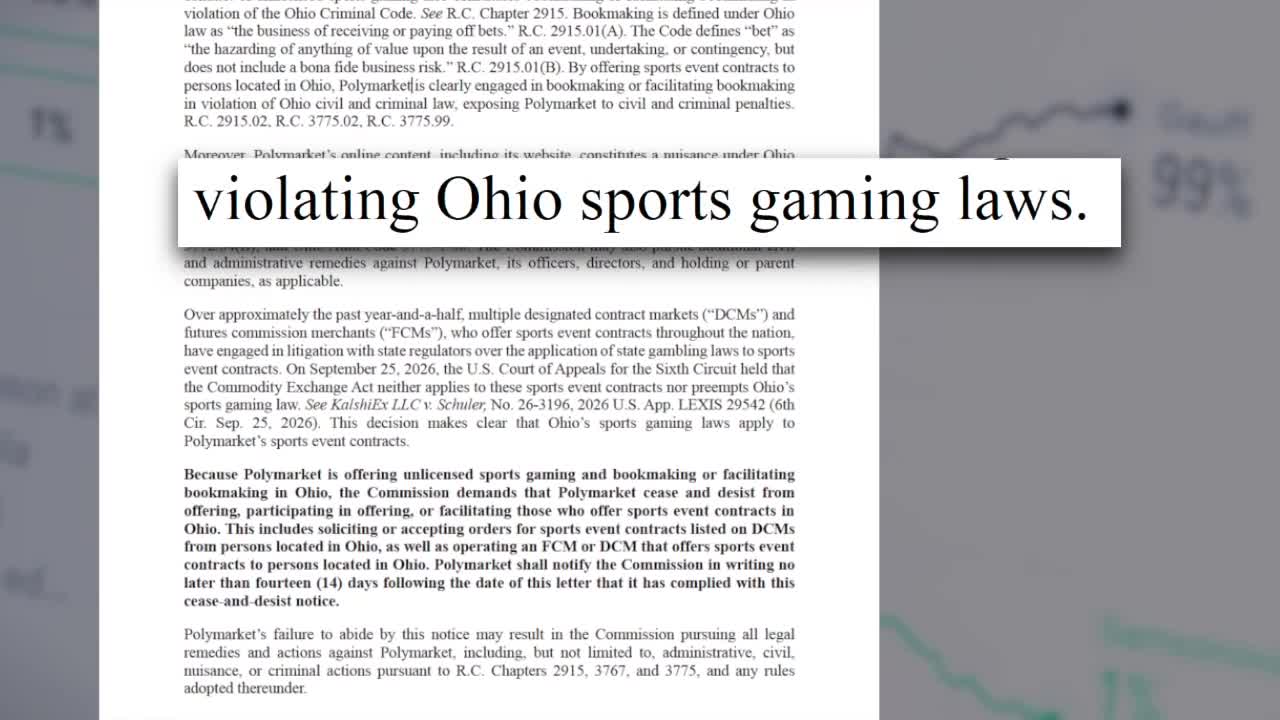
The Ohio Casino Control Commission issued cease-and-desist letters to 10 companies operating in the state that allow consumers to "trade" on sporting events. Each had a deadline of Friday to respond and confirm it had shut down those markets.
As of the end of business on Friday, most platforms were still up and unchanged. Some of the bigger companies are airing ads during games, which Ohio Gov. Mike DeWine has seen.
"I watched baseball last night," DeWine told us Wednesday. "I'm seeing ads up there from them."
Prediction markets let users "trade" on topics by entering what they call "event contracts" on sports and other topics like current events and politics.
"This is pure and simple gambling," the governor said.
He sees these ads as taunting.
"These people are trying to get around it, and they just are laughing at everybody," he continued.
Last month, DeWine told us he would fight prediction markets, which he and a panel of federal judges said have been skirting Ohio gaming laws.
RELATED: After court ruling, Ohio Gov. Mike DeWine to hold Kalshi accountable for operating illegally
In the lawsuit, platform Kalshi argued that its "contracts" are overseen by the federal government, not the state.
"It's clear what this is: it's clear this is betting, it's clear this is gambling," DeWine said. "It's nothing else."
After our original story aired in late September, DeWine said Casino Control followed through.
"The attorney general of Ohio is taking the action that he needs to take," he said.
On Oct. 2, the Commission sent 10 cease-and-desist letters to popular sites, including Polymarket, Coinbase and Robinhood.
"The law is on our side, and they've lost up to this point," Attorney General Andy Wilson said in an interview. "They need to come into compliance, or we're gonna force them into compliance."
In the letters, the state threatens each company with criminal and civil penalties.
"There are safeguards in place that protect against exploitation because the bottom line is these companies are just interested in money," Wilson continued.
Wilson said he would be able to recoup the money that the companies have made from sports contracts while operating in Ohio.
"It's over for them," he said. "Until another higher court says differently, it's time for us to start enforcing them..."
We reached out to all 10:
- Coinbase
- Gemini
- MooMoo Financial
- Novig
- Plus500US
- Polymarket
- Prophet X
- Robinhood
- Underdog Predict
- WeBull Financial
Kalshi didn't receive a cease-and-desist, since it received a court order and was told in the case what the state wanted.
"Markets can't operate when the rules change at every state line, which is why Congress created a single federal regulator with nationwide rules,” Kalshi spokesperson Dani Lever said.
Both Polymarket and Robinhood responded with similar statements, not addressing our questions but emphasizing that the federal government controls them, not the state. The rest either didn't respond or had no comment.
Through a records request, we were told by the Commission that platform Plus500US said it would stop the sports contracts.
While on the phone with the Commission, we made an account on Plus500US. Although there was a pop-up on some of the sections that said: "trading sports is not allowed in your location," we were able to seemingly get around it in order to wager, but never fully placed a bet. It is possible that it could have stopped us at the final step.
Case Western Reserve University business law expert Eric Chaffee explained that following Ohio’s regulations could be pricey.
"You would have to obtain a gaming license," Chaffee said. "In addition to that, there are lots of disclosure and compliance issues that are associated with having a gaming license."
Registering as a sportsbook includes a full licensing process that can cost upwards of a million dollars, according to state law. There is also a 20% tax on sports betting. Among other provisions, it requires users to be at least 21 to wager.
None of the prediction markets follow these regulations.
"You have to actually go out and file these suits," DeWine said. "And that's what we're going to do."
Follow Statehouse and Columbus bureau reporter Morgan Trau on X, Instagram and Facebook. Email her at Morgan.Trau@wews.com.
