


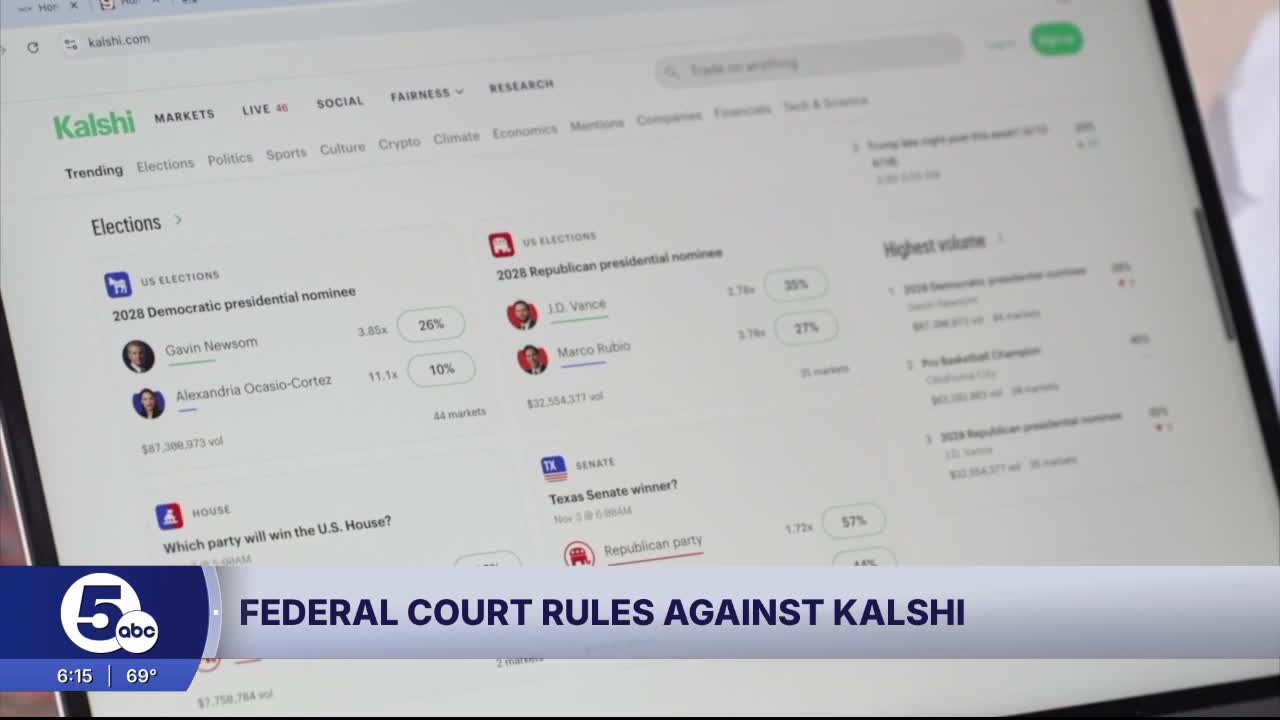


COLUMBUS, Ohio — Ohio Gov. Mike DeWine is promising to hold prediction market platform Kalshi accountable for skirting state gambling regulations for years. A federal court ruled that Ohio can require the company to follow sports betting laws.
Sports gaming is more than a $100 billion industry, but DeWine said Monday that the state has been losing out on money due to what he calls illegal operations.
"These so-called prediction markets, which are really gambling, nothing more than that, they're just trying to get around the law, don't want to play by the same rules everybody else does," DeWine told me.
In a unanimous decision, the Sixth Circuit Court of Appeals agreed, saying prediction market platform Kalshi has been skirting Ohio gaming laws.
"Kalshi has marketed itself as 'the first nationwide legal sports betting platform,' claiming that 'sports betting [is] legal in all 50 states on Kalshi." Judge Julia Smith Gibbons wrote.
The company had previously won in a Tennessee court, so this Ohio decision allows both states to enforce their laws.
The company operates by allowing users to “trade” on topics, entering into what they call “event contracts” on sports, like whether the Columbus Crew soccer team is going to win its next game.
WATCH: Ohio bill would ban politicians, staff from Kalshi, Polymarket prediction markets
RELATED: Ohio bill would ban politicians, staff from Kalshi, Polymarket prediction markets
Users can trade on different types of topics, not just sports, like politics and entertainment.
The company argues that their “contracts” are overseen exclusively by the U.S. Commodity Futures Trading Commission, and thus classified as federally protected swaps.
"Just because they call themselves something doesn't mean they're not gambling; if it's a pig, it's a pig. If we call that pig a sheep, it's still not a sheep; it's a pig," DeWine said. "These guys are pigs."
This fight isn't over for Kalshi.
"We disagree with this decision and don't believe it will survive further review. The law does not require a swap to involve 'intrinsic' financial consequences — and even if it did, sports clearly do," spokesperson Dani Lever said.
The ruling shows why a state-by-state patchwork doesn't work, she continued.
"Markets can't operate when the rules change at every state line, which is why Congress created a single federal regulator with nationwide rules,” Lever said
Mary Shepro, president of business operations of the Columbus Crew, was with the governor at an event on Monday.
"What kind of impact do sports bettors have on your team and on the morale?" I asked her.
"Well, the most important thing, and we do training with our players from the time they're a little — 12 to 13,14 year olds in our academy up to our first team — that without rules and integrity, the game is not what the game is supposed to be," Shepro responded.
RELATED: Ohio GOP lawmakers move to ban online sports gambling, betting on college athletics
She acknowledged that prediction markets and gambling are part of the ecosystem now, and is something they prepare players for.
"The whole point of playing a game with rules is that it's fair and that there's a winner and loser," she said.
That fairness, DeWine said, is Kalshi being fined $5 million and needing to register as a sportsbook like DraftKings or FanDuel.
There is a full licensing process that can end up costing upwards of a million dollars, according to the state law. There is also a 20% tax on sports betting. Among other provisions, it requires users to be at least 21 to wager.
Kalshi follows none of those regulations currently, and through court documents, said that complying could threaten the company's "viability."
"They just wanna have a free ride," DeWine said. "We will certainly enforce the law."
As of Monday evening, nothing on Kalshi’s website has changed to comply with the law.
Follow Statehouse and Columbus bureau reporter Morgan Trau on X, Instagram and Facebook. Email her at Morgan.Trau@wews.com.
