



COLUMBUS, Ohio — A newly introduced bill would ban Ohio public officials and their employees from "trading" in prediction markets.
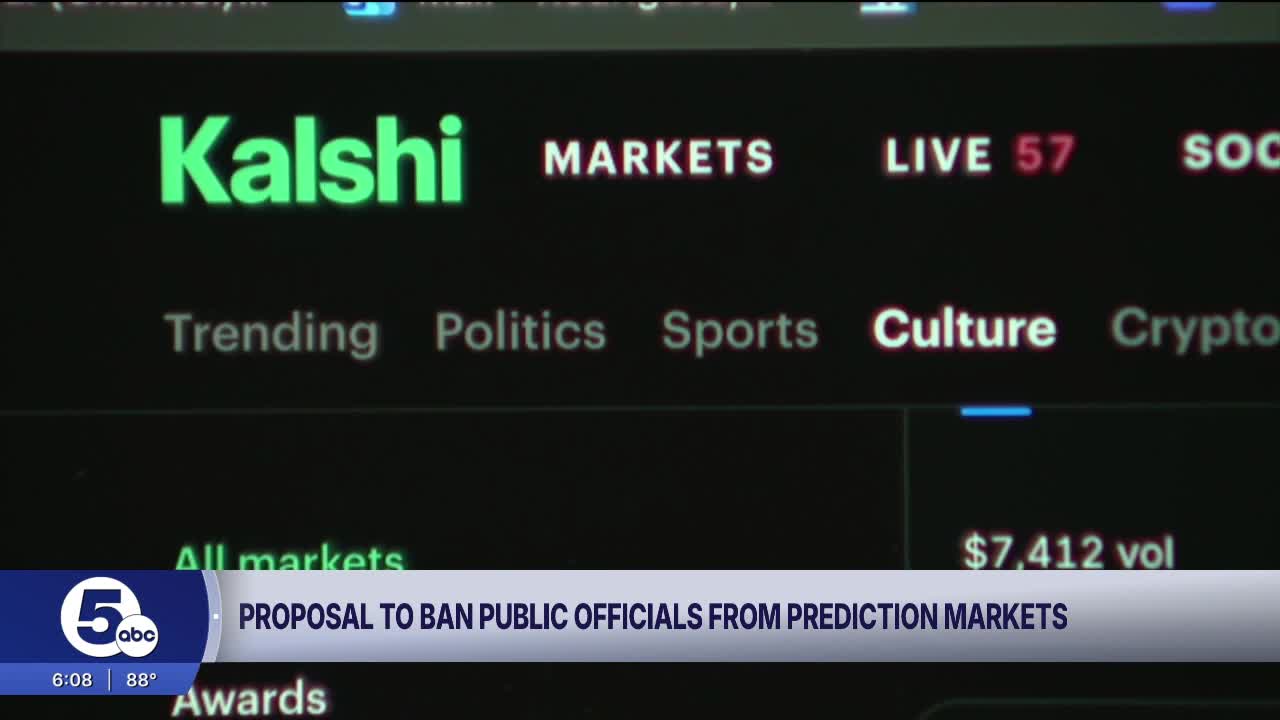
Prediction markets have been exploding in popularity, with the state reporting that more than 35,000 Ohioans have placed wagers on the platform Kalshi in one year.
"The prediction market environment that we're hearing about these days, it just doesn't meet the smell test, right?" state Rep. Sean Brennan (D-Parma) said.
Around the country, politicians are getting called out for using these apps to benefit themselves, like then-Virginia Democrat Mark Moran, who bet he would enter their U.S. Senate race.
Brennan and U.S. Senator Bernie Moreno say this kind of behavior is unacceptable.
"There shouldn't be a side hustle of using the information you get here to monetize," Moreno said.
Brennan has introduced a bill that would ban state public officials and their employees from not only making predictions, but also sharing any confidential information with anyone else to bet. If convicted, a politician could get 180 days in jail and be charged a $10,000 fine per violation. They would also have to pay back any profit they made.
"This is all so much in the dark that nobody is really protected, except the people that own [the platforms] and the people that have the insider information, and that's not fair," Brennan said.
The Democrat wants all state employees to follow this, but right now, the list includes all statewide executives, House and Senate lawmakers and the Ohio Supreme Court justices. All of their staff members are also prohibited from even having accounts on prediction market platforms.
The list extends to an officer or an employee of any legislative agency or the commissions on casino control, lottery or racing. The inspector general and the entire office, as well as anyone with the ethics commission, also wouldn't be able to participate. Members of the departments of commerce, insurance or administrative services are also banned.
More agencies may be added, Brennan said, after I mentioned the Department of Health.
Any legal gambling, like sports betting, would still be allowed for the public officials and staff.
Although supportive of preventing politicians from insider trading, avid gambler state Sen. Bill DeMora (D-Columbus) said that the bill oversteps.
"If I knew what the weather was going to be three days in advance, I'd be the richest person in America — that's true," DeMora said. "But I don't have that kind of insider information."
There are thousands of options to choose from in these markets, like who will win a reality TV show, how many measles cases there will be and the release date for video games.
DeMora doesn't use prediction markets because he believes they are illegal in Ohio, which Attorney General Dave Yost agrees with.
"This is gambling, no matter how they try to dress it up — and that means it belongs under state jurisdiction,” Yost said. “States have a longstanding right and responsibility to protect their citizens from the dangers of gambling, whether it’s on a prediction market or a casino floor.”
Kalshi is already in trouble in Ohio. In April, the Ohio Casino Control Commission sent Kalshi a notice of an “intent to impose” a $5 million penalty, arguing that the company has ignored regulations, including the state's 20% sports betting tax.
RELATED: Ohio GOP lawmakers move to ban online sports gambling, betting on college athletics
The company argued the federal Commodity Exchange Act preempts enforcement of Ohio law. Kalshi allows users to "trade," it says on its website. The company, in litigation, has said they host individual "contracts," more similar to stock trading than betting.
A federal judge disagreed in March, ruling that they must follow Ohio's sports betting rules. And DeMora has just introduced a bill to tax prediction markets.
"I'm not one of these hypocrites that's going to try to regulate something that I'm using illegally," he said.
Public officials shouldn’t be banned from all types of predicting, DeMora said, just the ones that relate to their jobs.
"Anything that the government would be able to regulate or oversee, you can't bet on those things," he said.
Kalshi already has regulations against political insider trading, including on lawmakers, staffers, candidates and some members of the media. We reached out for a comment on this legislation, but they didn't respond.
Polymarket, another massive platform, also has restrictions on candidates, politicians and staffers from trading on relevant topics. Their team declined to comment on the bill.
"To protect people, to protect the integrity of our government, there's nothing wrong with some guardrails," Brennan said.
Despite other states around the country also looking to ban politicians from prediction markets, there is little movement in Congress to prevent members from trading stocks.
RELATED: Ohio bill would raise tax on sports betting wagers
Follow WEWS statehouse reporter Morgan Trau on Twitter and Facebook.
