


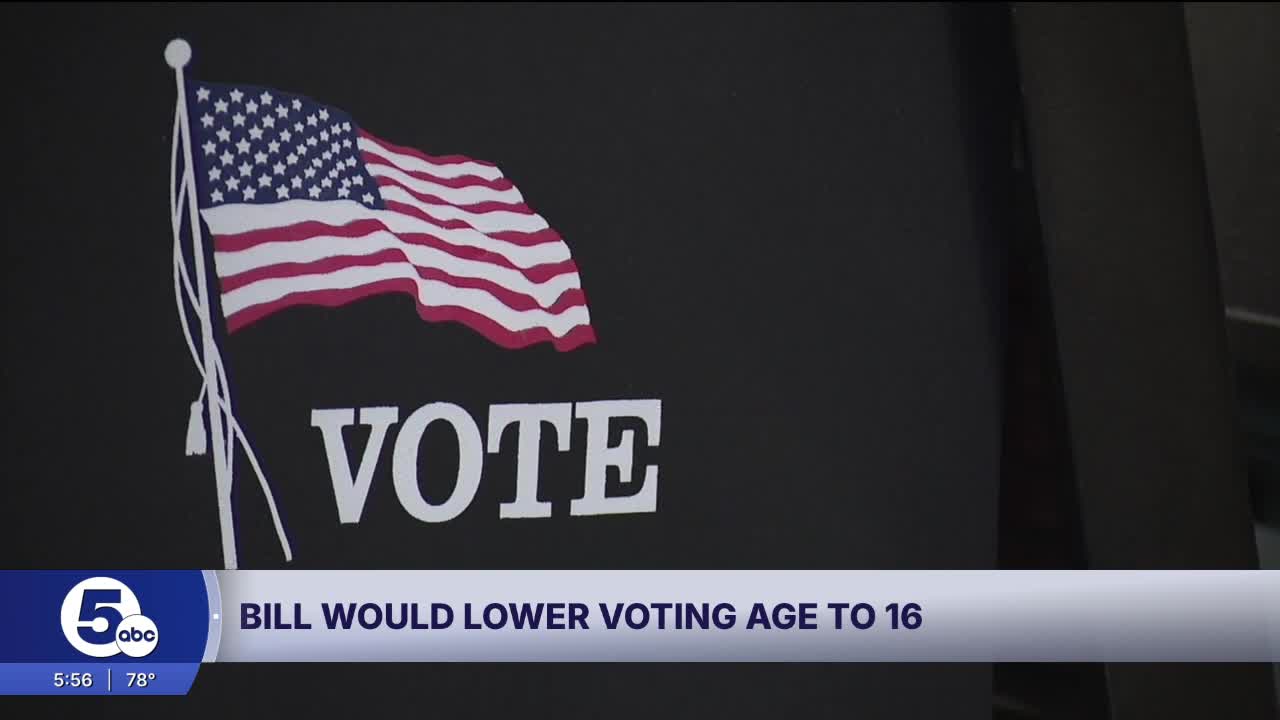


CLEVELAND — Turning 16 is a big deal for kids. It opens the door to working, to driving, to making more decisions for themselves, but should those decisions be extended to include having a say in who will represent them in government, like actually voting at the polls? State Rep. Chris Glassburn (D-North Olmsted) said yes.
"You know, one of our founding principles is no taxation without representation," Glassburn said. "If 16- and 17-year-olds are paying taxes, they should get a say in where that money goes."
That's why he and state Rep. Sean Patrick Brennan (D-Parma) introduced a joint resolution that, if passed, would ask voters to allow 16- and 17-year-olds to have a say in local elections in Ohio. Something Glassburn said is not without precedent.
"There's 20 states that let 17-year-olds vote in some levels of elections. There aren't any that do 16 yet, but there are several countries, Brazil, Austria, Belgium, that do so in Europe and in South America."
Glassburn argues that research has shown that the earlier someone gets involved in the electoral process, the more likely they are to stay involved, and as it stands in Ohio, young voters aren't getting involved.
"18-year-olds in Ohio are only registered at a 32% clip, which is 10 points lower than any of the surrounding states," he said. "There's been plenty of studies that if you vote in two elections in a row, that you become more or less a voter for life, and this is a way to try to get them involved for a couple of elections before they go off to college or start a family or technical school or do other things."
Brennan understands how people might feel at first glance at the resolution.
"I know there are a lot of people out there that won't like this idea; their knee-jerk reaction is they're immature, they don't know anything," he said.
Brennan, who taught high school American government for 30 years, feels differently.
"I bet my 16, 17, 18-year-olds know more about local, state and federal government than most adults do."
Charles Roman agrees with that, believing 16-year-olds are mature enough.
"I think so. If they are old enough to watch other children, like if they're babysitting, they're of babysitting age, yeah, I think they're allowed to think for themselves."
But on the campus of Cleveland State, those only a few years removed from that age think otherwise.
"Absolutely not," said Nijah Williams of Bedford when asked if she thought she was ready at 16 to start voting. "My thought process was completely different, and it was different at 18 too, so I think right now we should keep it at the age it's at."
Isabella Messina of Parma agreed.
"I don't even know what I was thinking at 16 to compare to now, so yeah, I would definitely keep the 18 if not older at that point, but 18 is definitely a good age range to keep it at."
Actually, up until 1971, the voting age in the U.S. was 21. It only changed to 18 after a three-decade-long debate that started during World War II and came to an end with the passing of the 26th Amendment in 1971. Brennan hopes a healthy debate is what this will stir.
"Hopefully, folks will have an open mind and not a knee-jerk reaction and let's have a civil debate about it just like I would have civil debates in my classroom with my students," he said.
