


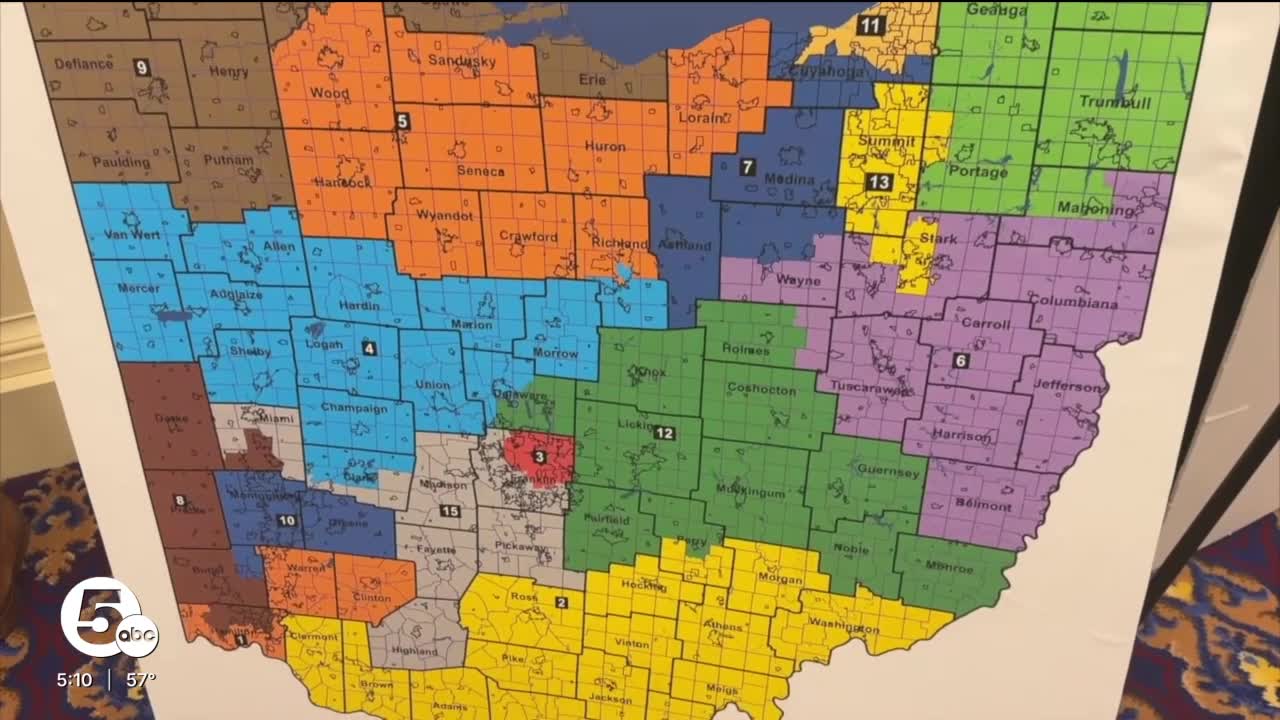



COLUMBUS, Ohio — After the U.S. Supreme Court struck down parts of the Voting Rights Act as unconstitutional, some states are trying to draw new district lines ahead of the election. Ohio, which completed a bipartisan process in 2025, will likely not be joining the latest mapmaking effort.
Since the Voting Rights Act (VRA) went into effect decades ago, minority communities have had the assurance that there is recourse if they are discriminated against when trying to cast their ballot, but the Supreme Court's latest 6-3 decision could take away representation.
Future elections could look different, at least that’s what voting rights advocate Jen Miller worries about.
"We could see large communities that are sliced and diced in ways that they really don't have fair representation," Jen Miller with the League of Women Voters of Ohio said.
The justices issued a decision in Louisiana v. Callais, overturning a Louisiana congressional map, saying its two majority-Black districts were unconstitutional.
"When large swaths of voters are not heard, our democracy will not be as effective," Miller said.
This dramatically alters the interpretation of Section 2 of the VRA, which has allowed for some racial data to be used when drawing congressional and legislative district maps.
"The court has made it really, really hard for districts to be drawn in a way that gives black people or other minorities a realistic chance to elect candidates of their choice," said Jonathan Entin, a Retired nonpartisan Case Western Reserve University constitutional law professor.
Entin explains that this could allow a legal challenge to a previously enacted map if racial data were used in creating the district.
"We'll see some effort by Republicans to redraw at least some of the congressional districts in a way that makes it more likely that Republicans can control, can win those," Entin added.
Ohio GOP leader Tony Schroeder cheered the ruling, saying it was a long time coming. Using race to draw districts is actually what is discriminatory to minority populations, he said.
"This actually harms black voters who may not have anything in common other than their race," Tony Schroeder, Ohio Republican Party Secretary, said.
He approved of Ohio’s 2025 mapmaking process, when the state's redistricting commission unanimously passed a 12-3 GOP-leaning map.
RELATED: These are Ohio's new congressional districts
The new map is being called a "compromise" by both GOP and Democratic leaders on the commission, angering both progressives and far-right advocates we spoke to.
Republicans were worried about a referendum, and Democrats say that any other map would have been significantly worse for them.
RELATED: Ohio Republicans, Democrats introduce bipartisan congressional map that favors GOP
"Will this ruling impact how the Ohio GOP redistricts moving forward?" I asked Schroeder.
"Well, I mean, I think there's some possibility that there will be litigation associated with it," he responded, adding that he doesn't think anything will happen in the short term to change Ohio's maps. "The larger impact we're going to see as a result of this case is in 2030, when every state's going to look at its redistricting in the light of that census."
Ohio is supposed to have certain safeguards against gerrymandering, but some voters, like Bria Bennett, said that politicians have continued to break that law, which a bipartisan Ohio Supreme Court has previously agreed with.
"This partisan gerrymandered, 12 Republican, three Democratic, map explicitly targets black and brown communities," Bennett said during the commission process.
Unlike other states, Ohio has a schedule of if and when it is allowed to redraw maps mid-decade. The congressional map decided in 2025 will be used for the next six years, according to the state constitution.
Legal experts say that it could now be up for interpretation.
Miller doesn't trust any politician to do the right thing when it comes to redistricting, regardless of whether it's in a blue or red state. She said politicians need to be out of the process as a whole, but that effort failed, in part due to what she calls deceptive ballot language, in 2024.
Still, both Schroeder and Miller think that 2030 is the target for more redistricting in the Buckeye State.
Due to the unanimous decision that came from the redistricting commission, plus House Speaker Matt Huffman's dismissal of the Trump administration's begs for more seats, points to Ohio staying out of the mapmaking spotlight — at least for the next few years.
Follow WEWS statehouse reporter Morgan Trau on Twitter and Facebook.
