


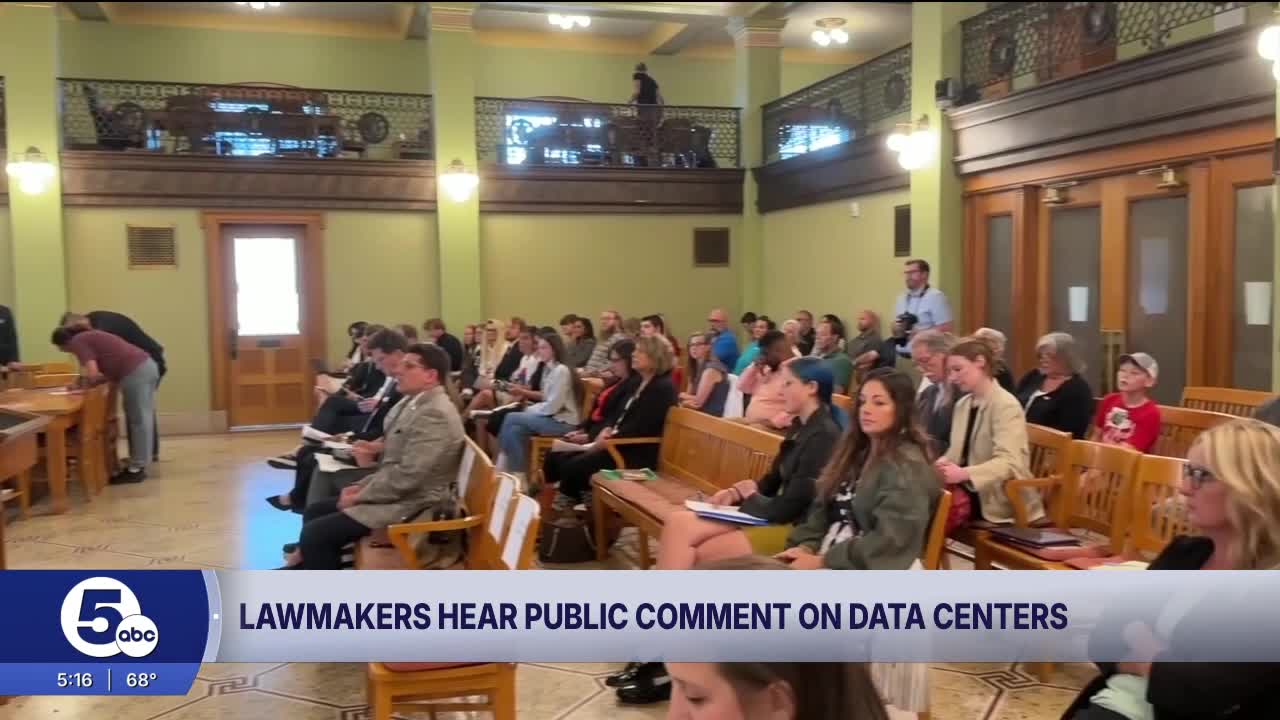



COLUMBUS, Ohio — Ohio residents testified for hours in front of a panel of lawmakers, arguing that the state either needs a data center moratorium or steep regulations to keep corporations from hurting the environment, as well as harming citizens' health and pocketbooks.
No matter which corner of Ohio they came from, the overwhelming majority agreed: no more data centers.
"Each and every person here has a reason why they're here, and that's what's brought us all together," Austin Baurichter with Conserve Ohio, a grassroots organization dedicated to ending the data center boom, said.
He was one of the more than 60 residents who provided testimony opposing the tech hubs at the Joint Committee on Data Centers hearing on Monday afternoon.
Opponents have several main concerns: they believe data centers damage the environment, take away farmland, are likely to raise utility bills, lower home values and create nonstop noise. They're also worried chemicals from the facilities could hurt drinking water.
"I am not at all surprised by the greed of corporations operated on principles adverse to the human condition," Baurichter said. "But I am surprised by those who took an oath to represent us, the people, and to advance our interests, our hopes and dreams, who are now advancing the interests of those adverse to us by allowing hundreds of data centers into our state before you decided to see 'what reality is' about them."
The committee, made up of a bipartisan group of lawmakers, has five main ways the lawmakers say they will support Ohioans. It will see how much data centers impact Ohio energy bills, look into the financial benefits to communities, evaluate what they do to water and wildlife, identify the national security risks and increase awareness of what hubs actually do.
As shown at a Perry Village data center meeting in April, transparency also remains a major concern for residents. Many testified that their city councils sign non-disclosure agreements with large corporations, not telling the community members about these data center projects until the contracts are signed, and public comment is irrelevant.
"If the State of Ohio is open for business to any company, why are these companies allowed to have NDAs when they are building in our communities?" Nanette Fitzpatrick, from Fairfield County, said. "These data centers are changing our way of life... It is almost impossible to find anyone willing to answer questions."
RELATED: Local developer, global tech firm plan major data center project in Portage County
But tensions ran high at the beginning of the meeting.
"You took an oath to protect this great state of Ohio, its natural resources and the people in it — all of you did, and you're the only ones with the power to change it," Nikki Gerber, from Adams County, said.
"I hope that you're not suggesting that we're not taking that oath seriously," state Sen. Brian Chavez (R-Marietta) said in response, to a large amount of laughter from the audience.
Chavez and state Rep. Adam Holmes (R-Nashport) are the co-chairs of the committee.
"I just want to make sure that we're talking about reality," Chavez said, after he disagreed with something chemical engineer Stephen Petty testified.
Chavez joined the one speaker in defending data centers, questioning the opponents.
"Are you being paid for this in any way?" the lawmaker asked the engineer, who noted concerns about chemicals impacting the safety of Ohioans.
"No," Petty responded, plainly.
I asked Chavez why he was questioning people about being paid to be there, and also asking where they were from, to which he said he just wanted to gather information. However, a press release sent out by the Senate GOP explained further.
"Data centers have been here for years, but now they're being politically targeted with a well-funded misinformation campaign from coastal special interests that want to make sure your data is stored in communist China," the release said.
After distancing himself from that statement, I asked where the China idea was even coming from.
"There's a lot of forces pushing back on a lot of different things... There's geopolitical forces at work here," the Republican responded. "Our job is not to worry about that. Our job is to find out facts and information here at the local level."
RELATED: Is a data center a blessing or a curse? Depends on the community.
Chavez is a supporter of data centers, explaining that the facilities are needed, and they bring jobs.
"Data centers are the physical structure where all of our technology is funneling through at this point," Chavez said. "So as we continue to become more connected, it seems like we're going to continue to need more resources."
Chavez questioned speakers, like Ohio Advocates for Medical Freedom President Stephanie Stock, who suggested that citizens should vote on whether a data center is located within a five-mile radius of a city or township.
"Where do we draw the line? Does everyone have to apply for a vote to, for every gas station, every big farm, every school? … We're not being fair to the industries. We're just saying data centers alone," he said.
"Citizens are gonna continue working to ban them if the legislative body doesn't take action to give them a voice," Stock responded. "This gives them a voice."
Also fueling opposition is recent reporting on new state figures showing that sales-tax breaks for data center projects approached $1.6 billion dollars last year, exponentially more than originally projected.
After the reporting, Gov. Mike DeWine asked the Ohio Tax Credit Authority to stop considering new requests for sales-tax exemptions while the legislature's joint committee on data centers holds hearings and decides how to proceed.
But on Monday, the administration announced a brand new deal, which was already set for review by the tax credit authority before the governor's exemption pause.
RELATED: DeWine halts new sales-tax breaks for data centers
The tax credit authority approved a deal with data center developer Cologix outside of Columbus. It's last new sales-tax break for a data center that the panel is approving — for now. The company will get a 50% discount on state and local sales taxes on construction materials and equipment at two new data center sites for a decade.
Cologix is looking to invest $1.167 billion and, based on that, would receive a sales-tax break worth an estimated $42.3 million.
The company expects to create 90 full-time jobs, generating $10 million in new annual payroll by the end of 2028, from data center projects in Orange Township (Delaware County) and Johnstown (Licking County). Those facilities will provide data processing and storage for multiple businesses.
At the statehouse Monday, critics said Ohio's data center boom was predictable.
"Do you think that they've been not paying attention to this?" I asked a group of opponents.
"No, no, no," multiple people said. "They made their decision years ago. They passed many bills years ago to open the door wide open to say, 'Come in.'"
Data center companies will get their turn to testify in front of the committee later this week.
News 5's Michelle Jarboe contributed to this report.
Follow WEWS statehouse reporter Morgan Trau on Twitter and Facebook.
