

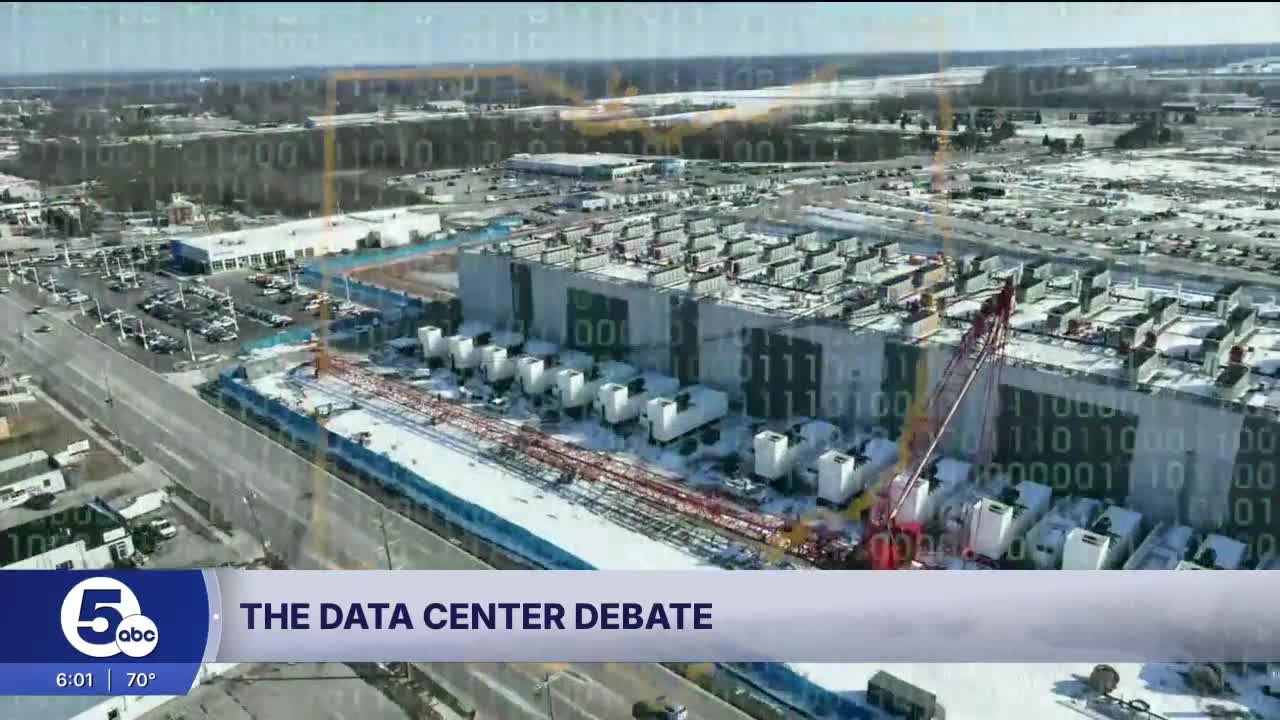



PERKINS TOWNSHIP, Ohio — Across the Perkins Local School District, just south of Sandusky, the boilers are failing. One of them is so old, it was originally built for a steamship. Air-conditioning is a dream.
That’s why Superintendent Lonny Rivera doesn’t have a problem with the mammoth data center rising just two miles away, on a former manufacturing site.
“From my lens, as an educator, this has been a godsend,” said Rivera, citing higher property-tax revenues from the first sprawling data-center campus in this part of Ohio.
When Perkins Township officials started weighing the proposal a few years ago, they didn’t hear much of a fuss. The data center — the first of four potential buildings on a roughly 130-acre site — occupies a longtime industrial property, near auto shops, a union hall, a car dealership and a Mexican restaurant.
“At the time when we first started discussing it, I don’t think there was that much of a controversy over whether data centers were good, bad or whatever,” said Tim Coleman, a Perkins Township trustee who leads the three-member governing body.

Now there’s plenty of controversy across the state.
Over the past decade, Ohio has become one of the top states for data centers, with more than 200 facilities — ranging from small computing hubs hidden in industrial parks to behemoths custom-built for Amazon Web Services, Google and Meta.
Most of the major projects are in central Ohio, clustered around Columbus. But the wave of development is coming this way.
Now Northeast Ohio communities are trying to get their arms around what’s happening — and figure out whether they really want a piece of big tech.
These facilities, filled with computing equipment, support almost everything we do online, from streaming movies on Netflix and scrolling social media to web-based banking and conjuring instant answers to almost any Internet query. They keep businesses running and safeguard sensitive information, storing and processing huge amounts of data.
People want the instant gratification — and backup storage — data centers provide. But in many Ohio communities, they don’t want the buildings anywhere near their backyards.
“We are starting to see Ohioans fight back. And I love that,” said Joshua Holmes, an entrepreneur and “extroverted nerd” who runs a small data center in Medina County.
“It’s not that they shouldn’t come here,” he said of major developers and big players in the tech industry. “But it should be responsibly. And if we’re not checking all the boxes to make sure it’s responsible, maybe they shouldn’t be here.”

'Someone's gonna benefit'
In Norton, about 80 miles east of Perkins Township, hundreds of people showed up last fall for a community meeting about a controversial proposal to build a data center near the entrance to a long-abandoned limestone mine.
That project stalled out in October, amid questions about the developer’s credibility.
In December, Norton City Council enacted a six-month moratorium — a freeze — on considering any new data-center projects. But tensions are still so high that it’s tough to get anyone to do an interview, let alone go on camera.
Mayor Mike Zita refused to discuss the data center moratorium and how city leaders plan to proceed. Council members contacted by News 5 either declined to comment or did not respond to calls or emails.
“Someone’s gonna benefit. It certainly ain’t gonna be the people in the area,” said Steve Muller, who lives on a quiet street near the former limestone mine.

He said he’s not opposed to development. But he’s dead set against data centers.
“Overall, from what I heard throughout the country, even where they have them, the people are very disappointed that they even let it happen,” Muller said.
That’s not the case in Perkins Township, though, where Aligned Data Centers plans to finish its first enormous building this year. The company paid $52 million for the property in 2023 and is investing more than $200 million in the first phase of construction there.
For the township and school district — which depend on property taxes — the project feels like a win so far. Unlike cities, townships can’t levy income taxes. So it’s not a big deal that the data center is expected to create only 18 permanent jobs by February of 2027.
“I think our local trades have done extremely well. And local businesses, as part of this construction,” said Gary Boyle, the township’s administrator.
Township trustees, the school board and the local career center agreed to plow 70% of the new property-tax revenues from the buildings back into the project over 30 years. They’ll share the other 30% and continue collecting full tax revenues from the underlying land.
As part of the development agreement, Aligned Data Centers made a $325,000 up-front payment to the township. Most of that money flowed to the school district.
“There’s several phases coming,” Rivera said. “That’s gonna give us some additional dollars to help us take care of some of the things to provide a better education for our kids.”

He commutes to Perkins Township from Oregon, a Toledo suburb that’s dealing with its own skirmish over a proposed data center. Rivera’s watching that fight. He understands people’s concerns about noise, electricity use, water and possible environmental impacts.
“But I think each community’s different,” he said.
'Not one of our core industries'
At Team NEO, a regional economic-development organization, Michael Lalich has seen a trickle of inquiries about data centers turn into a flood over the last two years.
These computing hubs have been around for decades, tucked on corporate campuses and nestled in nondescript warehouses. In Downtown Cleveland, you can walk by a data center without realizing it. The largest one, a 351,000-square-foot building on Rockwell Avenue, is a retrofit of a former industrial complex and telecommunications hub.
But the new breed of data centers is being built from the ground up.
Fueled by cloud computing and the rise of artificial intelligence, developers are sketching out multi-building campuses — for multiple tenants or single users.
Data center companies are gravitating to Ohio because of its proximity to Midwest and East Coast population hubs; deregulated energy market, which lets customers choose their suppliers; available, flat land, particularly in the Columbus area; relatively low risk of natural disasters; and public incentives.
The state offers sales-tax breaks on data-center equipment and construction materials for certain large projects, though some members of the General Assembly want to get rid of that sweetener. At the local level, communities can offer property-tax breaks.
“We have great energy infrastructure. We have a lot of water assets. We have good sites,” said Lalich, a Team NEO senior director who focuses on the tech sector.

He said Team NEO isn’t courting data-center projects or playing matchmaker. Companies and developers are identifying locations on their own, in what feels like a bit of a land rush.
“We’re not proactively sending them anywhere,” he said, adding that Team NEO is trying to preserve certain sites for advanced manufacturing and other kinds of businesses that create more long-term jobs.
“Data centers are not one of our core industries that we focus on, that we look to provide kind of the maximum benefit to the region,” he said. “But they can provide value.”
Proponents point out that data centers support thousands of construction jobs. A campus can take years — a decade or more — to build out, promising stability for plumbers, electricians and other blue-collar workers.
But ultimately, the massive buildings only employ a few dozen people on site.
In Lordstown, for example, a proposed 133-acre data center campus would span 1.65 million square feet and employ 120 full-time workers, according to court records. The village is in the middle of a legal fight with the developer behind the project.

'I got real questions'
Over in Medina County, Holmes’s data center is only 3,000 square feet. He’s adding more space, though, to serve clients including local governments and small businesses.
“It’s not that I don’t want hyperscale data centers in Ohio,” said Holmes, the CEO of LightSpeed Hosting. “I have no issue with it. It generates revenue from the building process. It’s great for construction companies. There are some jobs.
“But we need to be much more responsible in where we let them build, requiring improvements so that they’re not burdening the localities,” he said. “Requiring them to be responsible business owners in the community. And not just take advantage of what we have here in Ohio.”
In the General Assembly, lawmakers on both sides of the political aisle have introduced or are drafting bills to curb data-center development and regulate the industry. One bill would create a study commission to evaluate questions around the economic, environmental and energy impacts of the facilities.
Industry representatives and real estate experts don’t expect demand for new data centers to slow down anytime soon. A recent snapshot from the JLL real estate brokerage shows that existing facilities are 99% leased across the country.
There are many more projects on the drawing board.
But not all of them will pan out.
“I’m still seeing announcements come out that I don’t think will come to pass,” said Andrew Batson, the global head of data center research at JLL.
“The cost of building these sites is just getting incredibly large,” he said. “And there’s a smaller pool of contractors and finance partners … that have the skill set and the resume to actually see these to completion. So if you see a name that has never built something in the data-center space but they’re proposing a half-a-billion-dollar project, I got real questions about that.”
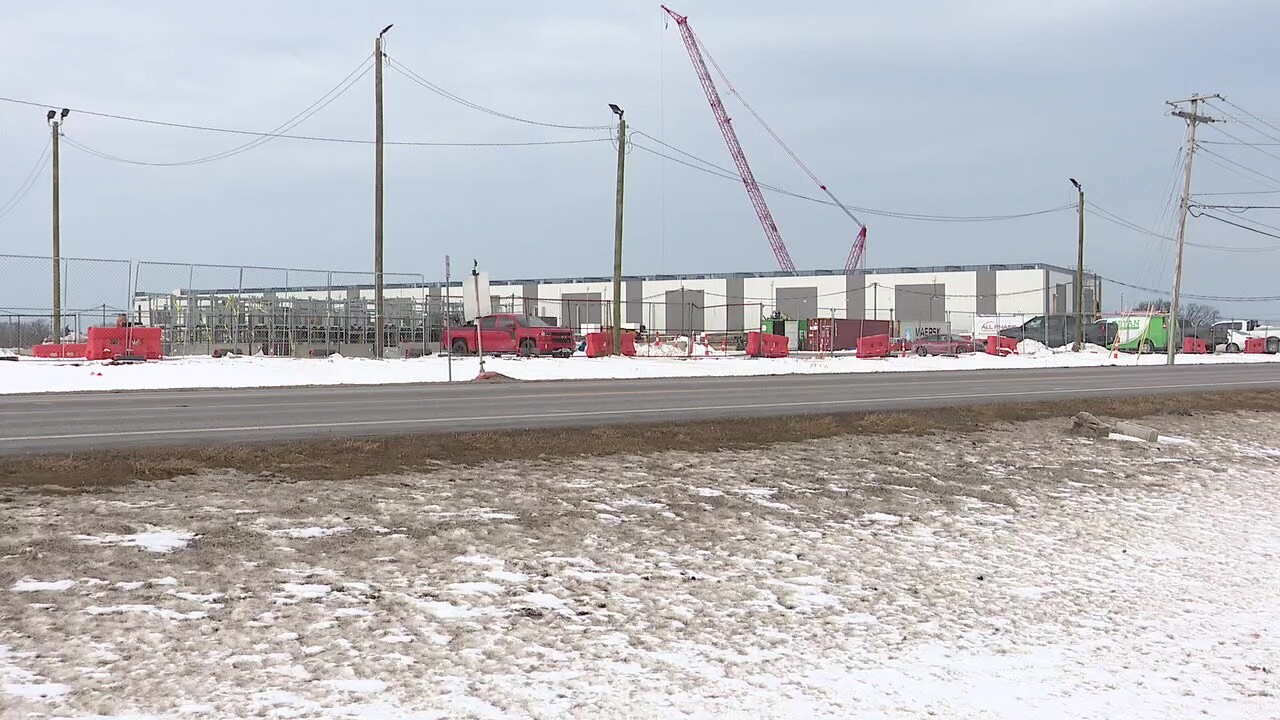
Aligned Data Centers, the operator behind the large project in Perkins Township, is an established player in the industry. The company is targeting former industrial properties like an old aluminum-smelting site in Maryland and land in Conesville, in East-Central Ohio, where a coal-fired power plant once stood.
In Perkins Township, Aligned is tapping into existing heavy power on the site, where thousands of workers once made wheel bearings for General Motors. The buildings, like many modern data centers, will use a combination of air and a closed-loop water system to help keep the computing equipment cool. The system gets filled once, then recycles a mixture of water and glycol.
Aligned expects the project to use 99% less water than the old manufacturing plant did.
Colton Brown, the company’s vice president of strategy and development, said data centers operated almost invisibly for decades — by design. The industry was built for privacy and information security. Aligned’s clients generally don’t want their names out there.
But it’s getting a lot harder to avoid the spotlight.
A few years ago, most people weren’t asking about power use, water use, noise and possible environmental impacts, Brown said. Now, everybody is — and there’s plenty of pushback.
“I think it’s understandable, right?” he said. “Because it is a lot of investment. It is happening very quickly. And it is something that folks really don’t understand very well. … A lot of folks are asking good questions. And we’re happy to answer them whenever we can.”
Over at Perkins High School, Rivera sees tax revenues from the data-center project as a solution — a way to avoid asking voters for additional money. Students are getting chances to go out to the construction site to see what’s happening, learning about new types of careers.
Walking the halls, he gets a firsthand view of how fast technology is changing everyday life. The kids are all working on tablets and laptops. Many textbooks and supplemental learning materials are online. And artificial intelligence is seeping into every aspect of life.
“This isn’t going away,” Rivera said of the demand behind the data-center boom. “It’s probably just gonna be more and more pervasive as we go on. But I think good dialogue has to happen on the pros and cons.”
Michelle Jarboe is the business growth and development reporter at News 5 Cleveland. Follow her on X @MJarboe or email her at Michelle.Jarboe@wews.com.
