

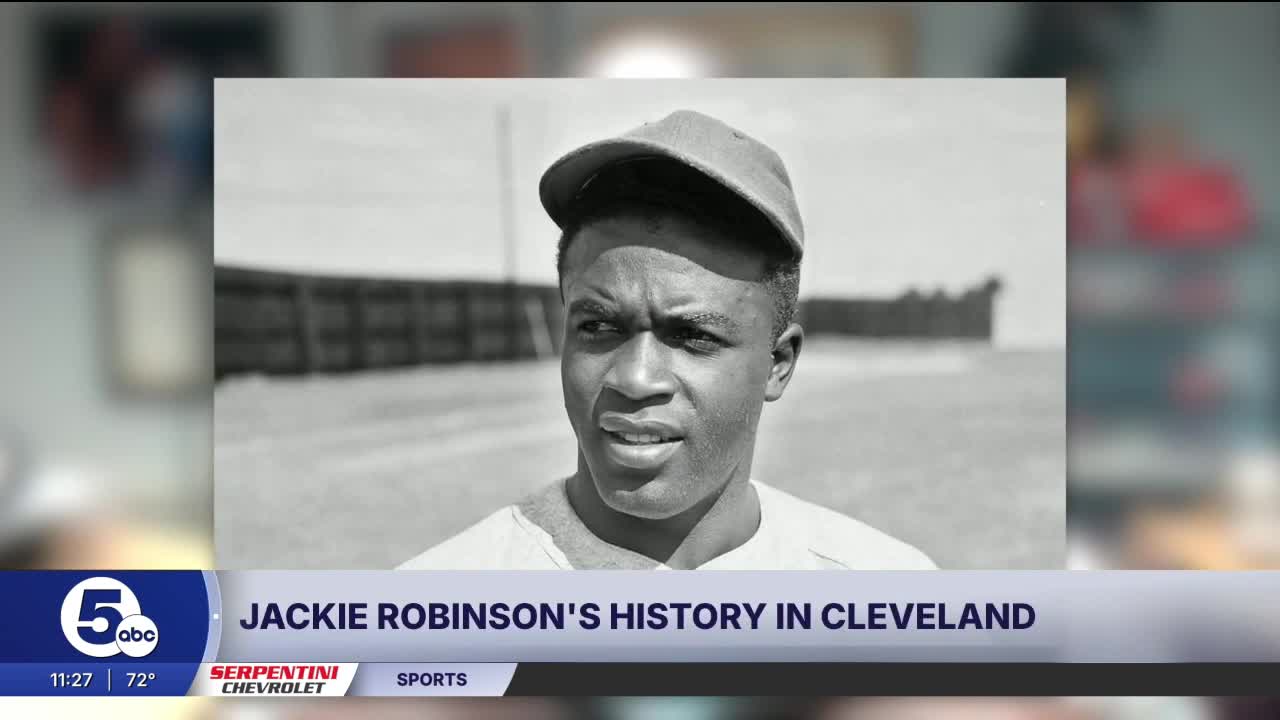


How do you measure the number 42?
Seventy-nine years to the day after Jackie Robinson broke baseball’s color barrier, it still feels impossible to articulate his impact on not only baseball but American culture. Bob Kendrick, President of the Negro Leagues Baseball Museum, believes that Robinson's first putting on a Brooklyn Dodgers uniform started much more than his Major League career.
"Jackie's breaking of the color barrier wasn't just a part of the Civil Rights movement. It was the beginning of the Civil Rights movement in this country,” Kendrick said.
Robinson was the face of it all. And he simply could not fail.
"It's hard for me to fathom that anyone would take on that level of responsibility and tremendous scrutiny, and I just think that he was preordained. He was destined to do this, and he handled it with such grace, class and dignity, while performing in such an amazing way while he was doing it. So I don't know if we can articulate just the profoundness of what Jackie Robinson meant. I think that he is America's greatest hero,” said Kendrick.
Today, America gets to celebrate a great hero, as every Major League team will wear the number 42. To this day, Robinson’s story exudes a feeling that is palpable throughout the country, whether he played a game there or not. Cleveland was one of those places where Robinson was never able to play as a major leaguer.
That is, for the Brooklyn Dodgers at least.
On July 24, 1945, over 11,000 fans at Cleveland Municipal Stadium saw the Cleveland Buckeyes host the Kansas City Monarchs.
“It was an afternoon at the ballpark, and you got to see, obviously, some real star power from Monarchs. And you have to see a really good Cleveland Buckeyes team,” says Vince Guerrieri, a SABR Baseball Historian who helped write “From Setbacks to Success: The 1945 Cleveland Buckeyes," which documents the Cleveland-based Negro League team’s run to a World Championship that year.
“That was really the high water mark for the team. And obviously it was a high water mark for Negro Leagues in Cleveland," Guerrieri said.
But the biggest reason people filled the stands for that game wasn’t just for the Buckeyes or for, at the time, the inconspicuous Robinson playing 2nd base.
They were there for the man on the Monarchs' mound: Leroy “Satchel” Paige.
“Paige, who was at that point, definitely the biggest star in the Negro Leagues, quite possibly one of the biggest in baseball altogether,” said Guerrieri.
And he showed why that summer day in Cleveland, striking out six batters. However, the Buckeyes would score three runs on the ageless wonder.
The fans came for Paige, but they would not forget Robinson. Down 3-0 in the 9th, Robinson stepped to the plate in Cleveland.
“Robinson came up, hit a very long drive to left field that hooked foul. And I mean very long because left field and the third base foul line in [the stadium] was about 385 feet, so he hit a long drive that hooked foul, and then he hit one to right field. Right field was a little more inviting. It was 290 feet,” Guerrieri wrote.
Robinson accepted the invitation.
“Jackie Robinson homered, made it a little bit of a closer game, but the Buckeyes were able to kind of finish it off," according to Guerrieri.
Little did the fans in attendance know the home team would become Negro League World Champions. Little did they know that Paige would be back in Cleveland just three years later, this time as a Cleveland Indian.
Little did they know the guy who hit a home run that day would change baseball and America as we know it.
“When you talk about Satchel Paige, you are talking about one of the biggest stars to ever play this game. And he called Cleveland home for a point in time and again, the great Larry Doby and ... Luke Easter, these were all legendary ball players who transitioned out of the Negro Leagues into Major League Baseball,” Kendrick said.
“And who knew that it would be this little known guy… little known as related to baseball playing [at the time] guy by the name of Jackie Robinson, who played [in Cleveland] in July of 1945 that will be responsible for helping Cleveland get that level of star quality from the Negro Leagues, because he would ultimately break baseball's color barrier," Bob Kendrick said.
