

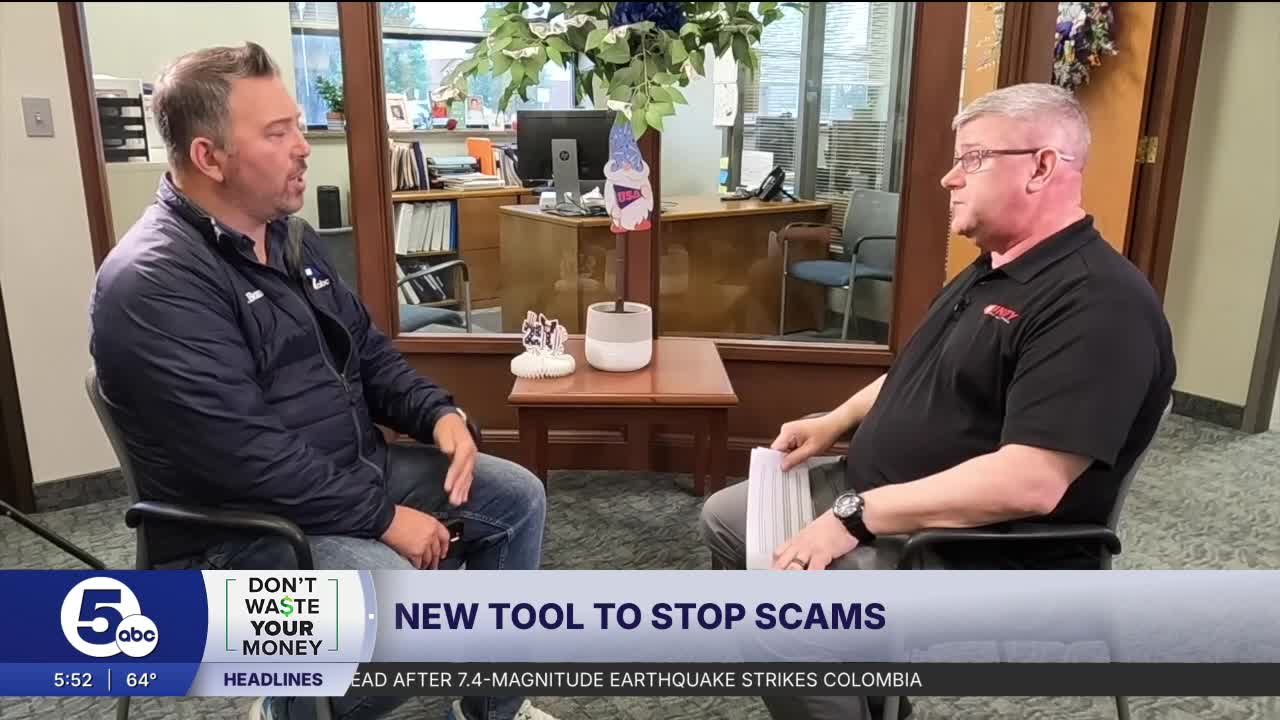


PARMA, Ohio — The Cuyahoga County Scam Squad just secured a $10,000 grant from a nationwide consumer protection fund to help roll out a new program that addresses the psychological hold schemes can have on victims.
As your consumer reporter focused on scams, I'm taking a closer look at how it works.
And it begins with an unsuspecting victim standing in front of a bank teller.
"People can lose everything they've worked for," said Brian Kiggins, Unity Credit Union.
Kiggins has watched it play out as unsuspecting customers request a heft withdrawal from their account.
"Do you really want to do this today?"
It’s the question he and his staff will ask if they suspect a scam is in progress.
"They're being coached at that point, where the voices of reason are taken out of the picture and that's very difficult," said Kiggins.
A frustrating scenario that Kiggins sees multiple times a year – people truly believing the lies being told to them.
"Hey, your banker's in on it. They're going to try to tell you not to do this, but you need to do this because your assets are going to be frozen or you're going to go to prison."
Now, tellers at Unity Credit Union, along with other financial institutions in Cuyahoga County will have a new tool to try and disrupt an active scam.
"When someone is mid scam, they are so wrapped up in the scam, unless they already have some doubts, it is hard to reach that person," said Sheryl Harris, Cuyahoga County Scam Squad.
The Scam Squad worked with psychologists and crisis intervention specialists to design a questionnaire that is designed to help tellers reach those who are living in another reality.
"We are trying to tap into that world that they're in and bring them out," said Harris.
The list of questions will be handed to consumers showing signs of being in a scam. They are listed in a calculated order to try and break the cycle.
"Did someone from a government agency tell you to do this, are you about to send money or take currency out to give to somebody who you've never met in person," said Kiggins.
The goal is to plant a seed of skepticism that will then sow doubt in the story victims are caught up in.
"That's what scam squad is trying to do with this tool is to create that uncomfortable moment where a member will say, you know what, I'm not going to do this today," said Kiggins.
For a while now, Unity Credit Union has done something similar on its own and Kiggins told me they've seen success.
"Through doing the questionnaire, you know, the member was like, you know what, I'm not going to do this today," said Kiggins.
The Cuyahoga County Scam Squad is partnering with the University of Cincinnati's Cyborg, a research center that looks at cybercrime prevention, to track the teller tool's impact.
"And I cannot tell you how rare it is for consumer protection materials or projects to actually be studied for effectiveness," said Harris.
As I mentioned, the Scam Squad worked with crisis intervention specialists and psychiatrists on this project.
Dr. Jeffrey Janata, professor of psychiatry at Case Western was tapped to share his expertise.
He told me we can better arm ourselves to take on scammers by asking two questions when we get that text, call, or email.
First: could this story be false?
Second: why me? Why is this person reaching out?
"I think we're trying to help them suspend belief and ask the important questions. You know, what if this was, what if this was fake? What if this was really a, a scam? And if they can do that early, they're much more likely to avert getting sucked in," said Janata.
Janata said there are patterns of gullibility that scammers identify in their victims.
Often, it's those who don't bring analytical thinking or questioning to the table, making it easier to prey on their emotions and get what they want.
