

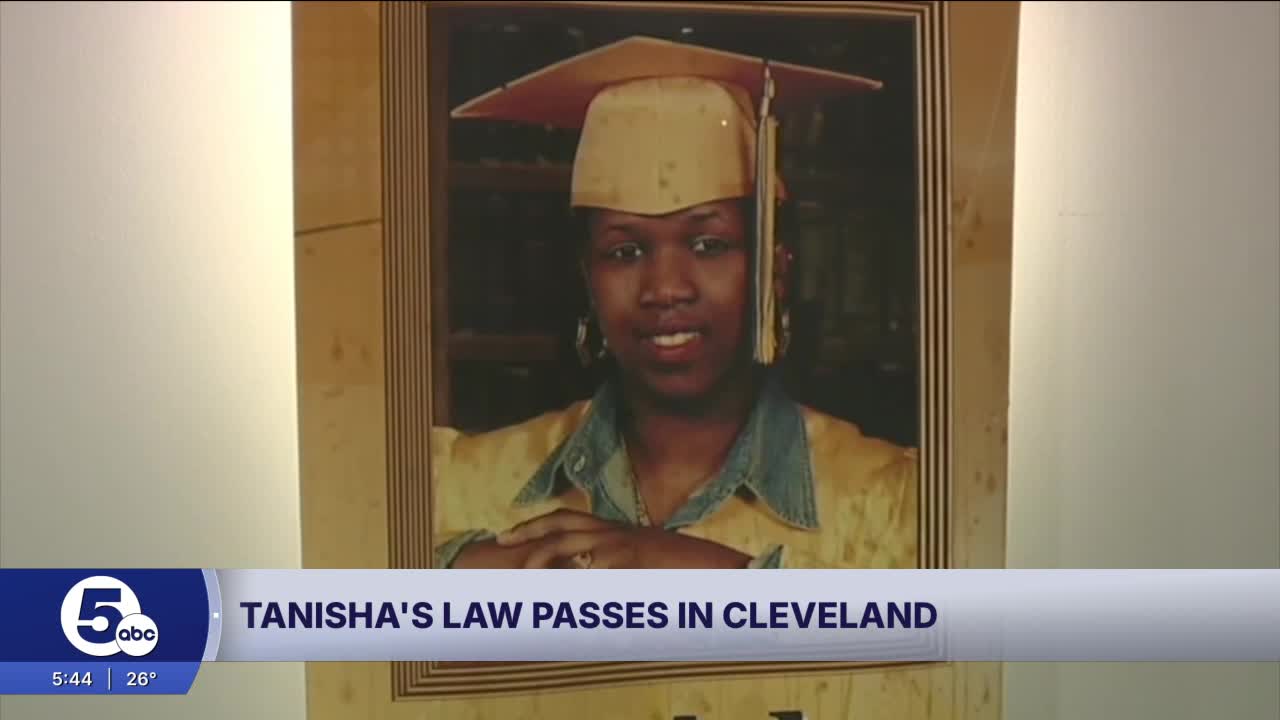


CLEVELAND — Cleveland City Council passed Tanisha’s Law at Monday night’s meeting.
It’s named for Tanisha Anderson.
She died in 2014 at the hospital after a struggle with Cleveland police officers during a mental health crisis.
Cleveland City Council Member Stephanie Howse-Jones spoke about Anderson’s daughter.
"She loved her daughter, and she showed up for her daughter, and she ensured that her daughter was engaged in life and because of that tragedy that happened on Nov. 12 of 2014, it changed the trajectory of Mauvion’s life, and she is a young woman right now. But I just want to let her know that your mother is not forgotten," said Howse-Jones.
Tanisha’s law creates a department of Community Crisis Response. Instead of police, trained, unarmed crisis teams will respond to calls for non-violent mental or behavioral health emergencies.
City officials said key components include:
- Creation of a Bureau of Community Crisis Response within Cleveland EMS, led by a Deputy Commissioner, to coordinate citywide crisis response efforts in collaboration with public safety, public health, and other city departments.
- Unarmed Crisis Response Teams made up of behavioral health professionals, social workers, peers with lived experience, and clinicians. These teams will be dispatched—often instead of police—to non-violent behavioral health crises, wellness checks, substance-use crises, and quality-of-life calls.
- Crisis call diversion through embedding mental health clinicians in the 9-1-1 dispatch center to route appropriate calls away from policing and toward behavioral health responses.
- Follow-up care and service connection, with responders assessing needs, providing resources, making referrals, and helping individuals access appropriate facilities or services.
- Transparency and accountability, including:
- Ongoing data collection on effectiveness, outcomes, costs, and return on investment
- An annual public report on program impact and recommendations
- A public online dashboard showing response data, police hours saved, and community feedback
- Expanded crisis intervention training for police, including:
- Mandatory crisis-intervention training for all officers (initial and annual refresher)
- Specialized, voluntary 40-hour training for designated Crisis Intervention Team (CIT) officers
- Stricter eligibility standards for CIT officers, excluding those with histories of excessive force complaints
- Public education and engagement, with outreach to inform residents about the new crisis response system and how to access it.
