

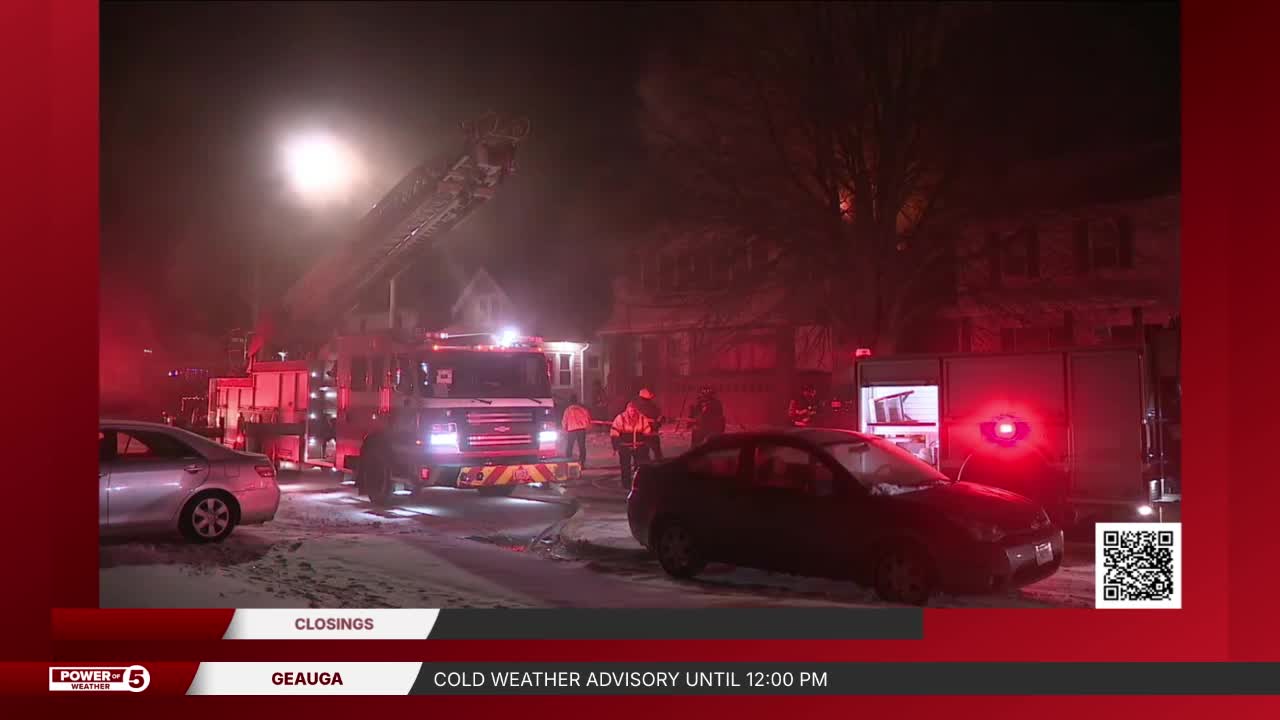


CLEVELAND — A Cleveland Firefighter was injured Tuesday morning after crews battled a house fire on Cleveland's West Side. The fire started around 3 a.m. inside a home on West 136th Street and Lorain Avenue.
Cleveland Fire confirmed to News 5 that a firefighter fell from the attic to the second floor while responding to the call. He was able to walk out of the home, and EMS rushed him to Metro Hospital, where he is in serious condition with neck pain, according to Cleveland Fire Public Information Officer Lieutenant Mike Norman. Cleveland EMS tells us no one inside the home was hurt.
Investigators are working to determine the cause of the fire. Lieutenant Norman says it's been a hectic and frankly brutal winter already. Just last Wednesday, he says, crews responded to five structure fires.
Our Overnight News Tracker captured crews salting the street and sidewalks along West 136th Street near Lorain Avenue—to prevent slips and falls at the most recent fire. EMS on scene was also told to get in their ambulances and stay warm until they were needed. With temperatures so bitter, people are doing whatever they can to keep out of the cold.
But in some cases, Norman says they are unknowingly putting themselves in danger. Norman warns that you should not heat your home using a stove or grill inside a garage or any other enclosed area.
"These are clear burn and fire hazards. This is a huge no-no. If you need additional support, go to a warming center," Norman said.
If you are using a space heater, Norman says keep three feet of clearance around it. Nothing should come in contact with the device.
Also, you should plug it directly into the wall—not an extension cord. And when you leave home, he says you should unplug the space heater from the wall. While a quick fix for heat, space heaters have caused countless fires over the past years, he says.
As for responding to calls, fire crews are taking extra precautions to ensure water is constantly circulating so it doesn't freeze in the truck. Norman says they work to stay hydrated, wear several layers under their uniforms, and pay close attention to their bodies for signs of frostbite and hypothermia. They also carry cold-weather bags—with extra changes of clothes, socks, and gloves.
"Some things can go wrong—certainly in the cold weather. And it's just more dangerous for us to fight fires this time of year. There's ice all over the fire ground. The water gets on your coat, your equipment. It's tough," Norman said.
Norman is asking folks to please be mindful of the sub-zero temps. If you can, stay at home. If your home has a fire hydrant in the tree lawn, clear snow from around it.
"This helps us so much. No one wants to experience a fire, but the sooner we can get access—-the less loss and damage you will experience," Norman said.
Norman also stresses that this is the time to have a carbon monoxide detector. Homes are sealed off, and with hot water tanks and old furnaces sometimes malfunctioning, he says that the device could save lives.
