

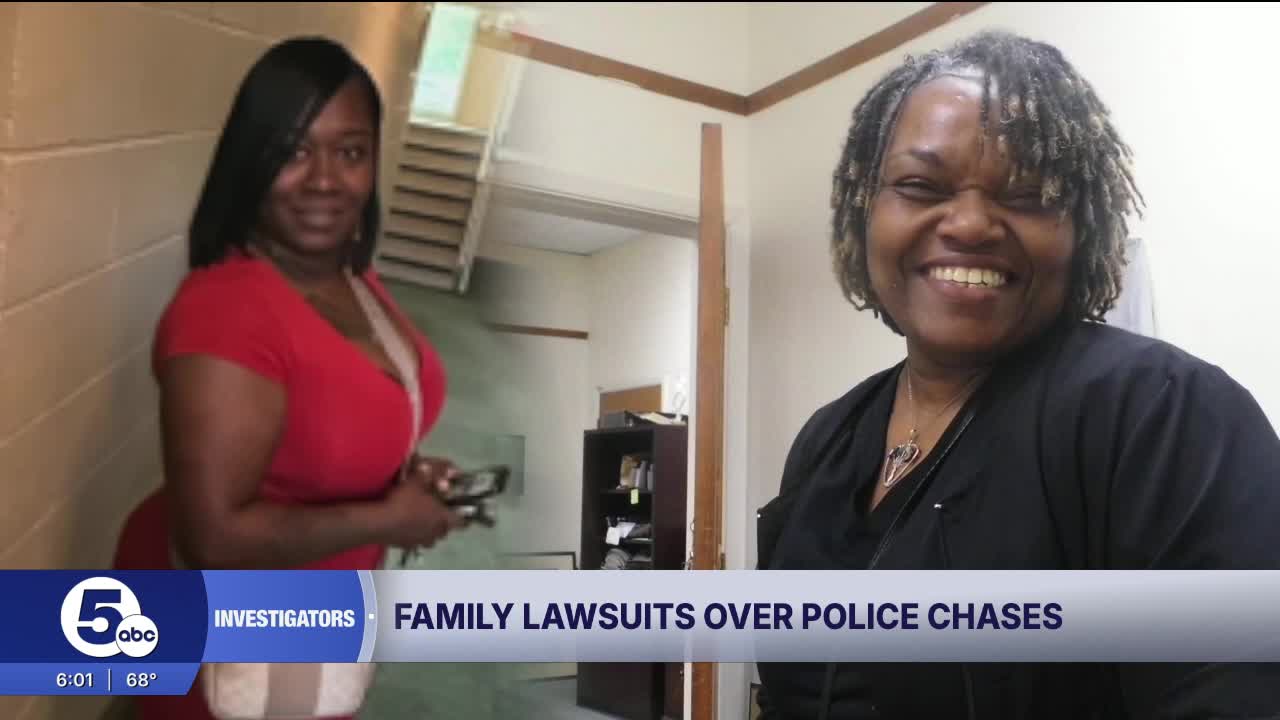


The families of Sharday Elder and Tamya Westmoreland, two innocent drivers who were killed during separate chases involving Cuyahoga County sheriff’s deputies last year, have filed wrongful death lawsuits.
According to the Elder family's lawsuit, the family believes the county violated its own pursuit policy by reaching high speeds, as well as other factors.
To read the lawsuit, click here.
Calls for accountability.
The families want chases to stop, and all Cuyahoga deputies involved in the two deadly chases to be held accountable, along with Sheriff Harold Pretel.
Last fall, the county released a new, more restrictive chase policy, but the attorney for the families says that is not enough.
The families of Westmoreland and Elder spoke during a news conference Monday outside the Cuyahoga County Administration building in downtown Cleveland.
"We just try to live through her and do the things she would want us to do to make her proud, but it’s definitely been hard and an adjustment,” said Westmoreland’s daughter, Dymond Westmoreland.
They called for justice and accountability.
"Why did you pursue the chase? Why did you let this happen to my sister?” Elder’s sister, Cearria Elder, said.
Attorney Stanley Jackson is representing both families and filed the civil lawsuits last week.
"Both of these women lost were the glue to their families over a minor traffic violation, that’s unacceptable. To have a policy in place that would allow that to happen shows that the county sheriff department, the Downtown police unit, was even ill-equipped to be a unit,” Jackson said.
Read the lawsuit here.
Loudermilk will not face criminal charges in either case.
In the Westmoreland crash, a special prosecutor found the initial stop for traffic violations was justified, and the driver, Nigel Perry, triggered the deadly sequence of events. Perry also died in the crash.
The same special prosecutor says the reckless driving by the suspect, Jaymone Whitaker, created the conditions that led to the deadly crash that killed Elder.
Read the special prosecutor reports here and here.
Jackson says the same deputy behind the wheel in both crashes is the common denominator.
"There’s no way, if there was true accountability, that Loudermilk would have been back on the road; that’s unacceptable after five months,” Jackson said.
Last month, News 5 investigators asked County Executive Chris Ronayne about the chases and whether he was preparing for lawsuits.
“I think our team is always following a risk management outlook,” Ronayne said.
“Looking back within the framework of the policy, had those pursuits were authorized within the framework,” Ronayne said.
Jackson believes the pursuit policy change by the county was rushed.
"This family would have loved to have been part of those community sessions that could have happened to engage them to say this is what we would rather see, we gave the ultimate sacrifice, we should be at the table,” Jackson said.
Dymond says the deadly chase that killed her mom left a lasting impact.
“I have two small children, and now I drive around daily, scared of a police chase,” Dymond Westmoreland said.
What happened?
On August 24, 2025, Elder was at a red light when a car came out of nowhere and slammed into the driver’s side door.
The 24-year-old driver was being chased by deputies with the Cuyahoga County Sheriff's Department Downtown Safety Patrol.
The county says deputies first tried to stop the suspected drunk driver at St. Clair Avenue and E. 13th Street, but the car didn’t stop and took off east.
Minutes later, and less than three miles away, the crash sent six to the hospital, including Elder’s passenger, a deputy, a woman, and a teenager, the same age as Sharday’s son.
Five months earlier, in March, a fiery crash killed another innocent woman, Tamya Westmoreland, and Nigel Perry, the man the deputy chased over concerns about window tint and expired tags.
The same deputy was behind the wheel in both deadly chases.
Revised Chase Policy.
The new chase policy restricts deputies on when and whom they can chase.
A deputy can still initiate a pursuit when someone doesn’t stop for them. But, only when it’s believed the suspect committed a violent felony, like a murder, kidnapping or rape.
In the revised policy, deputies also have to take into consideration things like protecting innocent bystanders, how well the deputy knows the area, the quality of the deputy’s driving skills in a chase, and communicating with dispatchers.
