

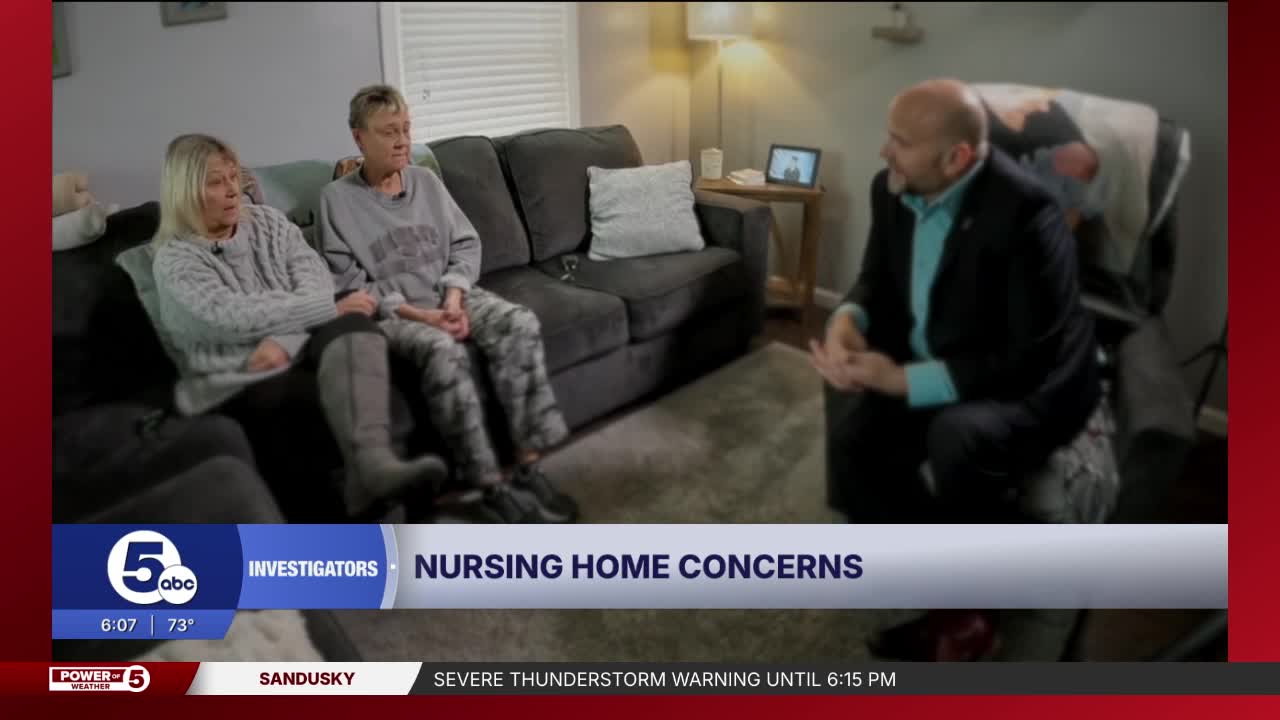


CLEVELAND — A federal program called “Special Focus Facility,” intended to improve care, is not doing its job. So, for many, it begs the question—who is holding these kinds of homes accountable?
Family and friends of loved ones in local nursing homes have been reaching out to the News 5 Investigators asking for help. We heard your concerns.
Our recent investigations into poorly performing facilities have shown that even a federal program called “Special Focus Facility,” which is supposed to improve care, is not doing its job in the long term.
RELATED: This was scary,' says paralyzed man who called 911 for help
So, for many, it begs the question, who is holding these kinds of homes accountable?
We recently told you about Louwava Hykes in Blossom Care Center of Cuyahoga Falls. That home was sold by Continuing Healthcare Solutions, which said it wasn’t a Special Focus Facility until after it was out of its hands back in 2022.
A name change to Blossom Care Center of Cuyahoga Falls happened in May of 2024, and it’s been an SFF home for 20+ months now.
WATCH:
RELATED: Local nursing home spends 2 years on federal list of poorly performing facilities
“When she does turn on her call light, they just walk right past it,” said a friend of Hykes, Becky Biddle. “They don’t pay any attention.”
Hykes’ niece Karla Hykes said, “It just breaks my heart. I can’t do anything.”
SCALING BACK ON REGISTERED NURSES
CMS sent us a statement recently saying it’s strengthening the program. But we also found the federal government is scaling back on staffing nursing homes 24/7 with registered nurses. Nursing homes complained about those previous regulations under the Joe Biden Administration.
However, those representing families of nursing home residents, such as Judy Marsh in Canfield, who they claim died under poor care, told us that’s not a good idea.
WATCH:
RELATED: Daughter says poor care in nursing home led to her mother's death; facility denies allegations
“The absolute last thing the nursing home industry needs and that nursing home residents like Judy Marsh need right now are less staffing requirements for these facilities,” said Attorney Matthew Mooney.
WORDS AND RESEARCH
Meanwhile, across Ohio, Attorney General Dave Yost just last month spoke about bringing resources together to help protect seniors. One of those partners is the Ohio Health Care Association, which represents 1,300 elderly care businesses in our state, like nursing homes.
“Across Ohio, we ensure every provider understands not only federal and state requirements, but also the best practices that create a culture of safety and accountability,” said the CEO of the Ohio Health Care Association, Scott Wiley.
After he said that, we went to the association’s website, which provides a search tool for anyone to find elderly care. When we searched for cities in Ohio, the health care association led us to its members’ nursing homes, including two on the federal Special Focus Facility list, which CMS reported are not providing best practices or care.
In fact, in recent inspections of those Ohio facilities, the state cited one in July of last year for “actual harm” with a fracture while trying to move a resident. And last June, the other home that’s been on the SFF list for 16 months was cited for failing “to ensure a resident was free from sexual abuse” from another resident.
The homes implemented measures such as “re-education to all staff,” “complete thorough (investigations)” and more.
“Elder abuse is not just a violation of trust, it’s a betrayal of dignity every Ohioan deserves,” said Wiley. “And our care community has zero tolerance for it.”
WHAT ELSE CAN OHIO DO TO HELP SENIOR CITIZENS?
In a separate case from the SFF homes, the Ohio Attorney General’s Office shut down the House of Loreto nursing home in Canton this year after concerns about care.
WATCH:
RELATED: Nearly all residents out of problematic nursing home after OH Attorney General asked for shutdown
So, we asked him if there’s anything more the state can do with special focus facilities like Blossom Care Center of Cuyahoga Falls that remain on the lists for months and months.
“Well, I appreciate you bringing that up, and I will be candid with you—that it’s not something that has been on my personal radar,” said Attorney General Dave Yost. “After this conference, I will speak with my staff, and we will take counsel with ODH and look at what this program does and doesn’t do.”
We asked multiple times for a follow-up interview to see what he found and ask about Hykes’ nursing home in Cuyahoga Falls. His office then referred us to the Ohio Department of Health, which, by the way, has told us it submits inspection info to CMS.
“We take every single complaint with great seriousness, and we investigate those complaints,” said Dr. Bruce Vanderhoff, director of Health at the Ohio Department of Health, in a recent interview about nursing home problems.
PROBLEMS WITH STAFFING IN NURSING HOMES
Wiley said in the news conference that Ohio nursing homes are doing well.
“There is no state in the eastern or central (area) that has higher quality scores than the state of Ohio,” said Wiley.
However, a newly released report from the Department of Aging showed that Ohio’s direct-care staffing levels fall below the national average, and certified nurse aide staffing was below that of all neighboring states except one. Also, the turnover rates for total nursing staff and registered nurses were above the national average and higher than all of the neighboring states.
“It’s very aggravating,” said Biddle. “It’s sad when you go in to talk to the director of nursing and, all of a sudden, there’s a new one. And then a couple of months, there’s a new one.”
The CEO of the Ohio Health Care Association said the nursing staff shortage is causing real stress on the system.
“So, we’ll continue to work with the Department of Health, the Department of Aging, our institutions of higher education around the state and any other workforce partner who wants to meet us at the table to find meaningful ways to grow the healthcare workforce to support the needs of Ohio’s aging population,” said Wiley.
Hykes’ friends and family said they’re counting on change to happen soon for Hykes and for elderly people across Ohio.
“They need more employees and people that want to work, but you can’t go out and grab them off the street,” said Hykes’ niece, Karla. “They have to want to have a job and really want it.”
The recent profile report of nursing homes by the Ohio Department of Aging showed the number of substantiated complaints in Ohio doubled from 2019 to 2022, and the state’s population of people age 60 and older will continue to grow through 2030.
