

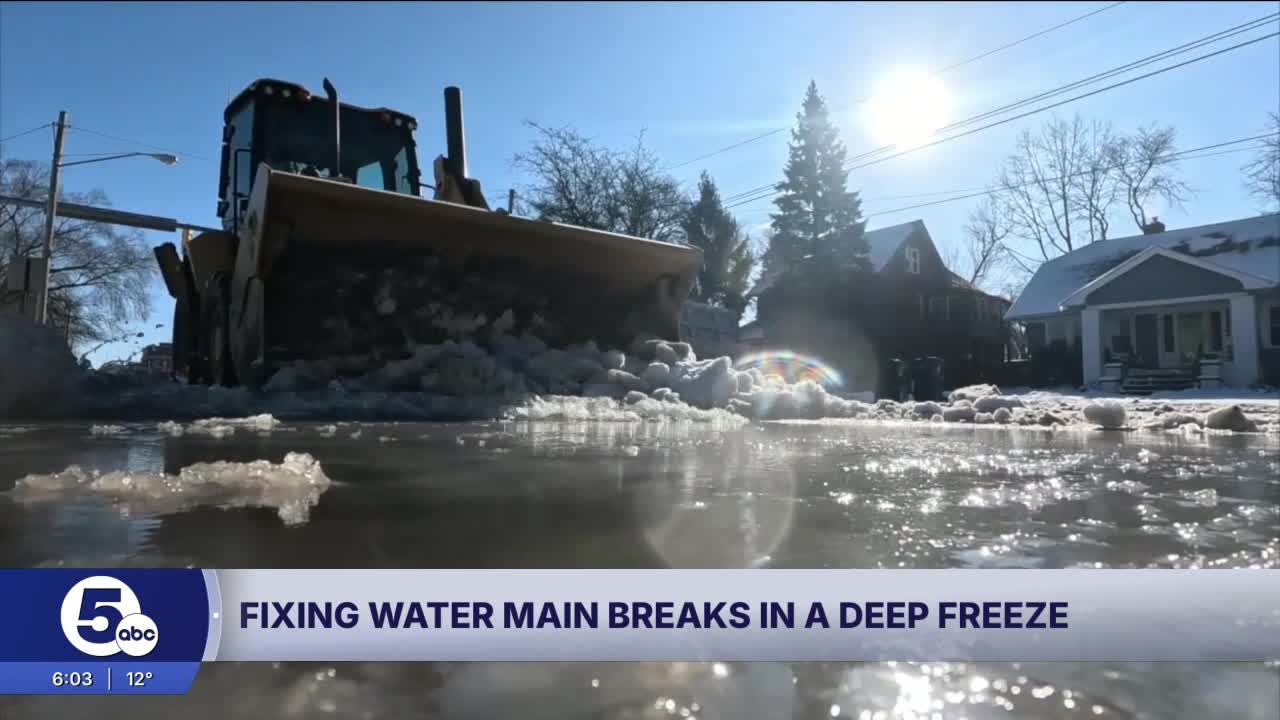


Water main breaks are part of winter in Northeast Ohio, causing headaches for drivers, homeowners and businesses.
According to Cleveland Water, outside of winter, they average three to five main breaks a day. During the winter, that bumps up to five to seven breaks a day -- even more during an extreme cold spell.
News 5 Photojournalist Dave Colabine has been driving by a water main break in an eastern suburb for several months on his way into work.
So, on Tuesday, he and I went to check on it and see if any progress had been made.
We found an icy stream that has been flowing slowly and steadily into the area of Cedar Road and Cottage Grove Avenue.
Neighbors telling us they've been dealing with it since as early as October.
Many are saying they're frustrated, fed up, and worried -- calling it a danger.
While it is in the city of Cleveland Heights, it's Cleveland Water’s line.
With the winter weather and extreme drop in temperatures this week, the flowing water has turned the front of homes into frozen fortresses, locking garbage cans, driveways, and homeowners into an icy jail.
One woman told us she damaged her car on the ice while trying to get out of her driveway.
Another woman said she couldn't even get out to drive to work and was thankful she could do some work remotely.
Finally, on Tuesday, Cleveland Water was on scene, and a fix was underway. Heavy equipment was also there, chipping away at the ice that had built up on the road and in front of homes.
It is not just the City of Cleveland Heights dealing with water main breaks.
In West Lake, a large water main break closed part of Dover Center Road on Tuesday between Center Ridge and Rose. The city said Cleveland Water had been notified.
Water main breaks are significantly more common in the winter because of the expansion and contraction of freezing ground, which puts a lot of pressure on pipes.
On their website, Cleveland Water provides an explanation.
They say when air temperatures drop below 32 degrees Fahrenheit, the water in the soil starts to freeze. The depth at which that happens is called the frost line. Here at home, that’s typically three to three-and-a-half feet. They say most of Cleveland Water’s mains and service lines are buried five feet or more. At this depth, the weight of the soil above exerts a downward force of about 200 pounds per foot of pipe.
However, the colder the winter and the longer it lasts, the deeper the frost line, and it doubles the pressure on pipes, which increases the likelihood of a break.
There's also still a lot of older cast iron pipes out there -- which are more brittle than ductile iron, which the other newer mains are made of.
With Cleveland Water on scene in Cleveland Heights on Tuesday, neighbors told us they were grateful that a fix was finally underway.
"I would say a big thank you finally, because it’s been there so long and I’d given up,“ said one man who's lived in the neighborhood with his wife for 33 years.
Cleveland Water maintains more than 5,300 water mains.
We did reach out to Cleveland Water for comment. They told us Tuesday evening that the break on Cedar Road had been repaired and the main was back in service.
They said their crews and contractors are working to address breaks as quickly as possible and prioritize them based on factors including severity of break, number of customers affected, and overall system integrity.
Residents with property damage can go through the city of Cleveland’s claims process.
If you see a water main break, call Cleveland Water’s 24/7 emergency line at 216-664-3060.
