

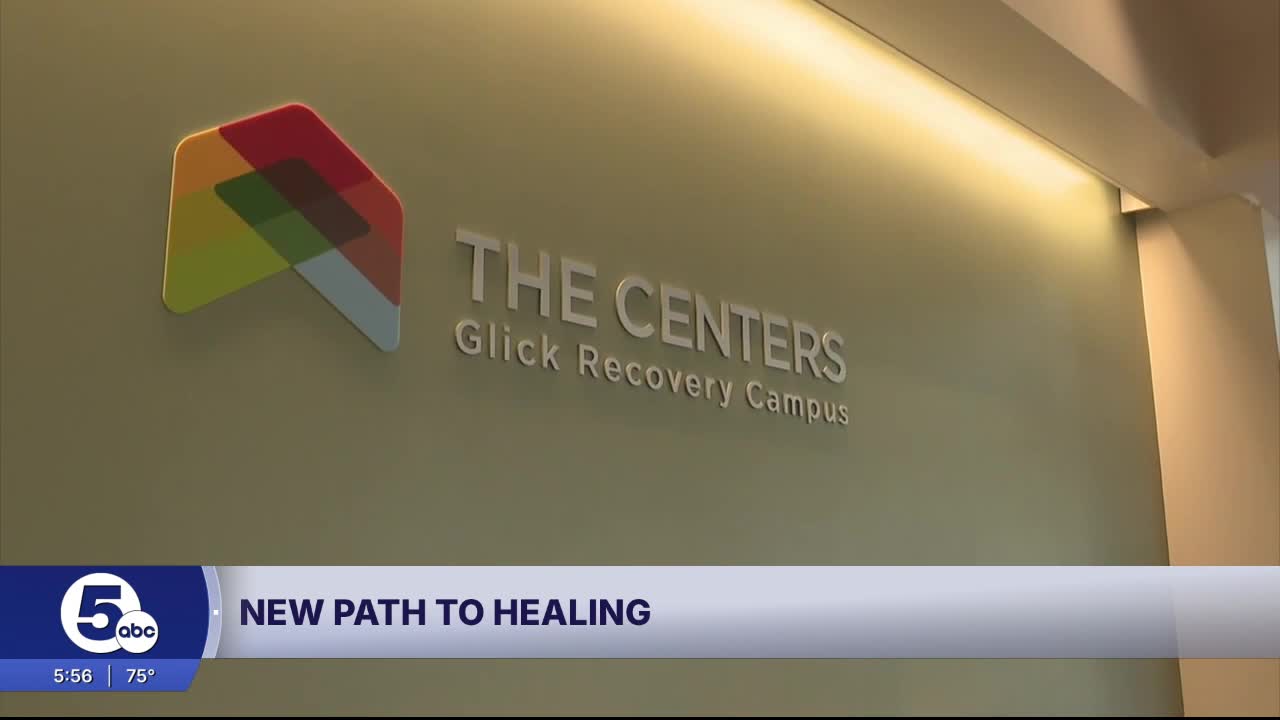


CLEVELAND — A ribbon cutting on a rainy Friday morning in downtown Cleveland.
“Typically, when it rains on something like this it’s good luck,” said Eric Morse, president and CEO of The Centers.
The Centers, one of the oldest and largest nonprofit health and human service agencies in Northeast Ohio, now operates Cuyahoga County’s first behavioral health crisis center that opens this month.
“Welcome to the Glick Recovery Campus,” said Morse to a crowd gathered Friday to celebrate the facility.
Those in attendance said they’re excited, they’re hopeful and that this kind of care is so needed.
“It brings together crisis stabilization, peer support, psychiatric care, medication for addiction treatment, withdrawal management, primary care, counseling, pharmacy, case management and outpatient services all in one integrated environment,” Morse said.
The 24/7 crisis care opens Sept. 28. So does the short-term stabilization unit.
The Centers team stresses that this is for any adult in a mental health or substance abuse crisis. No referral or appointment is needed. Come in, and they will figure out the right place for you.
Larry Heller, street outreach coordinator with Northern Ohio Recovery Association, said it can’t open fast enough.
“Because we need this universal point of access,” Heller said. “One place where no one will ever be turned away. That’s our most urgent need.”
The outpatient health care center on the third floor opens Sept. 14.
And the withdrawal management unit opens in January.
Among the goals of the Glick Recovery Campus is to reduce stress on emergency rooms and jails; two places people experiencing mental health or substance use crises often wind up and can linger for days.
“Today, with The Centers, we now have another option,” said Deputy Chief Jarod Schlacht of the Cleveland Police Department. “We cannot do this alone, and partnering with them is going to be critical to the citizens of Cleveland and the citizens of Cuyahoga County.”
The Glick Recovery Campus has a sally port for law enforcement and EMS to bring people experiencing a mental health or substance use crisis.
The Centers said staff will meet them and have law enforcement and EMS back out on the streets within minutes.
The Centers said the goal of the campus is also to help people recover and heal sooner.
“When someone in a behavioral health crisis comes in or family brings them in, they’ll be greeted by a peer and a nurse who then does triage and figures out what it is they need,” said Morse while touring lawmakers, law enforcement and community stakeholders around the new facility.
“Families and people who you love know that they have a real place to be cared for,” said Stephanie Howse-Jones, Cleveland City Council Ward 8, about The Glick Recovery Campus.
It is a $36 million project that’s a mix of federal, state and county money.
That includes $6.8 million in American Rescue Plan Act capital funds awarded by the Ohio Department of Mental Health & Addiction.
“What this project is, by definition, is hard; it is transformational,” said Ohio Rep. Bride Rose Sweeney, (D) House District 16.
Congresswoman Shontel Brown, (D) Ohio’s Eleventh District, spoke at the ribbon cutting Friday and announced that she has requested additional funding for The Centers in this year’s appropriation bill.
The project also includes $17 million in new market tax credits.
“What we know to be true about folks experiencing homelessness is they do cycle through jails, they do cycle through emergency departments because they don’t have the highest and best use system available to them when they are in crisis,” said Leah Werner, Corporation for Supportive Housing.
The Cuyahoga County Council allocated $7 million from its opioid settlement funds for the project, and this month will be debating whether to use more for operating costs over the next several years.
Philanthropy, led by the Glick Family and Sisters of Charity, also made the project possible.
I spoke with Sister Judith Karam during a tour for stakeholders prior to the ribbon cutting Friday morning.
She told me how needed this is in the community and later spoke about how deeply personal and meaningful it is to her that their legacy of addiction recovery will continue with the new Rosary Hall Withdrawal Management Unit that opens in January.
“Rosary Hall has always been an essential part of this community since 1952,” Karam said.
She also talked about how well the Glick Recovery Campus complements the St. Vincent Health and Healing Hub — the reimagined site of the former St. Vincent Charity Medical Center in the Central Neighborhood, among the poorest in the city.
The Healing Hub includes Goodwill Industries' plan to build an Opportunity Center with a grocery store just across the road on E. 22nd Street.
The Centers is expecting to serve 12,000 people a year at The Glick Recovery Campus.
The Centers hired close to 70 people for the new facility that'll employ between 130-140 people at full capacity. They said they are still hiring.
