

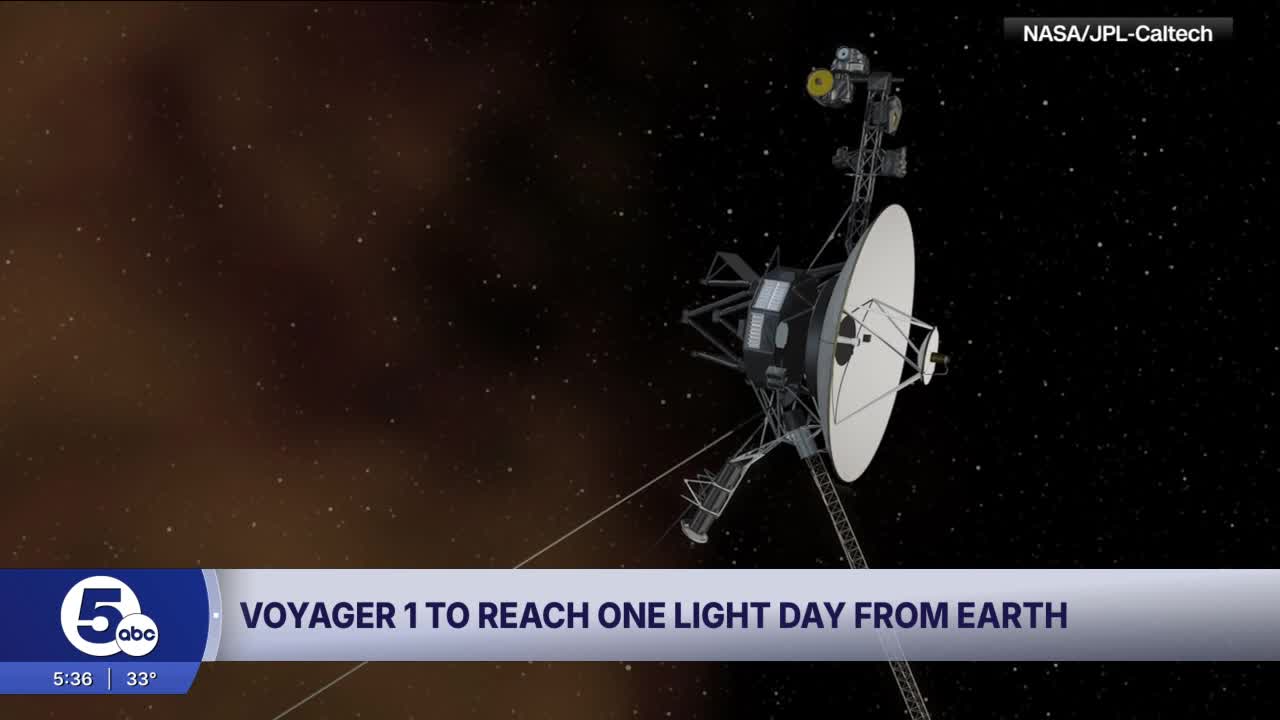


NASA says its long-running Voyager 1 spacecraft is on track to reach an unprecedented distance in 2026 when it becomes the first probe to travel one light-day from Earth.
Launched in 1977, Voyager 1 is the farthest spacecraft from the planet, currently about 15.8 billion miles from home as it travels through interstellar space.
One light-day is roughly 16 billion miles, a distance requiring 24 hours for a signal traveling at the speed of light to reach the spacecraft, according to Suzy Dodd, Voyager project manager at NASA’s Jet Propulsion Laboratory.
Each spacecraft still has three working instruments to study the far reaches of the sun’s protective bubble. This region, known as the heliosphere, is a vast envelope of magnetic fields and particles extending well beyond Pluto’s orbit. Voyager 1 and Voyager 2 are the only spacecraft operating in this distant region of space.
Voyager 1 discovered Jupiter’s thin ring and several of Saturn’s moons. Voyager 2 remains the only probe to visit Uranus and Neptune.
The update comes as NASA continues shutting down instruments on both Voyager probes to conserve power. Dodd said the energy-saving steps are necessary to extend the missions as the probes approach their 50th anniversary in 2027.
