

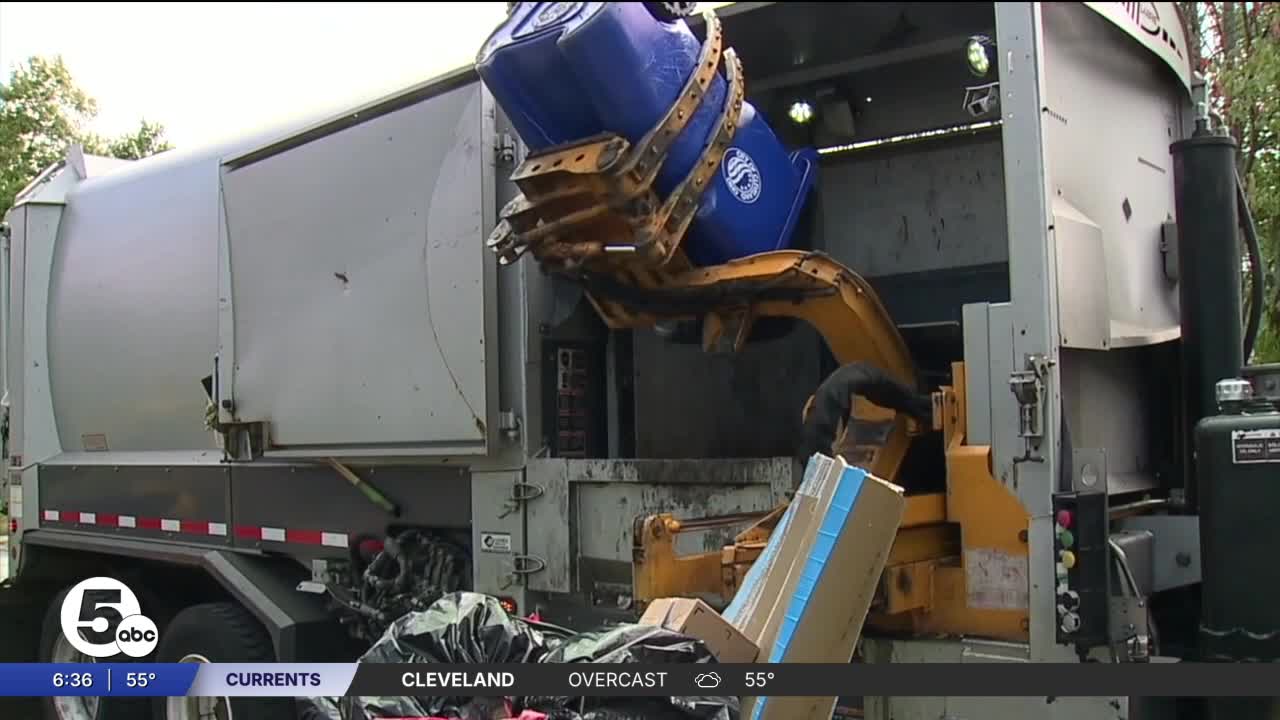


CLEVELAND — Cleveland’s recycling program has come a long way since the city shut it down in 2020, but city leaders admit there is still plenty of work to do.
For years, Cleveland has tried to rebuild trust and participation in its recycling efforts after officials revealed that nearly two-thirds of the material residents were placing in blue bins was actually trash.
In response, the city halted curbside recycling operations entirely in 2020.
Two years later, under Mayor Justin Bibb, Cleveland relaunched recycling with a new “opt-in” system.
Residents who wanted to participate were required to register with the city and place official recycling stickers on their blue bins.
The program was originally described as temporary.
Now, four years later, Cleveland leaders say they are still trying to improve participation and educate residents about what can — and cannot — be recycled.
“We’re not perfect, but we are working on trying to get to the place to make this better,” said Cleveland Public Works Director John Laird.
According to data presented to the council, the city has distributed roughly 175,000 blue recycling bins across Cleveland.
However, only about 70,000 households are actively enrolled in the recycling program — a participation rate of roughly 40%.
Under the current system, Cleveland crews collect recyclables only from residents enrolled in the opt-in program. Residents must have both a blue city-issued recycling bin and the city-issued recycling sticker.
Laird acknowledged that the system has been confusing for many residents.
Still, he says the city is working to improve communication and increase participation.
Public Works has also brought in consultants to help develop more effective outreach strategies and improve public engagement around recycling.
“We want to rethink, we want to go after some more folks who want to try to convince and persuade those folks who are on the fence about recycling,” Laird said.
He also suggested that more public education efforts could help residents better understand the process, and the city is currently working with a consultant to review and improve the program.
And longtime recyclers in Cleveland agree.
“The public needs to be informed, and I think there should be billboards. You don’t know how to recycle? Barcode this," said David, a Cleveland resident.
City leaders say there has been progress in at least one major area: contamination rates.
The city council reports contamination — meaning non-recyclable trash mixed into recycling bins — has dropped to about 14% over the past two years.
The city also says recycling saves money.
According to officials during the council meeting, every ton of material diverted from landfills through recycling saves Cleveland at least $20.
City leaders stress the following items can be recycled: paper, cardboard, glass, metal cans and plastic bottles.
However, several items should stay out of recycling bins, including electronics, old televisions, radios, Styrofoam and greasy pizza boxes.
CLICK HERE if you're interested in joining Cleveland’s recycling program.
You can also call 3-1-1 for assistance.
