

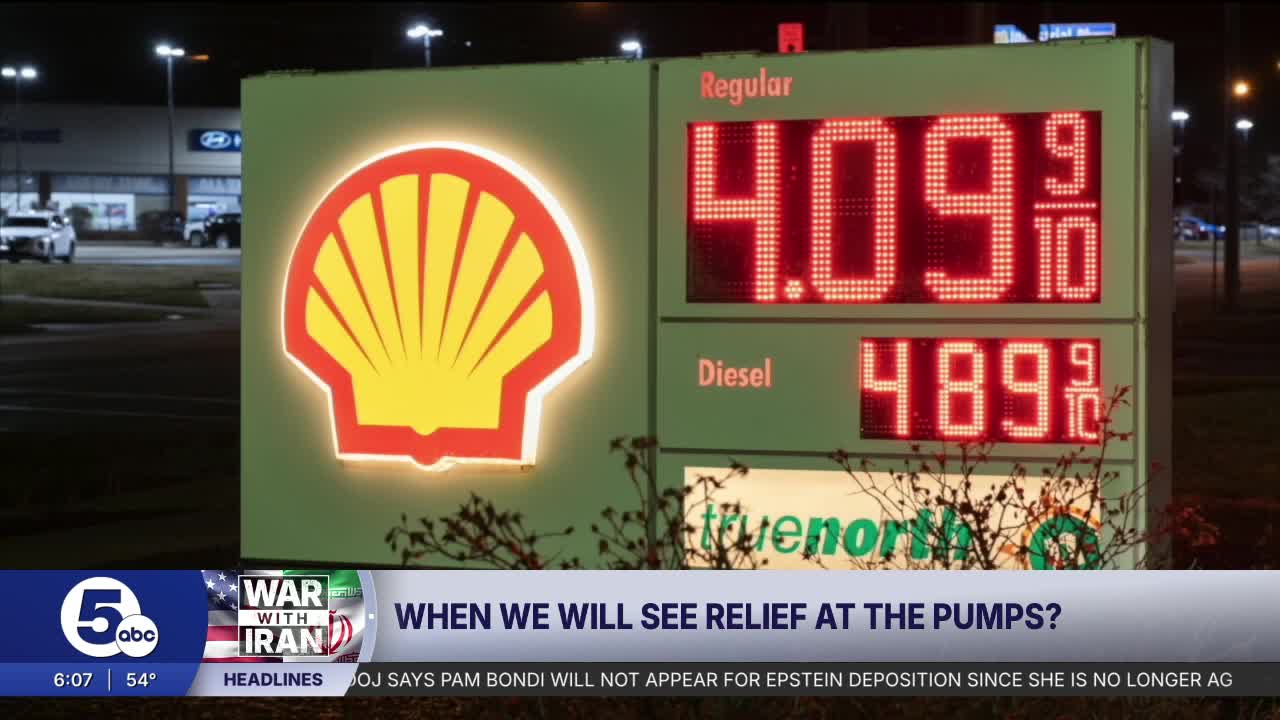


CLEVELAND — Some relief could potentially be on the way the next time you fuel up at the gas station.
Experts say that as tensions impacting shipping through the Strait of Hormuz begin to slightly ease, gas prices may start to decline.
However, drivers shouldn’t expect immediate overnight savings.
After weeks of volatility tied to conflict in the Middle East, analysts stress the situation remains highly unstable—even with ongoing reports of a temporary ceasefire.
Gas prices across Ohio surged to around $3.99 per gallon earlier this week.
Nationally, prices peaked at about $4.16 per gallon, while diesel climbed to $5.69, according to AAA.
In Ohio, the statewide average is now hovering near $3.93 per gallon—well above the $3.10 level a year ago.
While global oil prices dropped and stock markets rallied following news of a ceasefire, experts say consumers will likely only see modest, gradual relief at the pump.
That’s due to ongoing shipping delays, recent military activity, and continued uncertainty surrounding the conflict.
They say disruptions in oil routes can take time to resolve.
Patrick De Haan, Head of Petroleum Analysis at GasBuddy, says while prices may fall slightly in the short term, the ceasefire remains fragile—and escalation could quickly send prices climbing again.
"It's very possible that just as quickly there was a ceasefire—there could again be escalations—could be contending with higher oil prices. I can't underscore enough the uncertainty," De Haan said.
De Haan says that, from an oil market perspective, the most important factor is whether ships can safely pass through the Strait of Hormuz.
In the meantime, drivers are encouraged to shop around for lower prices. According to GasBuddy, some of the cheapest fuel in Northeast Ohio includes:
- $3.39 at Gas USA on West 117th Street in Cleveland.
- $3.43 at BJ’s in Avon.
- $3.45 at Sam’s Club in Sheffield Village.
- $3.52 at Sam’s Club on Brookpark Road.
How long the current back-and-forth will last remains unclear.
Experts say drivers should be prepared for continued price swings and consider using fuel rewards programs or discounts to offset costs.
For now, it’s a waiting game.
