


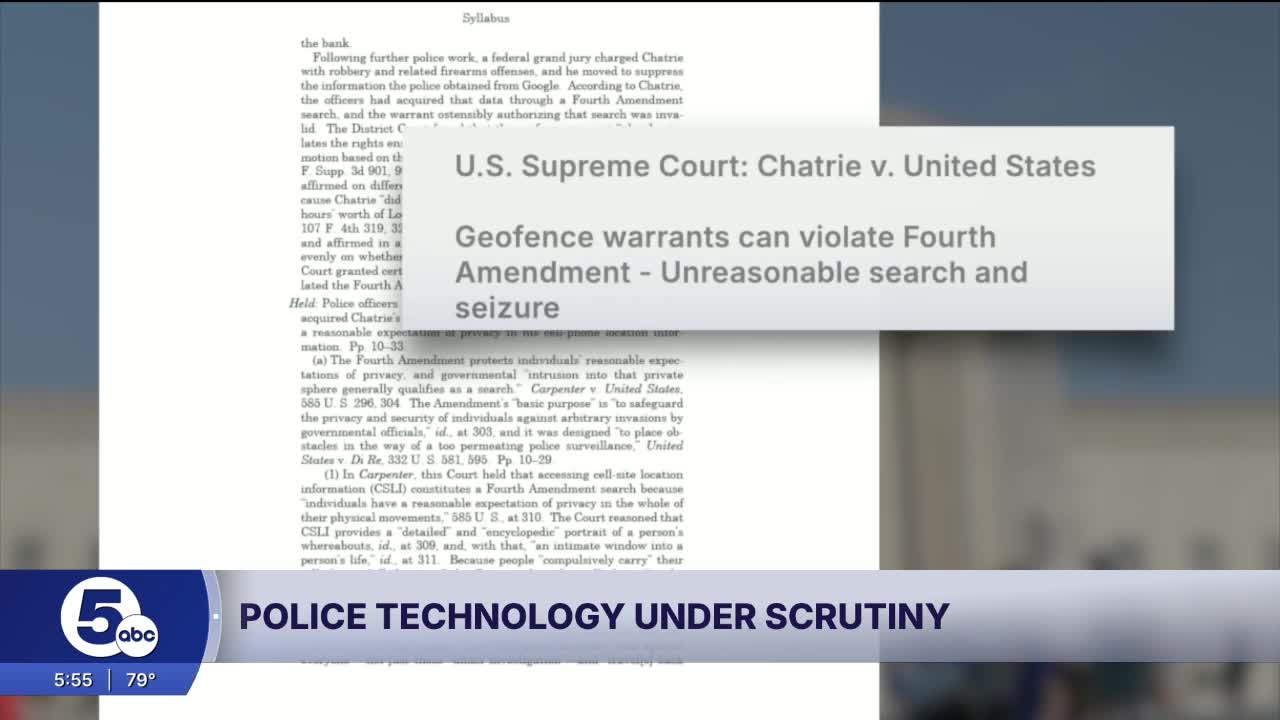



COLUMBUS, Ohio — The U.S. Supreme Court's decision restricting law enforcement's ability to use sprawling cell phone location data is bringing to light questions about the legitimacy of Flock Safety cameras.
Police use "geofence warrants" to get location data of suspects' electronic devices.
"We just hope that it is not a tool that is removed from our tool belt," Ohio Fraternal Order of Police President Jay McDonald said.
These can help solve crimes when police run out of options, he added.
A new Supreme Court decision is shining a spotlight on police technology.
"We need to make apprehensions in those [cases] as quickly as possible to prevent other violent crimes from occurring," he said.
But these search every device in an area, starting from casting a wide net to more in-depth data, Case Western Reserve University criminal law professor Mike Benza said.
"Law enforcement will go to Google with this administrative warrant, saying, 'Give us all of the IP addresses of any connected device in this area around this time when a crime or some other instance of interest has occurred,'" Benza said.
From there, police are able to expand the warrant and look deeper into specific accounts and addresses to get identity information.
The Supreme Court is making it harder or even impossible to get them. The justices ruled that these warrants could constitute an unreasonable search and seizure, because oftentimes citizens' data is scooped up and investigated even if they have no connection to the crime.
"I don't believe my cell number being found in a particular location is particularly troublesome to me if I haven't committed any crimes," McDonald said.
But just because someone else committed a crime, it doesn't mean that there is no longer a right to privacy, Benza said.
"This could help prevent a surveillance state?" I asked the professor.
"Yes, which is exactly the concern that the court is addressing: Can technology basically eliminate the Fourth Amendment protection against an unreasonable search and seizure?" Benza responded.
Police would still be able to get this data, as long as they can prove it in a probable cause warrant, not an administrative one. The latter have easier standards to obtain.
But this ruling worries law enforcement for another reason: Flock camera surveillance.
"Flock cameras are extremely important," McDonald said. "I certainly hope that this does not have an impact on that."
The cameras, typically used as license plate readers, have popped up all over the state and country. They are facing increasing pushback, especially online and at city council meetings.
Flock No was formed late last year when the City of Cleveland wanted to push through the council an emergency proposal to expand Flock's footprint beyond license plate readers without giving other companies a chance to bid.
"I’m not comfortable knowing that my movements over the last month can be reconstructed in very great detail at any given time,” Flock No’s Bryn Adams said.
Benza explains that Flock cameras themselves are likely not violating privacy laws if they are just used for plate reading. They could, though, depending on how much data the company is collecting and how agencies are using it.
The Shaker Heights Police Department changed its policy regarding Flock license plate readers after data revealed that numerous outside agencies were using the system for immigration-related searches.
We recently obtained public records chronicling all Shaker's license plate reader data requests from Dec. 20, 2025, through the end of April, 2026.
The data sets show that Shaker Heights data was accessed more than 700,000 times, but Shaker Police accessed it only 1,016 times. The majority, 693,573 searches, were done by other law enforcement agencies in Ohio and across the country.
A reason was listed for each search. Immigration was listed 282 times. I.C.E. was mentioned 32 times.
Shaker Heights said the city now prohibits searches for "immigration," and any outside agency accessing Shaker Heights' cameras must abide by the new rules.
"If it's used to track you, it now starts to look more like the geofence and the location data," Benza said.
On June 17, the Cleveland City Council Safety Committee voted 3-1 against renewing the Flock Safety contract for the city’s license plate readers. However, they are expected to have another meeting to discuss in mid-July.
RELATED: Flock cameras are still on in Cleveland, even though the contract expired
The Flock camera debate could make its way to the justices' desks in the coming years.
In the meantime, Ohioans are taking Flock into their own hands.
Police in Parma are trying to find out who took down their Flock cameras. Two people, who covered their faces, sawed the surveillance cameras down.
News 5 Investigator Tara Morgan contributed to this report.
Follow WEWS statehouse reporter Morgan Trau on Twitter and Facebook.
