


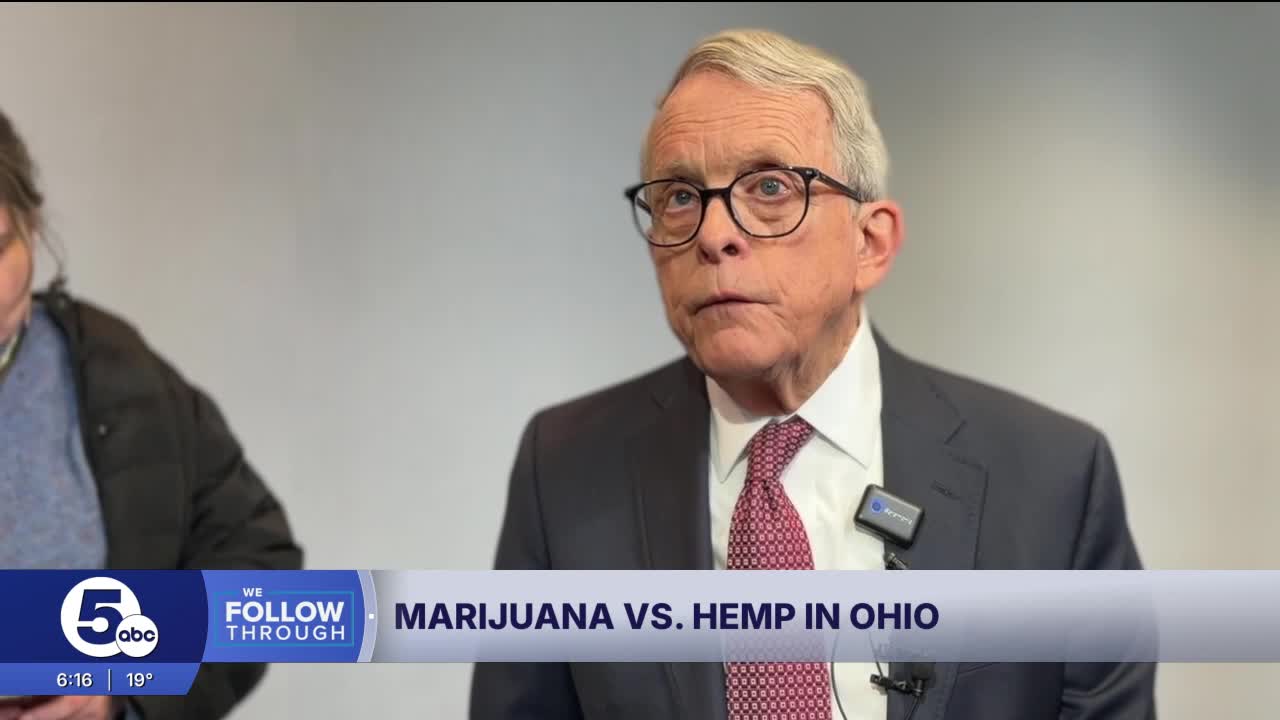


COLUMBUS, Ohio — Ohio Gov. Mike DeWine wants cannabis advocates to stop "whining" after Republicans passed restrictions on marijuana and completely banned "intoxicating" hemp products. Those complaining activists are collecting signatures to put a referendum on the ballot to repeal the new law.
In November of 2023, 57% of Ohioans voted yes on Issue 2: the legalization of recreational cannabis.
I have been covering marijuana policy extensively for years, including a series answering viewer questions about cannabis.
But signed into law in December, Senate Bill 56 makes dramatic changes to marijuana usage and bans low-level THC hemp products. Frustrated with the legislation, Urban Artifact's Scotty Hunter wanted to make a change.
"The fact that the legislature is okay with eliminating 6,000 businesses, a billion dollars per year in economic activity, it's crazy to me — especially when so many Ohioans are struggling," Hunter said. "This is an opportunity for so many small businesses, and now, you're gonna make the economic situation even tougher."
Hunter says this could hurt his Cincinnati-based brewery, one that sells THC-infused drinks, which is why he’s helping collect signatures to get a referendum on the November 2026 ballot to repeal a portion of S.B. 56.
"It's about the freedom of choice and the government not being overbearing in what people can do day to day in their everyday life," Hunter said. "And S.B. 56 completely tramples all over that."
But 21+ breweries aren’t the only place to buy intoxicating hemp. Consumers can get it in gas stations and smoke shops, and it has no age requirements.
"You see this gray market that pops up selling dangerous drugs to children and all other Ohio consumers," Adrienne Robbins with the Ohio Cannabis Coalition said.
One of the biggest opponents to the repeal effort is actually the marijuana industry. Robbins represents Ohio’s licensed cannabis dispensaries, which are frustrated by the lack of oversight on hemp. Hemp sellers say that dispensaries just hate losing business to them.
RELATED: Ohio's new THC ban could 'wipe out an entire industry,' brewery says
"Is this a turf war between the regulated marijuana industry and the unregulated hemp industry?" I asked Robbins.
"That's a great question," she responded.
But she said no, because hemp shouldn’t have turf.
"You have a group of businesses who decided to invest in Ohio, start businesses here, live here, serve medical marijuana patients, and now serve adult-use cannabis consumers, and do it in a safe way where they're also giving back to those communities that they're doing business in," Robbins said. "On the other hand, we have no idea where these products are coming from."
She doesn't want this to be seen as industry versus industry: it's legitimate versus unknown.
Hunter argued that brewers do follow food safety regulations.
"There are processing rules and regulations and testing requirements that we have to adhere to," he said.
Dispensaries should want S.B. 56 overturned, he added, noting that the legislation criminalizes marijuana usage.
Marijuana restrictions
The bill institutes a public smoking ban and prohibits smoking in cars. Also, it gives landlords the ability to prohibit smoking and vaping, bans outdoor venues from allowing marijuana and requires all products to be kept in the same package they were bought in.
It also makes it a crime to have an "open" marijuana container, meaning if someone has a baggie of edibles in the backseat of a Lyft or on a public bus — if it had ever been opened, they would be breaking the law.
RELATED: Did Ohio's THC reform just create a bunch of new crimes?
It also makes it a crime to buy out-of-state cannabis. Federal law currently doesn't allow marijuana to go across state lines, but it isn't enforced. This would be an enforceable state provision preventing a citizen from going to Michigan, where the weed is cheaper, to buy.
The legislation also removes protections against discrimination for housing, employment and even organ donation.
As well, Democrats argue that a provision would allow for police to have probable cause during traffic stops if someone is a "known consumer" of marijuana.
I asked Robbins if she was okay with consumers going to licensed stores, buying legal marijuana, yet getting ticketed or receiving misdemeanors for behavior allowed under Issue 2.
Just because S.B. 56 helped out dispensaries and got rid of their competition, should consumers have to suffer?
"I don't think it's really my place to say whether it's okay or not," Robbins responded. "What I can say is... Us, as Ohioans, need to come together and decide what kind of industry we want. What I have heard from Ohioans is they want a successful industry that's ultimately sending their tax dollars back into their local communities."
She continues that what they didn't ask for is "unregulated synthetic drugs" to be sold all across Ohio. Issue 2 did not deal with intoxicating hemp, and voters did not choose it at the ballot box.
While marijuana industry leaders are opposing the repeal effort, consumers and individual dispensaries have told us that they are helping to push it forward.
Next steps
Ohioans for Cannabis Choice, the organization running the campaign, is starting to collect the nearly 250,000 signatures they need by mid-March, when the law goes into effect.
If they collect the needed signatures, the law will be paused until the November election.
At an unrelated event Thursday morning, I asked DeWine about what could happen if the repeal effort succeeds.
"If the voters do that, does that say to leave it alone?" I asked. "They said what they wanted at least — now — twice."
"Well, I think we're very consistent with what voters intended," the governor responded.
For years, GOP leaders have argued that not only do they know what voters truly wanted when each person went to the polls, but that voters didn't know.
"I think the proponents should be happy with their victory at the polls, instead of now going back and whining about something the legislature has done, which frankly I think is very consistent with what the average voter was thinking when they went in to vote," DeWine said.
Hunter took offense to the governor's remarks.
"We elect officials to represent us and represent what we want to see happen," Hunter said. "We don't elect officials to tell us how to behave, how to act, what to consume. I think they're out of line, quite honestly."
Even if the S.B. 56 is repealed, lawmakers can continue doing whatever they want. They could, in theory, draft a new bill with very similar wording and pass it again.
This stems from how Issue 2 was passed.
For context, there are two main ways citizens can get a new proposal on the statewide ballot: an initiated statute and a constitutional amendment. The recreational marijuana proposal was an initiated statute, which means it goes into the Ohio Revised Code. An initiated statute, or a law, has an easier process of making it to the ballot than a constitutional amendment. Initiated statutes can be easily changed by lawmakers, while amendments cannot.
Advocates say that they are focused on the referendum effort, but everything is on the table — including putting forward a constitutional amendment.
GOP leaders, unsurprisingly, do not want that.
Have questions? Let me know, and I'll answer them.
To read your mind: You can find out more about where to sign the petition by clicking here.
I have continued to cover any and all changes to marijuana policy that lawmakers have made or want to make.
I also have a series answering your questions about cannabis in Ohio. Please email me written questions — or a video of you asking a question — to be featured in our next edition. Send questions to Morgan.Trau@wews.com with the subject line "THC questions."
Follow WEWS statehouse reporter Morgan Trau on Twitter and Facebook.
