


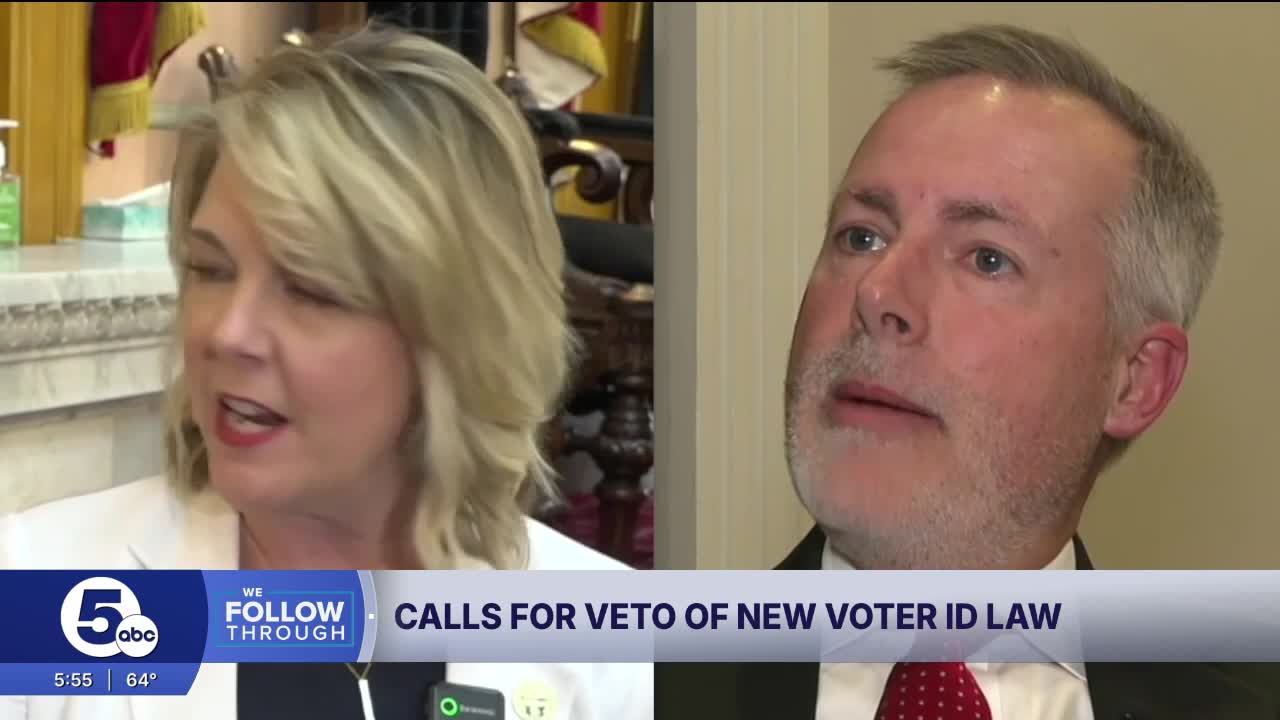



COLUMBUS, Ohio — As Gov. Mike DeWine is being asked by voting rights groups to veto a new bill requiring a photo ID to cast an absentee ballot, Ohio's secretary of state candidates differ on what they think he should do.
While both Republicans and Democrats support requiring identification to vote, Ohio’s secretary of state candidates differ on a newly passed bill.
"Photo ID for mail-in ballots is incredibly important because we want to make sure that people are who they say they are," Republican nominee Robert Sprague, the current state treasurer, said in an interview.
Sprague supports the state legislature's last-minute amendment to House Bill 472.
RELATED: Voter photo ID amendment on Nov. ballot in Ohio
The original H.B. 472 would waive ID fees for individuals facing homelessness. The new version requires an applicant to provide two forms of ID out of multiple options, including live capture of a photo ID or an electronic signature.
"This amendment is half-baked, and it is sloppy," Democratic nominee Allison Russo, the former House Minority Leader, said while speaking on the chamber floor.
In an interview on Monday, Russo urged DeWine to veto the provision.
"Ohio's system works," she said. "There's no evidence that there is fraud in our mail-in voting."
Russo is joined by Libertarian nominee Tom Pruss in her request for a veto.
"Governor DeWine should veto this bill and send a clear message that protecting voting rights is not a partisan issue," Pruss wrote in a Facebook post. "Ohio deserves election laws that strengthen confidence in our system, not laws designed to discourage participation."
The origin of the changes stems from bargaining within the GOP.
Ohio Republicans really wanted to put a constitutional amendment on the November ballot that would require a photo ID to vote in person, a policy already in state law.
The policy, passed as S.J.R. 10, was unlikable to both Democrats, who said it was an effort to increase Republican turnout in the midterms, and further-right members of the GOP. Conservative activists testified that the proposal doesn’t do anything for actual election integrity, which, to many of them, is requiring photo ID for absentee ballots.
As stated, S.J.R. 10 does not require photo ID for absentee ballots; however, it allows it as an option. In order to get enough GOP votes to get the resolution to the ballot, lawmakers amended the unrelated H.B. 472.
RELATED: Ohio Senate passes resolution to put voter photo ID amendment on Nov. ballot
"They are desperately seeking anything that might potentially drum up enthusiasm for them," Russo said.
Republicans denied this being a "ballot juicer," and Sprague defended his party for not putting it under higher law.
"I'd love to see that in the constitutional amendment as well, but I'll defer to the General Assembly on where they want to put the photo ID for absentee ballots," he said.
I have continuously asked Republican leadership, Sprague included, if ID is so important, why not have it in the Constitution? Each has said that it is just "not what they are doing" right now.
Pruss called it "election manipulation," rather than integrity.
"After years of telling Ohioans that our elections are secure, Republican lawmakers continue searching for solutions to problems that don't exist," Pruss said. "When politicians make it harder for eligible citizens to vote, while knowing full well that fraud is already exceedingly rare, the inevitable result is fewer people participating in elections."
To be clear, there is no evidence of widespread voter fraud in Ohio, even when photo ID laws weren't in place. Thousands of audits have proven that.
H.B. 472
Currently, to get an absentee ballot, a voter must provide their generic personal information, a signature and either the last four digits of their Social Security number or their full driver’s license number. They also could provide a photo ID, but it isn't required.
Under the newly passed bill, an applicant would need to complete all prior work, plus upload a live-capture photo ID and an electronic signature to an online portal — one that would need to be created by the state. Individuals could also mail a photocopy to their board of elections.
"I actually think this is something we could get to good agreement on [for] many components of this, but it was rushed through," Russo said while on the floor.
There are mistakes in the language, she points out, noting numerous typos that could dramatically change access.
"It refers to ballots in the plural, which, now, it's going to be OK that you can cast multiple ballots," she said, exasperatedly.
The Democrats are finding common ground with some Republicans. Talking to reporters, Sec. LaRose said it was being pushed too quickly and would require money. Both candidates agreed.
"If you wanna have secure elections, it's gonna require investment," Sprague said when I asked him what happens to the boards of elections set to deal with an unfunded mandate. "I'm fine with that."
But the bill doesn’t provide funding to boards of elections, which Russo says puts them in a tough spot—being overworked with little guidance. Both she and Sprague said they would advocate for more help.
"They always, probably, should be having more money," Sprague said.
Boards of elections and public libraries would have to provide a free copy of a photo ID. People can apply for an exemption if they have disabilities, but Russo argues that these could be difficult to get approved.
"Who actually makes the judgment of whether or not those exemptions are real?" Russo asked.
The bill neglects to say who investigates and approves the exemptions.
"If you were claiming an exemption and someone to be determined says that it is not a legitimate exemption, you will be faced with charges of election fraud, and that is a felony," Russo explained.
Republicans have argued back against this point, saying that Democrats are trying "everything they can" to make the bill more confusing.
"If you're sick, this bill doesn't apply to you. If you're disabled, this bill does not apply to you. If you're in jail, this bill doesn't apply to you. If you can't work the computer or show your ID, you can stop by the board of elections. If you can't work your phone to show your ID, you can stop by the Board of Elections. If you don't have a copier to make a copy of your photo ID, you can use your phone or go online or go to the Board of Elections," state Rep. Brian Stewart (R-Ashville) said.
Sprague pointed out that other states already have similar systems.
"You can see that in Kentucky or in Wisconsin, where they already have this sort of photo ID that's required for a mail-in ballot, they're able to handle it fine," Sprague said.
Moving forward
If the governor signs the bill, it wouldn't go into effect until November 2027.
DeWine has declined to comment specifically on the bill, but his team said he is reviewing it thoroughly. He has until the end of the day on Wednesday to sign, veto or do nothing and let it go into effect.
Previously, the governor has expressed his dissatisfaction with moves like this from GOP leaders, yet he has still signed their election legislation.
LaRose is trying to figure out the logistics, as are local boards of elections.
"We appreciate the General Assembly’s commitment to election integrity, and we’ve already begun assessing the technical requirements of this new law, especially as it relates to the construction of a secure digital portal for absentee ballot applications," LaRose's spokesperson Ben Kindel said. "As always, we’ll ensure that Ohio remains the national gold standard of election administration."
But politically, this is something the GOP can run on.
The vote on H.B. 472 and S.J.R. 10 already seems crucial to the election, which is why Russo says she doesn't have a problem with voter identification.
Prior to Russo's vote, I asked Sprague what he thought a predicted no vote on both would mean.
"Well, I think she'll say something as to why she votes no," Sprague said, avoiding directly criticizing Russo. "I can just tell you I'm speaking for myself. I think it's fundamental to election security in the state of Ohio, and I think the people of the state of Ohio are gonna support it."
I asked if that meant he wouldn't have ads about her voting no. He said he wasn't sure. The day after her vote, an X account affiliated with Sprague began posting attack ads.
Russo clapped back, bringing up my interview with Sprague from April, in which I asked him for one example of mail-in voter fraud. He could not during the interview.
RELATED: They're running for Ohio secretary of state. Get to know the candidates.
Follow WEWS statehouse reporter Morgan Trau on Twitter and Facebook.
