


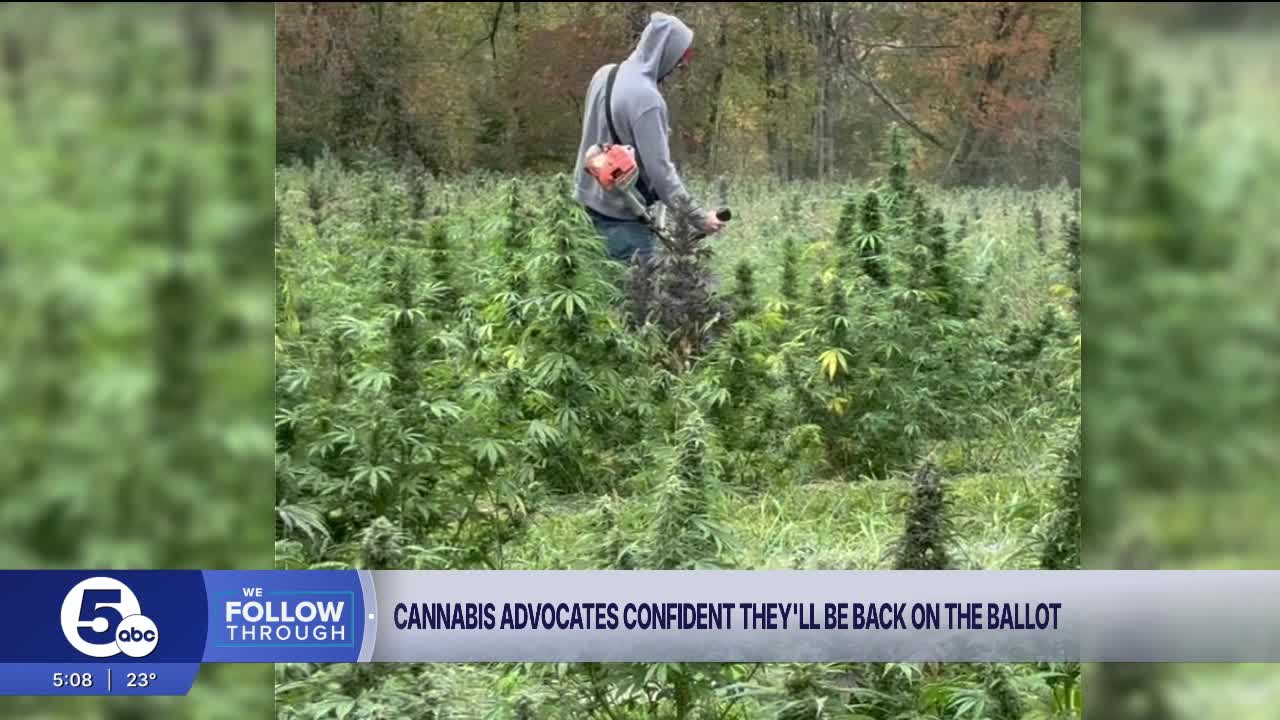



A group of Ohio farmers has joined the fight to repeal legislation that would completely ban "intoxicating" hemp products.
From sunrise to sunset, the Ellwood family makes a living in their fields.
"We have 19 acres," Joey Ellwood, who owns Modern Remedies, said. "I've always tried to think beyond just the conventional strategy."
He isn’t producing Ohio’s usual crops — soybeans, corn or wheat. He's farming hemp, a plant part in the cannabis family.
Ohio has fewer than 20 active hemp producers, according to federal data.
Farmers have already had a tough few years in Ohio. Droughts have plagued rural areas, major cases of bird flu broke out in 2025, and tariffs caused massive financial struggles for soybean farmers.
"We do see the light at the end of the tunnel," he had said regarding his ability to make money from growing hemp. "We're pacing, candidly, to do very well prior to the December ban."
His Tuscarawas County farm, where he also helps produce hemp-infused drinks and tinctures, could be uprooted by soon-to-go-into-effect legislation.
Signed into law in December, Senate Bill 56 makes dramatic changes to marijuana usage and bans low-level THC hemp products.
I have been covering marijuana policy extensively for years, including a series answering viewer questions about cannabis.
Ellwood, along with many farmer friends, cultivators and businesses, is collecting signatures to get a referendum on the ballot to repeal S.B. 56. The Fountain Cannabis Company, another hemp producer, also rallied online against S.B. 56.
"As a farmer, and someone who's not just some dumb hillbilly hoping to get high, it really gives me pause as to what we're up to here in Ohio," Ellwood said. "It seems like a nanny state."
But Republicans like Senate President Rob McColley (R-Napoleon) argue that this ban is necessary because hemp products are unregulated and have no age requirement to buy.
"Our primary concern with intoxicating hemp was the products that are the edibles, primarily the stuff that's unregulated; we don't know where it came from. We don't know if it's even produced in the United States. We don't know if it's even marketed to be what it is," McColley said. "It's also actually targeting children."
RELATED: Gov. DeWine tells marijuana advocates to stop 'whining' about new restrictions created by GOP
The hemp industry is pushing for a repeal of the state hemp ban, McColley said, despite a federal hemp ban going into effect in November 2026.
"They're already facing uncertainty because, obviously, there's the federal prohibition that's going to kick in," he said.
Still, the Ohioans for Cannabis Choice campaign said they feel confident that they will be able to turn in enough signatures by the upcoming deadline. They need 250,000 signatures by mid-March. If they collect the needed signatures, the law will be paused until the November election.
The campaign added that many farmers are with them, whether they produce hemp or not.
"Really, for you, this is about government overreach and personal liberty?" I asked Ellwood.
"Yeah," he replied. "We want to make sure that this is a possibility for other farmers and communities beyond."
The battle isn’t over, he said, as he knows his crop — and the cause — will keep growing.
Marijuana impact
In November of 2023, 57% of Ohioans voted yes on Issue 2: the legalization of recreational cannabis.
But under S.B. 56, a dozen voter-approved provisions were criminalized.
The bill institutes a public smoking ban and prohibits smoking in cars. Also, it gives landlords the ability to prohibit smoking and vaping, bans outdoor venues from allowing marijuana and requires all products to be kept in the same package they were bought in.
It also makes it a crime to have an "open" marijuana container, meaning if someone has a baggie of edibles in the backseat of a Lyft or on a public bus — if it had ever been opened, they would be breaking the law.
It also makes it a crime to buy out-of-state cannabis. Federal law currently doesn't allow marijuana to go across state lines, but it isn't enforced. This would be an enforceable state provision preventing a citizen from going to Michigan, where the weed is cheaper, to buy.
The legislation also removes protections against discrimination for housing, employment and even organ donation.
As well, Democrats argue that a provision would allow for police to have probable cause during traffic stops if someone is a "known consumer" of marijuana.
I've continued to ask Republican lawmakers if they will leave THC policy alone if the voters repeal S.B. 56. DeWine told me that advocates need to stop "whining" about the restrictions.
"Well, I think we're very consistent with what voters intended," the governor responded.
For years, GOP leaders have argued that not only do they know what voters truly wanted when each person went to the polls, but that voters didn't know.
"I think the proponents should be happy with their victory at the polls, instead of now going back and whining about something the legislature has done, which frankly I think is very consistent with what the average voter was thinking when they went in to vote," DeWine said.
McColley responded to the same question that this repeal effort is just coming from the hemp industry, not the marijuana industry, and that is what people voted on. Issue 2 dealt with recreational marijuana, not hemp. However, he didn't address the fact that the bill adds criminal penalties to weed.
Even if the S.B. 56 is repealed, lawmakers can continue doing whatever they want. They could, in theory, draft a new bill with very similar wording and pass it again.
This stems from how Issue 2 was passed.
For context, there are two main ways citizens can get a new proposal on the statewide ballot: an initiated statute and a constitutional amendment. The recreational marijuana proposal was an initiated statute, which means it goes into the Ohio Revised Code. An initiated statute, or a law, has an easier process of making it to the ballot than a constitutional amendment. Initiated statutes can be easily changed by lawmakers, while amendments cannot.
Advocates say that they are focused on the referendum effort, but everything is on the table — including putting forward a constitutional amendment.
GOP leaders, unsurprisingly, do not want that.
Have questions? Let me know, and I'll answer them.
To read your mind: You can find out more about where to sign the petition by clicking here.
I have continued to cover any and all changes to marijuana policy that lawmakers have made or want to make.
I also have a series answering your questions about cannabis in Ohio. Please email me written questions — or a video of you asking a question — to be featured in our next edition. Send questions to Morgan.Trau@wews.com with the subject line "THC questions."
Follow WEWS statehouse reporter Morgan Trau on Twitter and Facebook.
