



AKRON, Ohio — After serving their country, military veterans often face a major question: What comes next?
The University of Akron is offering one possible answer: the classroom.
Through a new initiative called Operation Teach, current and former military members and their families can pursue careers as licensed K-12 educators at no cost.
The program is funded through a nearly $500,000 state grant and is part of the Ohio Department of Education and Workforce's Governor’s Ohio Military Veteran Educators Fellowship Pilot Program.
For Marine Corps veteran Jacob Cornelius, the program is providing a path to a career he never expected.
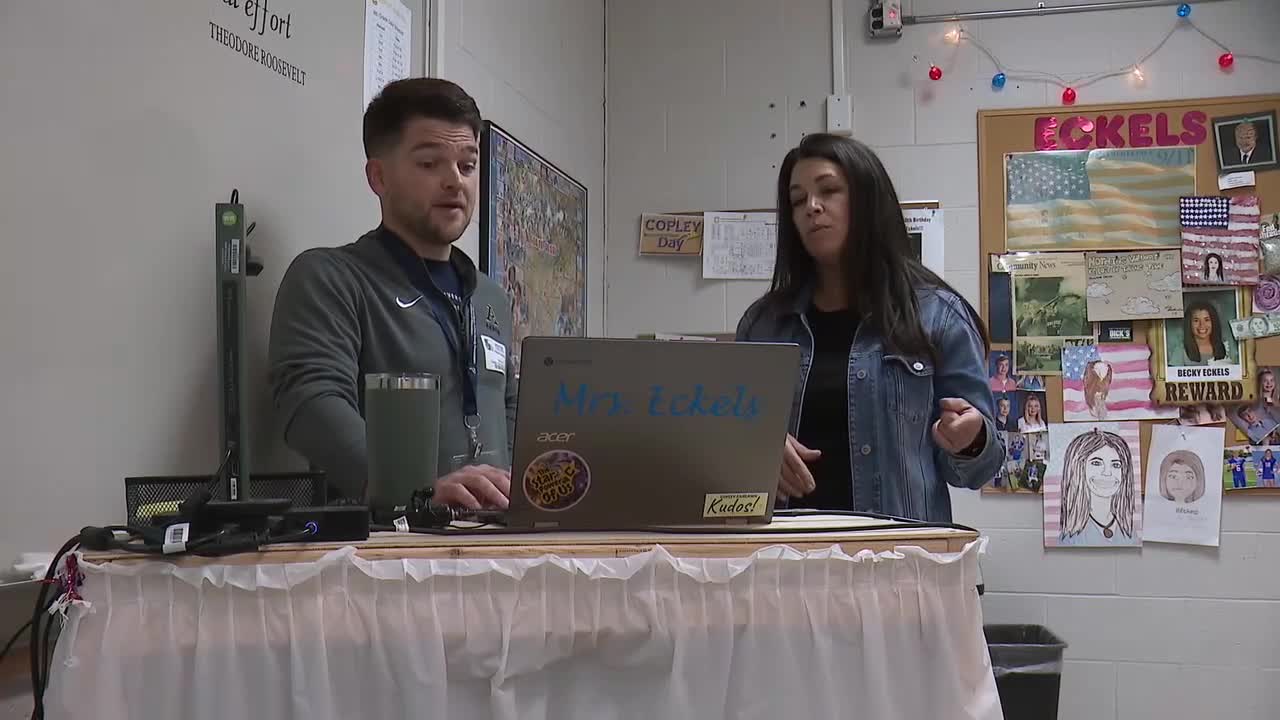
Cornelius is gaining classroom experience at Copley-Fairlawn Middle School, where he works with eighth-grade students and learns how to carry out lesson plans.
“I love working with the kids, walking in every day. ‘Oh, Mr. C., Mr. C., how you doing?’” Cornelius said. “It’s great.”
Cornelius graduated from Wadsworth High School before joining the Marine Corps, where he served for five years. After leaving the military, he went to college and later worked in the defense industry.
Teaching was not originally part of his plan. That changed after a conversation with his wife.
“Have you ever thought about going into education?” Cornelius recalled her asking. “And I had never even considered going into education.”
He eventually discovered Operation Teach.
The University of Akron said the program is designed to provide a streamlined pathway for military members and their families to earn an alternative teaching license and begin careers in education.
Participants must have a bachelor's degree or be working toward one.
The university is currently seeking students for the program, and the financial support goes well beyond tuition.
“Everything is paid for; tuition, fees, books. They even provided a laptop,” Operation Teach advisor Dr. Renee Mudrey said.
Much of the program is offered online, giving participants flexibility if they don't live near Akron. Participants also get classroom experience through partnerships with school districts as they work toward student teaching and eventually full-time teaching positions.
Mudrey said veterans often bring skills developed during military service that can translate well to education, including leadership, discipline, and experience in areas such as math, computation, and intelligence.
She sees the program as another opportunity for veterans to serve.
“I think that Operation Teach just removes those hurdles and those barriers and gives them that really clear view of an opportunity to be able to do the next layer of service,” Mudrey said.
For Cornelius, taking responsibility for a classroom draws on some of the confidence he developed in the military.
“When you're up in front of a classroom, it's you, so being able to take that responsibility on yourself and have the confidence to say, ‘Yeah, I can handle this. I can do it,’” he said.
His goal is to eventually become a high school history teacher.
While Cornelius never imagined that career while serving in the Marine Corps, he now sees teaching as another way to give back.
“It was exactly what I was looking for, the ability to give back to not only your community, but also to pour yourself into the next generation of young Americans,” Cornelius said.
